

01 Short answer: separate optimization is almost never needed
Voice search doesn't require a separate SEO strategy for the vast majority of sites. Voice assistants — Google Assistant, Siri, Alexa — mostly pull answers from the same sources regular search uses: featured snippets, structured data, and pages that already rank well for the equivalent text query.
That doesn't mean voice search can be ignored entirely — some practices genuinely help a page become a spoken-answer source more often. But those are the same practices that work for regular SEO: a clear, direct answer to the question, structured data, and natural language in the text. A separate "voice SEO" as its own discipline doesn't really exist in practice.
02 How voice search is actually used
Before optimizing for voice search, it's worth understanding how it's actually used — and that's not quite how marketing articles often frame it.
- the vast majority of voice queries are simple commands: set a timer, play music, check the weather — not commercial search queries;
- voice search on a smartphone often just dictates a regular text query into the Google interface, and the result is shown the same way it would be for typed text;
- smart speakers (Google Home, Alexa) get used for commercial and informational queries noticeably less often than for everyday commands and media.
That means the share of traffic that reaches an article or a commercial page specifically through a voice interface stays small for most niches compared to regular text search.
03 Where the assistant's answer actually comes from
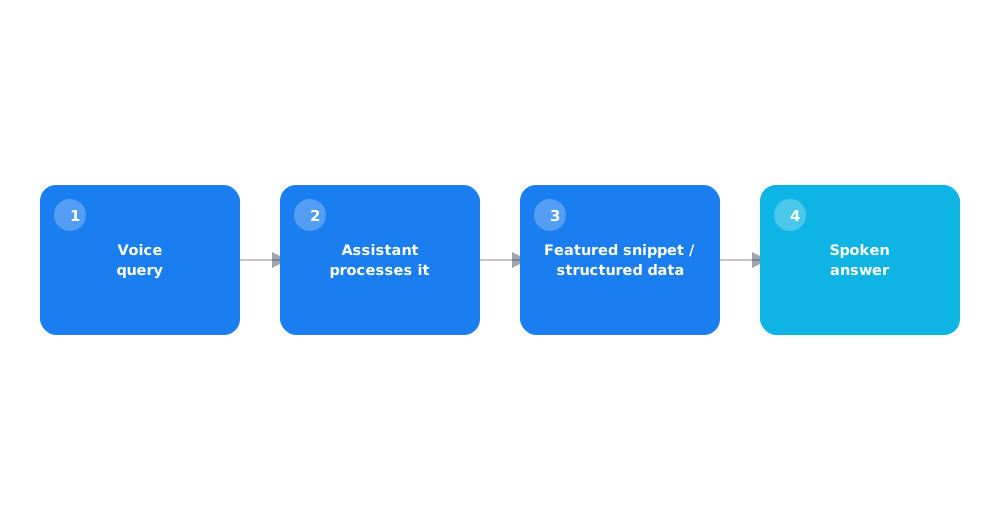
When a voice assistant does answer an informational question out loud, the source of that answer is almost always the same mechanism as in regular search results.
In most cases, Google Assistant reads out a featured snippet — the block with a direct answer shown above regular search results. Google's official documentation describes how featured snippets are generated: the system automatically picks the page and the text fragment that most precisely and concisely answers the query. A featured snippet can't be bought or configured directly — landing one is determined by the quality and structure of the content.
04 What actually helps a page become a voice answer
Since a voice answer's source is a featured snippet or structured data, the practices that help land one overlap with good SEO practices in general rather than forming a separate discipline.
- A direct answer near the top of a section. A short, self-contained answer to a specific question in the first sentence or two after a heading raises the odds that fragment gets picked by the algorithm.
- A question-and-answer structure. H2/H3 headings phrased as real user questions, with a clear answer right after — the same pattern an FAQ structure uses.
- FAQ structured data. When a page genuinely has a question-and-answer block, FAQPage markup helps search engines recognize that structure unambiguously.
- Natural, conversational language. Voice queries tend to be phrased as full sentences ("how do I choose," "which is better") rather than short keywords — text that naturally answers phrasing like that performs better for both voice and regular search.
05 Local voice search is its own case
One scenario where voice search sees noticeably heavier use than average is local "near me" queries on a smartphone — finding a nearby café, pharmacy, or repair shop.
Here the deciding factor isn't article content but the quality of a Google Business Profile listing — accurate hours, address, reviews, and business category. For a local business, this is the area worth prioritizing, and it overlaps largely with local SEO in general rather than being a narrow, voice-specific task.
06 Who should actually pay special attention to this
For most commercial sites, voice search isn't a separate task — it's a side effect of good SEO. But there are situations where it's worth thinking about more deliberately.
- local businesses with a physical location — a café, service shop, or clinic — where "near me" queries genuinely form part of the traffic;
- sites with a large block of practical how-to and FAQ content, where a question-and-answer structure should already be part of good content anyway;
- e-commerce with voice purchases through smart speakers — a narrow but growing scenario in specific niches, worth checking whether a product page answers basic product questions plainly enough.
07 Common misconceptions about voice search
A few persistent myths have built up around voice search that are worth addressing before putting budget behind it.
- "You need long keywords with question words." Those keywords are useful for a content plan in general, but they don't guarantee a voice answer on their own — the structure and quality of the answer itself matter more.
- "There are dedicated voice search analytics tools." In practice, most search engines don't break voice queries out into a separate, analyzable category within standard tools like Search Console.
- "Voice search will soon replace text search." Predictions of explosive growth in voice search's share, common a few years back, haven't held up in practice — growth turned out to be noticeably more modest.
08 FAQ
Does a site need separate optimization for voice search?
For most sites, no. Voice assistants pull answers from the same sources regular search uses — featured snippets and structured data — so solid SEO already covers most of what's needed.
How do I know if traffic is coming from voice search?
Directly, almost not at all: standard analytics tools, including Search Console, don't break voice queries out into their own category, so it has to be inferred indirectly from query phrasing.
Does FAQ markup help get a voice answer?
FAQPage markup helps search engines more precisely recognize a question-and-answer structure on a page, which raises the odds that fragment gets used as a direct answer, voice included.
Who should specifically think about voice search?
Mainly local businesses with a physical location, where "near me" queries make up a noticeable share of traffic — there, a Google Business Profile listing's quality matters more than article content.
Is it true voice search will soon replace regular text search?
Predictions of a sharp rise in voice search's share, common a few years ago, haven't held up in practice — the growth turned out to be noticeably more modest than expected.