
The main shift in SEO by 2026 is from competing for a position to competing for a mention: more and more, the user gets an answer right in the results or an AI chat without visiting a site. Yet the foundation hasn't changed — technical health, intent, usefulness, and links work as before. This guide covers what has actually changed and what a business should do.
01 The gist in two paragraphs
SEO in 2026 has two layers. The foundation is the same: the site must be indexable, match search intent, provide helpful content, load fast, and have link support. The layer on top is new: content has to be prepared for being not only ranked but cited in generative answers, and expertise requirements have tightened.
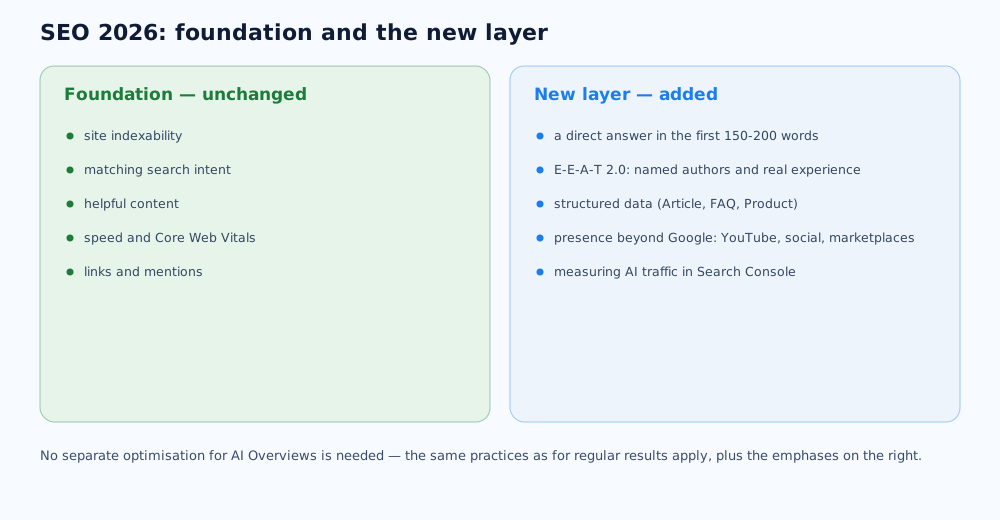
Google states in its document on AI features in Search that no separate optimisation for AI Overviews and AI Mode is required — the same practices as for regular results help. Everything that follows is emphasis, not new rules.
02 AI Overviews and AI Mode: what changes for traffic
AI Overviews is a generated answer above the regular results for some queries, more often informational and question-based. AI Mode is a separate conversational search mode. Both change the shape of traffic.
What it means in practice:
- for informational queries, some users get the answer without clicking links — traffic for those queries drops;
- being in the answer's source block gains value: it drives clicks and brand mentions;
- for commercial, transactional, and local queries the effect is much smaller — the user still goes to a site or Maps;
- traffic from Google's AI features shows in the Search Console Performance report alongside regular search.
How sources are selected for an AI answer and what to change on pages is covered in detail in the separate article on AI Overviews and GEO.
03 GEO: optimising for generative answers
GEO (Generative Engine Optimization) is the work of getting generative systems to cite your content: AI Overviews, ChatGPT, Gemini, Perplexity. The goal here isn't a list position but being included in the answer itself as a source.
What raises the odds of being cited:
- a direct answer to the main question in the first 150–200 words, not after a long intro;
- explicit definitions of terms and short claims that are easy to lift into an answer;
- data and figures with context and a named source;
- a clear structure: subheadings for sub-questions, lists, tables;
- freshness and correct markup.
It's essentially the same content quality a human needs — just formatted so the key point is on the surface. The base of GEO is well-built keyword research and an understanding of intent, covered in the article on keyword research.
04 E-E-A-T and the brand as an entity
E-E-A-T is Experience, Expertise, Authoritativeness, and Trust. In 2026 the emphasis shifted to the first: Google and its raters look for proof of first-hand experience, not a rehash of other people's articles.
What it means for a site:
- articles should name an author — with a name, specialisation, and bio;
- the text needs signs of first-hand experience: examples, figures from practice, screenshots, real cases;
- the site should be consistent in its topic, not write about everything;
- mass AI content without expert review loses positions after recent updates — Google updates its algorithms several times a year, as it warns in the document on core updates.
Separately, the brand as a recognisable entity grows in weight: mentions, links, consistent company data across sources. How to build mentions and links without risk is in the article on link building, and the content quality criteria are in Google's helpful content guidance.
05 Zero-click and "search everywhere"
Demand is less and less confined to Google's classic results. People look for answers and products on YouTube, social media, marketplaces, and AI chats, and part of the path to purchase happens off the site.
This extends SEO into being present where the audience searches:
- for a local business, Google Maps and the local pack gain weight;
- for products, visibility in marketplace search; how to build it on Ukrainian platforms is covered in the article on promotion on Rozetka and Prom.ua;
- for complex topics, video on YouTube, which often lands in both regular results and AI answers;
- for B2B and expert niches, presence in industry communities and Q&A sites.
The site stays the centre but is no longer the only point of contact.
06 Technical: structured data, speed, clean HTML
The technical requirements aren't new, but their weight has grown: to appear in both regular results and AI answer sources, a page has to be easily readable by a machine.
What to look at first:
- Indexability — without it the page is in neither results nor AI answers;
- Content as text — key information in HTML, not loaded by a script that may not run;
- Structured data — Article, FAQPage, Product, Organization, BreadcrumbList help Google understand the content and relationships;
- Core Web Vitals — speed and layout stability remain a tie-breaker factor.
How to check all this yourself is laid out in the article on the SEO audit, and how to write titles and descriptions that get clicks in the changed results is in the piece on Title and Description meta tags.
07 What a business should do now: a checklist
Trends turn into value only through concrete actions. The order: base first, then content, then extending presence.
- Check indexability and the site's technical state, clear blockers.
- Rewrite the start of key pages so the main answer is in the first 150–200 words.
- Name authors on articles, add bios and signs of real experience.
- Add Article, FAQPage, and — for stores — Product markup.
- Update important articles: fresh data, missing subtopics, remove the outdated.
- Extend presence: Google Maps, YouTube, marketplaces, industry sites.
- Set up tracking of traffic from AI features in Search Console and watch the trend.
The full promotion roadmap these steps fit into is in the pillar article on how to get a site into Google's top yourself. Rebuilding SEO for 2026 can be done with our help too — it's part of SEO services.
Voice search regularly shows up in SEO trend lists, but in practice it deserves a dedicated look rather than general claims — covered in does a site need voice search optimization.
08 Frequently asked questions
Is classic SEO dead in 2026?
No. Indexability, matching search intent, helpful content, speed, and links remain the foundation — both regular results and inclusion in AI answers are built on them. It's not the base that changes but the layer on top: base SEO plus preparing content for generative answers and stricter expertise requirements.
Do I need to do anything specifically for AI Overviews?
Google states directly that no separate optimisation for AI Overviews and AI Mode is needed: the same practices as for regular search apply. For a page to be eligible as a source in an AI answer, it must be indexed and able to rank in Google. Specific steps help — a direct answer in the first paragraphs, structure, structured data — but it's not a new discipline, it's reinforcing the old one.
What is GEO?
GEO (Generative Engine Optimization) is optimising content so generative systems cite it: AI Overviews, ChatGPT, Gemini, Perplexity. The goal isn't a position in a list but being included in the answer itself as a source. Explicit definitions, direct answers, data with context, structured lists, and markup help.
How do I check E-E-A-T on my site?
Work through the questions in Google's helpful content document: is it clear who the author is and what their experience is; are there signs of first-hand experience rather than paraphrasing; does the piece cite sources; is the site consistent in its topic. For health and finance topics these requirements are strictest.
Is it still worth running a blog if AI gives the answers?
Yes. The blog remains a source AI pulls facts and quotes from, and an entry point for the long tail and for queries with a clear intent to do or buy something. What changes is the quality bar: shallow filler articles lose their point; pieces with expertise and specifics win.
What should I do first?
Technical and base first: make sure the site is indexed and technically healthy, and that key pages answer the main question in the first paragraphs. Then authors and expertise, Article and FAQPage markup, updates to important articles. And in parallel, extend presence where the audience searches: Maps, YouTube, marketplaces.