
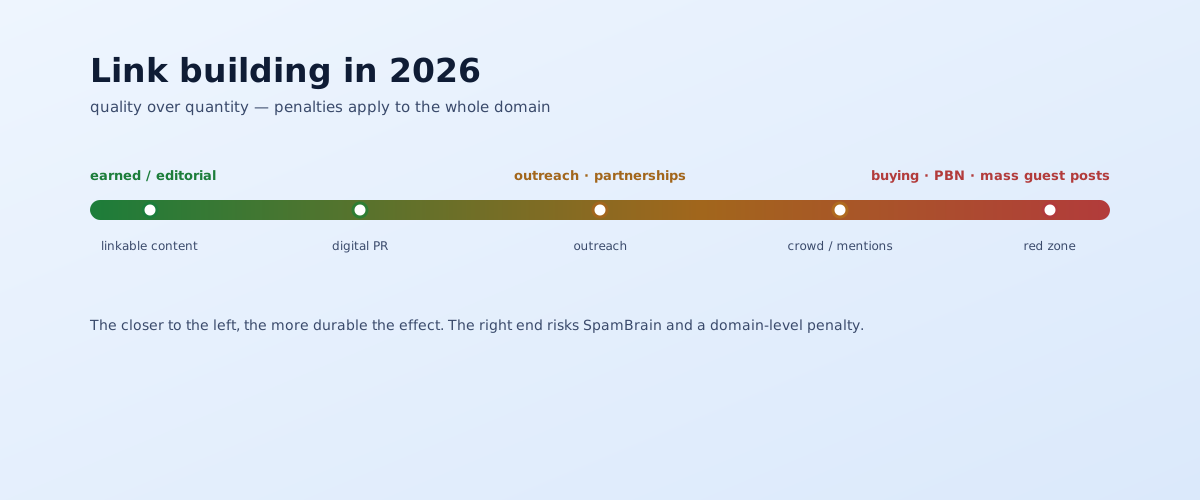
Links remain one of the primary ranking factors, but the rules have changed. SpamBrain detects unnatural link patterns, and penalties apply to the whole domain rather than a single page. So in 2026 link building isn't "buy 100 links" — it's the steady growth of a link profile that strengthens the site without exposing it to penalties.
01 What link building is and why it matters
Link building is the work of getting other sites to link to yours. To Google, a link from one site to another is a trust signal and a hint about topic. In competitive niches, reaching the top without link support is nearly impossible: content and technical work take a page to a ceiling, and beyond that you need external authority.
What has changed over the past few years:
- Quality over quantity. One link from an authoritative topical site is worth more than a hundred from directories and networks.
- Domain-level penalties. An unnatural link profile puts the whole site at risk, not just the one page being promoted.
- SpamBrain is trained on schemes. Mass buying, exchanges, and template guest posts are recognised by their footprints.
The takeaway is simple: build the strategy around links you earned or placed for a real reason, not around volume.
02 How Google evaluates links
Before chasing links, you need to know what makes a link useful and what makes it worthless or harmful. Google looks not at the number of links but at their source, context, and the naturalness of the profile as a whole.
Donor quality
A useful link sits on a site close in topic, with real search traffic, where content is written by people for readers rather than by a marketplace for SEO. A link from an article people actually read is worth more than one from a section that exists only for placements.
Anchors and diversity
A natural profile contains different anchor types: branded ("Grottix"), anchor-free ("here", "at this link", a URL), generic ("read the article"), and only a small share of exact commercial matches. If most links to a site use the same commercial anchor, that's the first sign of artificial promotion.
What to mark with the rel attribute
Mark paid and affiliate links with rel="sponsored", user-generated ones (comments, forums) with rel="ugc", and the rest you want to withhold weight from with rel="nofollow". The rules are in Google's documentation on outbound links. This applies both to links from your site and to how a site places a link to you.
03 What's prohibited: link spam
Google explicitly lists the schemes it treats as violations. Understanding this list matters more than any "white-hat" tactic: one placement caught by a filter can wipe out months of work.
Link spam includes:
- buying and selling links that pass weight without a
rel="sponsored"attribute; - reciprocal "you link me, I link you" exchanges at scale;
- networks of sites (PBNs) built for links to one project;
- mass guest posts on one template with commercial anchors;
- automated submissions across directories, profiles, and comments;
- site-wide links in footers, widgets, and partner templates;
- placements in low-quality directories and "article" sections with no audience.
The full list is in Google's spam policies, in the link spam section. If a placement can be described as "we pay to get a link placed", it almost certainly breaks the rules.
04 Strategies that work in 2026
The links that actually move positions share one thing: the site has a reason to link to you beyond payment. Below are the approaches that produce that.
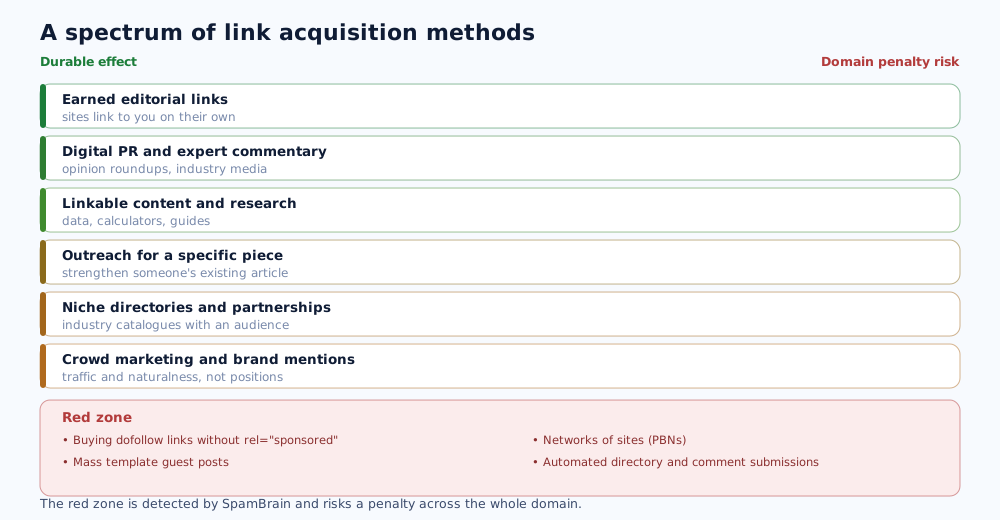
- Linkable content — research with your own data, calculators, in-depth guides and templates that people link to because they're a handy source.
- Digital PR and expert commentary — taking part in opinion roundups, comments for industry media, replies to journalists.
- Outreach for a specific piece — offering a site a link that genuinely strengthens one of their existing articles.
- Broken link building — finding broken links on other pages and offering your working page instead.
- Niche directories and partnerships — industry catalogues with a real audience, associations, integrations, joint content.
- Local links — city directories, local media, event sponsorship; especially important for a business tied to a city.
05 Outreach step by step
Outreach is the most scalable of the white-hat tactics and also the most labour-intensive. The result depends on how precisely the sites are chosen and how much real value you offer.
- Analyse competitors' links from the top — which pages get links and from which donors.
- Build a list of potential donors: topical sites, blogs, media, directories.
- Assess each donor: search traffic, topic, editorial quality, spam signals.
- Find a reason: how your material helps their audience and which of their pages it strengthens.
- Write a short personal email — no template phrases, no pressure.
- Send one or two polite reminders a few days apart.
- Track statuses in a sheet: contact, reply, placement, link type, anchor.
Outreach pairs well with a site audit: before chasing links, make sure the pages you promote are technically sound — covered in the piece on the SEO audit.
06 Crowd marketing and brand mentions
Crowd marketing means links and mentions in live discussions: forums, question-and-answer services, review sites, topical chats, and social media. Most such links withhold weight, so their role isn't positions directly but traffic, awareness, and a natural-looking profile.
To keep crowd marketing from turning into spam:
- reply on the substance of the discussion and add a link only where it genuinely helps;
- don't post the same text across dozens of sites;
- alternate links with plain brand mentions that carry no link;
- don't expect a position effect — treat crowd as a traffic and reputation channel.
Google also treats brand mentions without a link as a prominence signal, so systematic reputation and PR work indirectly strengthens the link profile too.
07 How many links, pace, and toxic links
Three questions people most often get wrong: how many links you need, how fast to build them, and what to do with bad links from the past.
- How many. The benchmark is referring domains for top-10 pages on your queries. That's a target, not an absolute "links per month" figure.
- Pace. Gradual and tied to the site's growth: new links appear as content ships and traffic grows. A sharp spike on a static site looks unnatural.
- Toxic links. Traces of past buying, spam submissions, networks. In most cases Google simply ignores them; the Disavow tool is only needed with a large volume of artificial links and an existing manual action.
A weak or, conversely, "dirty" link profile is one of the typical reasons a site isn't growing; the full list is in the article on why a site isn't ranking on Google. How links fit into the overall strategy is shown in the pillar on how to get a site into Google's top yourself, and there's a dedicated breakdown for online stores in the ecommerce SEO guide. Full-service link building is part of SEO services.
Building new links only makes sense alongside periodically checking the ones you already have — how to find and safely remove problem links is covered in our backlink audit and toxic links guide.
08 Frequently asked questions
How many backlinks does a site need?
There's no absolute number — the benchmark is set by competitors in your niche and for specific queries. If top-10 pages average 30–50 referring domains and you have five, close the gap; if you already have more than the top, links probably aren't the problem. Count referring domains, not total links.
Is buying links risky?
Yes. Buying links that pass weight is explicitly against Google's policies and is recognised by SpamBrain from typical footprints: the same donors, template text, matching anchors. Since 2024 the penalty applies at the domain level, so the whole site is at risk, not one page. Paid placements are only acceptable with a rel="sponsored" attribute and no intent to influence ranking.
What is crowd marketing and does it work?
Crowd marketing means links and brand mentions on forums, in reviews, question-and-answer services, and topical communities, left in the context of a real discussion. Such links have almost no direct effect on positions: most are nofollow. Their value is traffic, brand awareness, and a natural-looking link profile.
How do I check the quality of a donor site?
Look at four things: topical relevance to your site, real search traffic (not just link metrics), editorial content (written by people, not a link farm), and the absence of spam signals — site-wide links to dozens of unrelated sites, "partner articles" sections, or heaps of anchor links in every post.
Do I need the Disavow tool?
In most cases, no. Google decides which links to trust and ignores spammy ones without harming the receiving site. Disavow is only needed when a large volume of artificial links points at the site — bought by you or a previous contractor — and it has already caused a manual action in Search Console.
Do guest posts still work in 2026?
Occasional quality pieces in topical publications with a real audience — yes. Mass guest posts on one template across a network of sites "for the link" — no: that's exactly the pattern SpamBrain is trained to detect. If a site charges a fixed fee to place any article with a link, that's already link buying.