

01 Short answer: the budget follows from orders, not the other way around
A niche-test budget needs to be calculated from how many orders or leads are required for a fair "it works / it doesn't" verdict, rather than picking an arbitrary amount and seeing what happens. A typical benchmark is 15-30 conversions per test channel — fewer than that doesn't give enough statistics to tell a real result apart from noise.
Below is how to turn that conversion count into an actual budget through an expected CPL, how much time to allow for the test, and the signals that say it's time to stop — in either direction.
02 Step 1: set a target number of conversions for the test
Before calculating a budget, it's worth deciding how many orders or inquiries would be enough to draw a sound conclusion about the niche — that number depends on how expensive and infrequent the purchase is.
- for a mass-market product bought frequently, 20-30 conversions is usually enough for a first read;
- for an expensive B2B product with a long deal cycle, even 10-15 quality leads can be a meaningful sample, since the purchase itself is rare;
- if the conversion tracked is an earlier action than a sale (an inquiry, a call), the number needs to go up, since some of those will drop out further down the funnel.
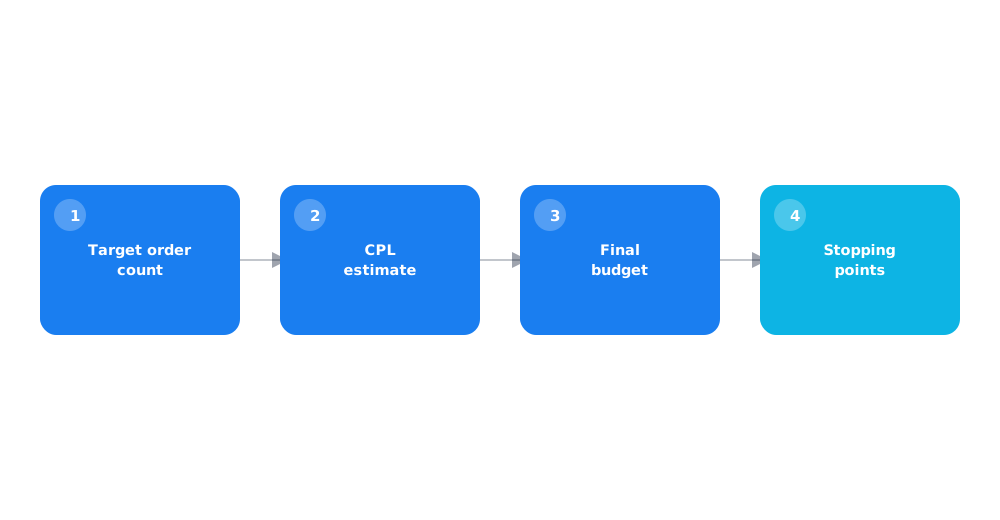
03 Step 2: estimate the expected CPL for the niche
Once there's a target conversion count, the next step is estimating roughly what one costs — without that number, there's no way to translate the target into an actual budget.
If there's already some experience in the niche — a past campaign, or a similar business in the same region — that's the number to build from. With no experience at all, a sensible approach is using the CPL range of a related, better-understood niche as an upper bound rather than guessing blind. A detailed breakdown of the cost-per-lead formula and which costs to include in it is covered in how to calculate CPL.
04 Step 3: turn conversions and CPL into a final budget
With a target conversion count and a CPL estimate in hand, the test budget comes from a straightforward multiplication — but it's worth building in a margin for how uncertain that CPL estimate is, rather than using the bare number.
- the base calculation: target conversions × expected CPL = the minimum test budget;
- a margin for uncertainty: if the CPL estimate comes from a related niche or someone else's experience, it's sensible to add 30-50% so the test doesn't stall halfway through if the real cost per lead turns out higher;
- for a brand-new niche with no prior CPL estimate at all, build in a wider margin than for one with at least a rough benchmark.
05 How to spread the budget over time
The calculated budget shouldn't be spent as fast as possible — part of a test's time goes not toward the result itself, but toward letting the ad platform's algorithms gather enough data to run steadily.
Google Ads' official documentation on campaign budgets — About campaign budgets — explains that a budget is set as an average daily spend rather than a hard daily cap, and recommends starting with a more modest daily budget while checking daily how the campaign is spending before raising it. In practice, for a niche test, that means stretching the calculated budget over at least 2-3 weeks rather than trying to burn through it in a few days.
06 When to stop a test earlier or later than planned
A calculated budget is a plan, not a hard commitment to spend it all regardless of interim results — there are signals that justify deviating from that plan in either direction.
- it's worth stopping early if the CPL is several times (3-5x) higher than expected within the first 30-40% of the budget — that usually signals a systemic problem with the offer or audience, not statistical noise;
- it's worth continuing past the plan if results are close to the target but the sample is still too small for a confident conclusion — stopping early at that point risks a false negative;
- if the result is ambiguous (not a clear failure or a clear win) and just a few conversions short of the target, it's more sensible to add a small extra budget than to draw a final conclusion from an incomplete sample.
07 Common mistakes when calculating a test budget
A handful of budgeting mistakes recur regardless of the niche — worth accounting for at the calculation stage, not discovering after the money's already spent.
- A fixed amount with no link to conversions. Picking "some $500" upfront with no tie to a target order count gives no way to know whether that's enough for a fair verdict in this specific niche.
- Spending the budget too fast. Burning through the whole budget in 2-3 days leaves the ad platform's algorithms no time to gather data for steady delivery, which skews the resulting CPL.
- Ignoring the deal cycle length. For a B2B niche with a deal cycle spanning several weeks, judging purely by cost per inquiry, without checking whether those inquiries convert into sales later, can be misleading.
- Changing the offer or audience mid-test. Changing a campaign's key parameters before the test is done makes the data gathered so far unusable for a fair verdict and effectively means starting over.
08 FAQ
How do I quickly calculate a minimum budget for a niche test?
Multiply the target conversion count (usually 15-30 for a first read) by the expected CPL, then add a 30-50% margin for how uncertain that CPL estimate is, especially with no prior experience in the niche.
What if there's no CPL data at all for the niche?
Use the CPL range from a related, better-understood niche as an upper bound and build in a wider budget margin than you would for a niche with known benchmarks.
How long should a niche test run?
At least 2-3 weeks — the budget shouldn't be spent over a few days, since part of that time goes toward letting the ad platform's algorithms gather enough data to run steadily.
Can a test be stopped early if the result is clearly bad?
Yes — if the CPL is several times higher than expected within the first 30-40% of the budget, that usually signals a systemic problem with the offer or audience, and there's little point spending the rest of the plan.
What if the test result is ambiguous?
If it's just a few conversions short of the target, it's more sensible to add a small extra budget than to draw a final conclusion from an incomplete sample.