
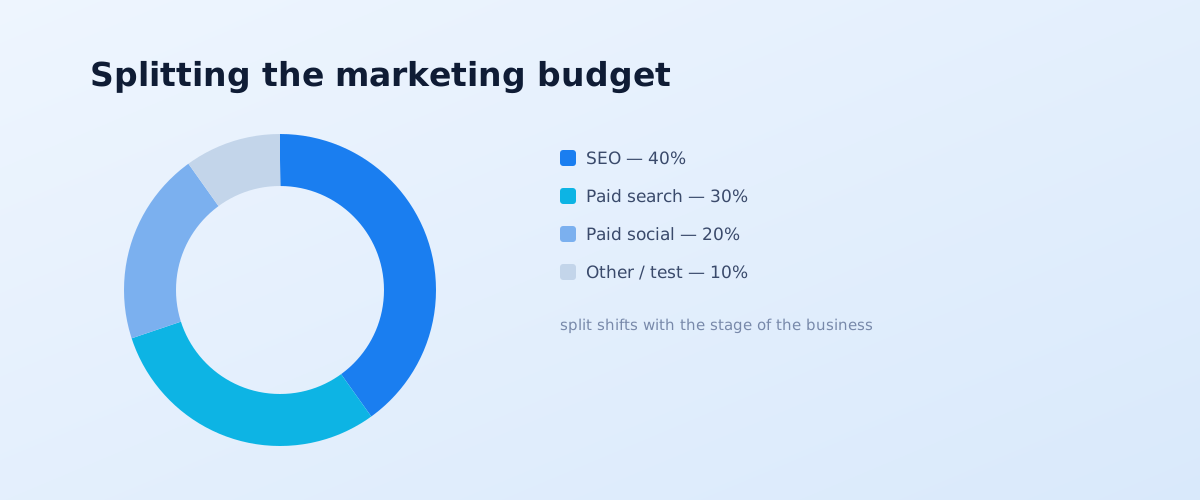
The question "how do I allocate a marketing budget" usually comes in two forms: how much to set aside, and how to split that sum across channels. The first is settled by a percentage of revenue, the second by the stage of the business and where demand sits. The mistake that costs money most often is splitting the budget evenly across all channels or, the opposite, putting everything into one. Below is how to size the total budget, what the split depends on, and three working allocation models for different business stages.
01 The short answer: how much, and on what principle
If you need a guide with no detail, keep two anchor numbers and one rule in mind. They are broken down later in the article, but they are enough for a first decision.
- How much to set aside. A small business usually spends 5–15% of revenue on marketing; in active growth, up to 20–30%; in maintenance mode, 3–5%.
- How to split across channels. Not evenly. The younger the business, the more goes to fast paid traffic (paid search, paid social); the more organic and data you have accumulated, the higher the SEO share.
- A test reserve. Keep 10–15% of the budget aside for testing new channels, audiences and offers.
The core principle: the budget is allocated not by "fairness" between channels but by which channel gives the best payback for the current business goal, and how fast. This allocation is not static — you review it against results, covered at the end of the article.
02 How much to budget for marketing: a percentage of revenue
The most common way to size the total budget is to take a percentage of revenue. The logic is simple: marketing is an investment that should scale with the business, not a fixed "just in case" sum. It is calculated one of two ways: a percentage of forecast revenue for the coming period, or a percentage of last period's revenue.
The percentage benchmarks depend on the stage the business is at and its goal:
- Active growth, capturing market share — 15–30% of revenue. The business deliberately runs at a loss or break-even on profit for the sake of growth.
- Moderate growth — 7–15%. A balance between expansion and profit, the typical zone for most small businesses.
- Maintenance, steady operation — 3–7%. The budget covers sustaining the current flow of customers without ambitions of sharp growth.
These ranges are a starting point, not a rule. In niches with high competition and a long deal cycle the percentage is higher; in niches with strong word of mouth and repeat sales it is lower. It is sensible to combine approaches: calculate the percentage of revenue as an upper bound, then cross-check against how many leads you need and at what price you can realistically acquire them.
03 What the channel split depends on
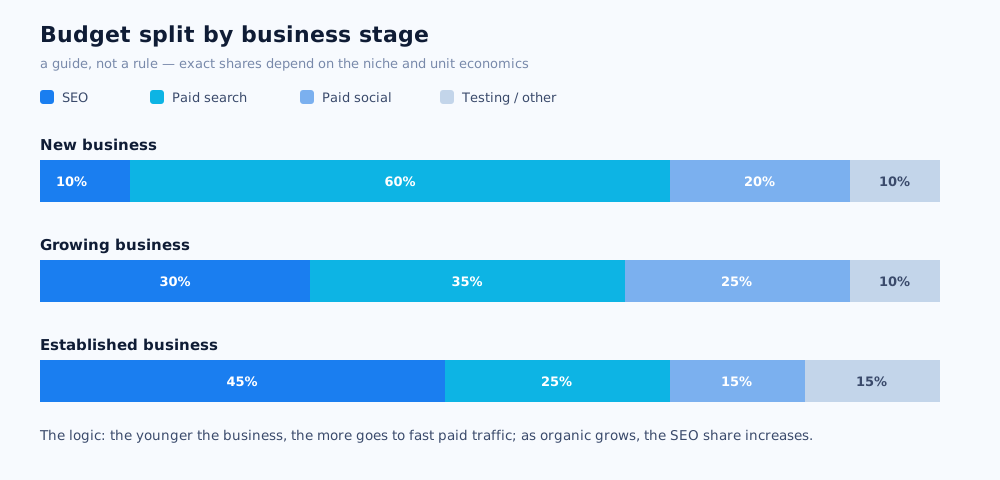
The total sum is set by the percentage of revenue, but how to split it across SEO, paid search, paid social and the rest depends on three factors. The diagram below shows how the allocation shifts by business stage, and the factors themselves are broken down after it. How much to set aside for paid social specifically and what daily minimum counts as workable is covered in how much Instagram and Facebook ads cost.
Unit economics and the deal cycle
If the product is low-cost, impulse-purchase and with a short decision cycle, paid channels pay back quickly and you can invest in them more boldly. If the product is expensive and the decision takes weeks and several people, direct advertising rarely leads to a sale — here content, SEO and warm-up touches carry more weight, and paid traffic works for the first contact. Before splitting the budget, you need to understand the cost of acquisition and the lifetime value of a customer — how to calculate them is covered in the article ROAS, ACoS, CPL and CPA explained.
Stage of the business
A new business needs leads now and has no organic yet — so most of the budget goes to paid search and a smaller part to the SEO foundation that will pay off later. A growing business already has some pages ranking, and the balance shifts toward SEO. An established business with strong organic uses paid traffic selectively — on the highest-converting queries, remarketing and seasonal peaks. What that SEO foundation consists of and in what order to build it is covered in the step-by-step plan how to promote a website to the top of Google yourself.
Current channel performance
If one channel already delivers leads cheaper than the rest and can be scaled without a rise in cost, it makes sense to grow its share rather than spread money evenly. And the reverse: a channel that steadily produces expensive leads and has not improved in months is a candidate for a budget cut, not for extra spend "to get it going".
04 The model for a new business
A new business has no organic traffic, no accumulated customer data, and often no time to wait. The job of the budget at this stage is to get the first leads as fast as possible and check whether the economics add up, while laying the foundation for the long term in parallel.
An approximate allocation for the first months:
- Paid search — around 60%. The main source of leads here and now, on a narrow segment of the highest-converting queries.
- Paid social — around 20%. Audience testing and first reach, especially if the product is visual or impulse-driven.
- SEO foundation — around 10%. The technical audit, site structure, baseline content. There is no return in this period, but SEO does not start without this stage.
- Testing — around 10%. Checking hypotheses on offers, landing pages, additional channels.
How to choose between paid search and SEO at the start, and why they are not both launched at full strength at once, is covered in detail in the article SEO vs PPC.
05 The model for a growing business
A growing business has already tested one or two channels, knows its cost per lead, and has some organic traffic. The job of the budget is not just to hold the flow but to grow it while lowering the average cost of acquisition. This is where coordinated channel work starts to matter.
An approximate allocation:
- SEO — around 30%. Organic already delivers, the investment pays back, the share grows.
- Paid search — around 35%. Still the main source of leads, but partly moving to mid- and low-volume queries and remarketing.
- Paid social — around 25%. Warming up the audience, working with cold demand, scaling working combinations.
- Testing — around 10%. New channels (for example, YouTube, marketplaces), new segments.
At this stage it matters that the channels work in sync rather than living separately with different contractors — why that is critical is covered in the piece on integrated digital marketing.
06 The model for an established business
An established business with strong organic and a recognisable brand gets a significant share of traffic for free. The job of the budget is to defend and expand that position, and to use paid traffic as an amplifier rather than the main source.
An approximate allocation:
- SEO — around 45%. Holding positions, expanding the keyword set, building authority and mentions, including for appearing in AI answers.
- Paid search — around 25%. Selective: the highest-converting and branded queries, remarketing, seasonal peaks.
- Paid social — around 15%. Sustaining reach, working with new product lines.
- Other — around 15%. Content marketing, PR, reputation work, email, partner programmes.
At this stage the budget goes less into "buy a click" and more into retention, repeat sales and strengthening the brand as an entity — partly because AI answer blocks take on some of the simple informational queries.
07 How to reallocate the budget against results
An allocation fixed once at the start of the year almost always turns out to be suboptimal a quarter later. A budget is not an estimate but a managed flow that you move by the numbers. Two review cycles work here.
How it looks in practice:
- Monthly — by cost per lead. Look at cost per lead and payback per channel and campaign. Move some money from the worst-performing campaigns to those that work better and have not hit a ceiling. How to set up conversion measurement so this data is reliable is described by Google in its conversion tracking help; the mechanics of daily budgets are in a separate help article.
- Quarterly — by the channel split. Check whether organic has grown enough to cover queries you pay for in ads. If so, lower bids on them and move the freed-up budget into expanding SEO or new segments.
- The "kill or scale" rule. A campaign that fails to reach its target cost per lead for three months and is not improving is closed, not "tuned" indefinitely. A campaign that pays back steadily and is limited only by budget is scaled first.
Common mistakes when allocating a budget:
- Splitting evenly. Equal shares across channels ignore the fact that channels deliver different payback and suit different stages.
- Everything into one channel. It works well while the channel works, and wipes out the lead flow at the first disruption — an update, rising bids, a ban.
- No testing budget. Without a reserve the business never tries anything new and freezes on its current channels until competitors overtake them.
- Not measuring. Reallocating the budget without reliable per-channel cost-per-lead data is guessing, not management.
Planning the allocation and running all the channels under one owner, rather than piecing together reports from different contractors, can be delegated — how that works is described on the Grottix services page.
Before splitting the budget between channels, it helps to know the level of competition in each — that's what competitor analysis in SEO and paid ads shows.
To decide which budget split is justified, each channel is judged by payback — the method is in the article on how to calculate marketing ROI.
Before splitting a budget across channels, it helps to decide which one to start with in the first place if the budget is tight — see the guide on choosing between SEO, SMM, and paid search.
Before splitting a budget across channels, it's worth making sure the choice of channels itself is based on real data about the customer and competitors rather than intuition — covered in marketing audit for a business.
Testing a brand-new, unproven niche is a special case of budget allocation on its own; how to calculate a budget specifically for that kind of test is covered in how much budget you need to test a niche.
08 Frequently asked questions
What percentage of revenue should go to marketing?
A guide for a small business is 5–15% of revenue, but the exact figure depends on the stage and goal. A business in active growth can reach 20–30% of revenue; an established one in maintenance mode can drop to 3–5%. Calculate it from forecast revenue for the period, or from last period's revenue multiplied by the chosen percentage.
How do I split the budget across SEO, paid search and paid social?
It depends on the stage and where demand sits. A new business should put most of it into paid search for fast leads and a smaller share into the SEO foundation. As organic grows, the SEO share increases and paid search moves to the highest-converting queries. Paid social is kept where the audience needs warming up. Do not split it evenly.
Can I put the whole budget into one channel?
At the start, sometimes yes: with a small budget it is better to get one channel to a working result than to spread money across coordinating several. But relying on one channel long-term is risky: an algorithm change, rising auction bids or an account ban wipe out the flow of leads. As the business grows, diversification is a must.
Do I need a separate testing budget?
Yes. It is sensible to reserve 10–15% of the budget for testing new channels, audiences and offers. Without a test reserve you either never try anything new or you take money from working campaigns and drop on current leads. Spend the test budget on small, controllable hypotheses, not one large experiment.
When should I review the budget allocation?
Regularly — monthly by the numbers and quarterly by strategy. Each month you look at cost per lead and payback per channel and shift some money from the worst to the best. Each quarter you review the split itself: if organic has grown and covers queries you pay for in ads, part of the paid-search budget frees up.
What to do if the budget is very small?
Do not spread it. Pick the one channel that will give a measurable result fastest for your goal — usually paid search on a narrow, highest-converting set of queries — and get it to break even. Only once the first channel brings leads steadily do you add a second.