
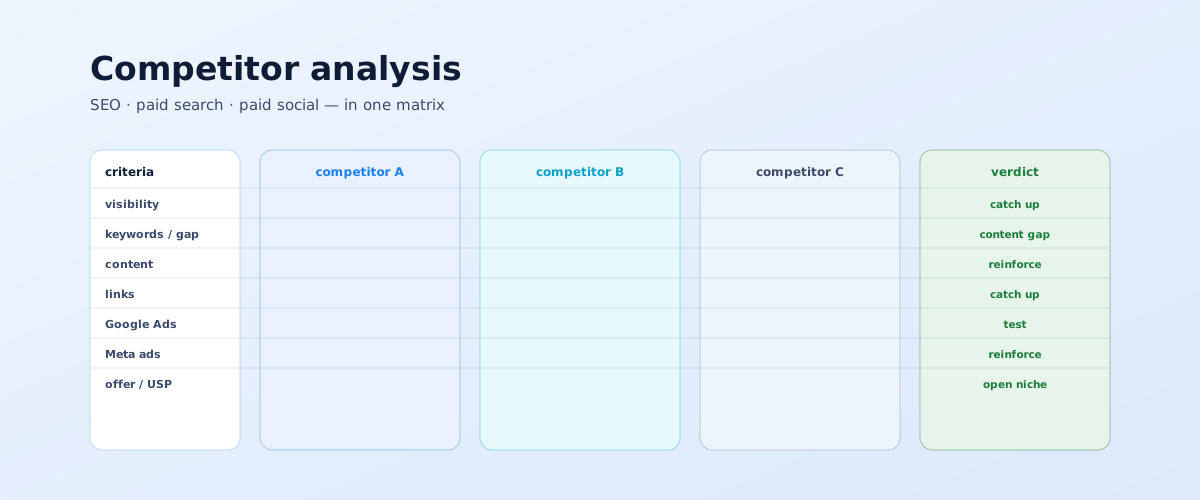
Competitor analysis isn't a one-off "let's see what others are doing" — it's how you work out which goals are realistic, where the gaps in your marketing are, and where not to spend budget. This guide walks through analysing competitors across three fronts at once — SEO, paid search, and paid social — and turning it all into an action plan.
01 Why and when to analyse competitors
Competitor analysis answers three practical questions: how ambitious the goals in this niche can be, which channels and formats have already proven they work, and where you have room to stand out. Without it, strategy runs on guesswork, and budget goes to testing hypotheses competitors have already tested for you.
A competitor review is especially worth doing in three situations:
- before starting promotion — to gauge the level of competition and set realistic timelines and budget;
- during a plateau — when positions and leads have stopped growing and you need to find what others do better;
- on a quarterly schedule — so you don't miss new offers, formats, and growth points.
The output isn't a report for the archive but a short list of concrete actions: which pages to build, which to strengthen, which ad formats to test.
02 How to identify your real competitors
The main mistake is analysing whoever you consider a business rival. In search and ads you compete not with them but with whoever holds the top for your queries: that can be aggregators, marketplaces, directories, and content sites.
Manual search by target queries
Take 10–20 queries that bring in customers, or should, and enter them in Google in incognito with the right region. Note the top-10 domains for each query. The ones that recur most are your search competitors — they show both the real level of competition and the page format Google considers a match for the query.
Visibility overlap in tools
Paid platforms show the domains with the largest keyword overlap — more accurate than the manual method because it accounts for hundreds of queries at once. From the full list, pick 3–7 competitors for a deep analysis: that's usually enough, and a larger number only dilutes the conclusions.
03 SEO analysis: visibility, keywords, structure
The SEO part answers how competitors earn organic traffic and what of that you can repeat or do better. You look at the system, not individual pages.
What to assess at this step:
- Visibility and its trend — how many queries the competitor has in the top 10 and top 3, and whether that's rising or falling;
- Keywords and the content gap — queries where competitors rank and you have no page; a "keyword gap" report gives a ready list of topics;
- Site structure — which sections and landing pages competitors have for commercial and informational clusters;
- SERP features — who owns the answer boxes, images, video, and local pack for your queries.
How to gather and cluster your own keywords from this data is covered in the article on keyword research; for online stores, the catalogue analysis structure is in the ecommerce SEO guide. Google states in its SEO starter guide that a page should match what people are actually looking for — so the format of competitors' top pages is a hint about intent.
04 Content and technical analysis
Separately, review a few of competitors' top pages for your priority queries — to see what level of coverage Google considers enough for the top.
For the leading pages, look at:
- Intent match and completeness — which subtopics are covered, which blocks are missing, what you can add;
- H1–H3 structure — how the topic is broken down and in what order;
- Freshness and expertise — update date, whether an author is named, whether sources are cited;
- Technical state — load speed, mobile version, structured data, clean URLs.
The goal isn't to copy the structure but to see the bar and beat it on usefulness: cover subtopics competitors miss, add specifics, examples, and current data. How to check the same things on your own site is in the piece on the SEO audit.
05 Link profile analysis
Links largely decide who reaches the top for competitive queries, so competitors' link profiles are a source of both benchmarks and ready-made prospects.
What to look at:
- Referring domains for top pages — a benchmark for the volume you need;
- Growth pace — steady growth or sharp spikes;
- Donor types — media, industry blogs, directories, crowd;
- The link gap — donors linking to several competitors but not to you: a ready outreach list.
How to turn that list into a safe link strategy is covered in the separate link building guide.
06 Ad analysis: Google Ads and Meta
Competitors' paid ads show which queries, offers, and creatives are bringing them leads right now — often the fastest source of working hypotheses.
Google Ads
Look at which queries competitors show ads for, what copy and extensions they use, and which landing pages they send to. Google Ads Keyword Planner helps gauge demand and bid ranges (an account is needed, running ads isn't); ad history and volume come from paid competitive-intelligence tools. Ads that run unchanged for a long time are usually working.
Meta: Facebook and Instagram
The public Meta Ad Library shows every active ad for any Page: creatives, copy, formats, launch date. It reveals which combinations a competitor is scaling and for how long. A Meta Pixel on a competitor's site (checked with the Meta Pixel Helper extension) means they build audiences and run retargeting.
07 Offers, positioning, and turning findings into a plan
The last step compares not traffic and links but what the customer sees: the offer, prices, terms, and proof. This is where the quick wins most often are.
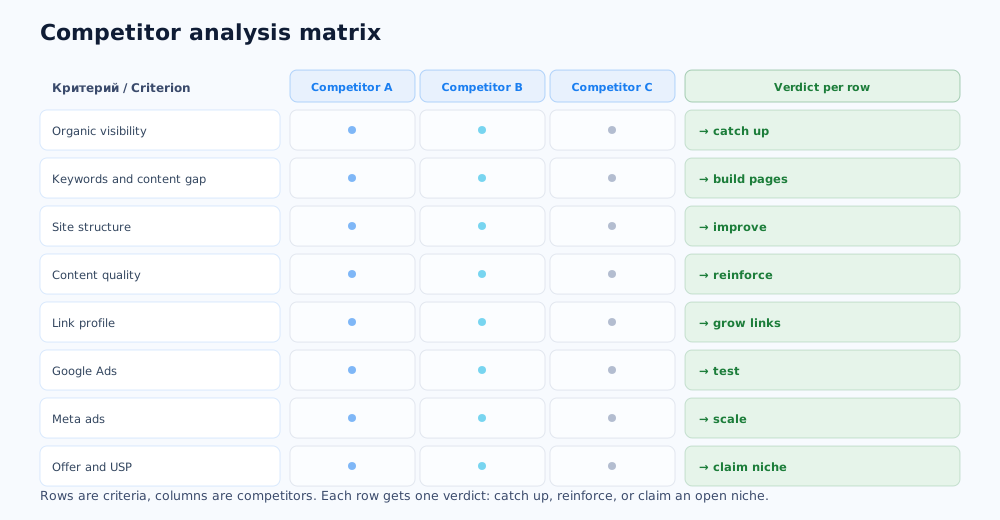
What to compare in offers: the offer and positioning itself, prices and how they're presented (open or "ask us"), guarantees, social proof (case studies, reviews, numbers), forms and lead magnets, response speed. Then everything — from visibility to offers — goes into one table where rows are criteria and columns are competitors, and each row gets a verdict: where you're behind and must catch up, where you're ahead and should reinforce that in content and ads, and where there's demand nobody has claimed.
We run this analysis at the start of every project — it's where both SEO services and work on the other channels begin.
The irrelevant categories that show up for competitors in adjacent niches are a good source for a negative keyword list in Google Ads.
08 Frequently asked questions
How do I identify competitors in SEO?
By the SERP, not the market. Enter 10–20 of your target queries in Google (in a private window, with the right region) and note the domains that appear in the top 10 most often. Those are your search competitors — they may include aggregators, marketplaces, and content sites, not just direct business rivals. Pick the 3–7 most frequent ones for a deep analysis.
What tools do I need for competitor analysis?
A free minimum: Google (manual review of results and ads), Google Search Console for your own site, the Meta Ad Library for creatives, Meta Pixel Helper and extensions to check trackers. Paid tools (Serpstat, Ahrefs, Semrush, SimilarWeb, SpyFu) give competitors' keywords, links, traffic estimates, and ad history — for ongoing work they save dozens of hours.
How do I see which keywords competitors rank for?
Through paid tools' "domain keywords" and "keyword gap" reports: the latter shows queries where competitors rank but your site has no page. Without paid access, do it manually — analysing the titles, copy, and structure of their landing pages shows which queries they're clearly optimised for.
How do I see competitors' ads on Facebook and Instagram?
Through the public Meta Ad Library: it shows every active ad for any Page — creatives, copy, formats, launch date. Ads that have run for a long time without changes are usually working. A Meta Pixel on a competitor's site (checked with the Meta Pixel Helper extension) means they run retargeting.
What is a content gap in competitor analysis?
A content gap is the topics and queries competitors get traffic for where you have no matching page, or a weaker one. You find it by comparing several competitors' keywords with your own site's. Closing a content gap is one of the fastest ways to grow organic traffic, because the demand is already proven.
How often should I analyse competitors?
A full analysis every 3–6 months, and always before starting promotion or changing strategy. It's worth checking competitors' ads in the Meta Ad Library and their new pages more often, monthly: new offers and creatives appear constantly, and your response shouldn't lag.