
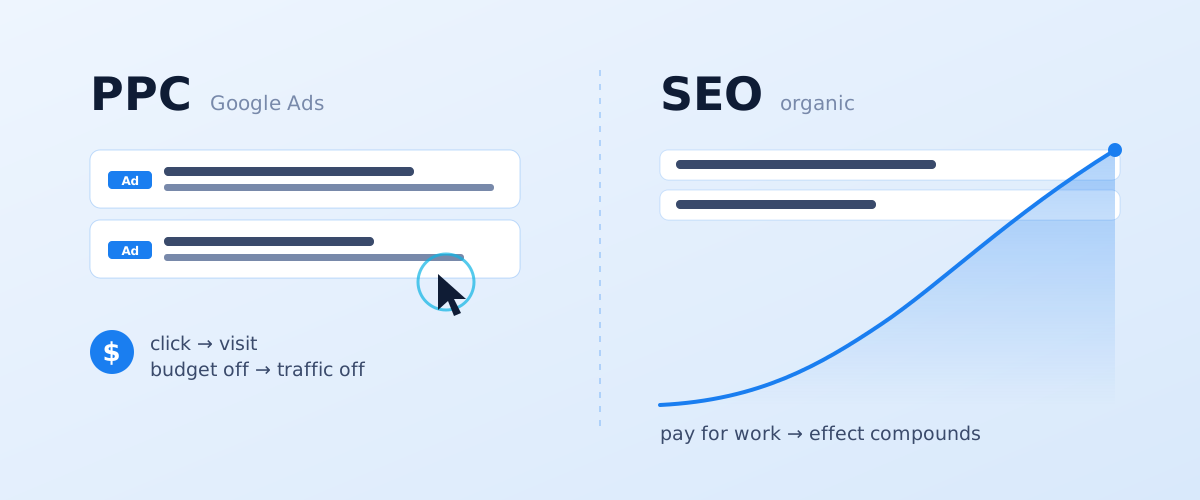
The "SEO or PPC" question almost always comes up in the same situation: the marketing budget is tight, sales are needed, and two contractors are pulling in opposite directions — one promising traffic in six months, the other promising leads tomorrow. The answer does not depend on which channel is "better in the abstract", but on how much time the business has, how demand behaves in the niche, and what matters more right now — speed or a lower acquisition cost down the line. Below is how these two tools work, how they actually differ, and how to choose for a specific goal.
01 The short version: the core difference in 30 seconds
Boiled down, the difference between search engine optimisation and paid search comes down to three points, and everything else in this article is detail on those three. Understanding them is enough to make a preliminary decision; the tables and scenarios below are there to test and refine it for your niche.
- Speed. PPC brings visitors on the day you launch. SEO reaches meaningful traffic in 4–6 months and beyond.
- What you pay for. With ads you pay for every click, and you pay continuously. With SEO you pay for work — the audit, content, technical fixes, links — and once you rank, traffic comes without a direct charge per visit.
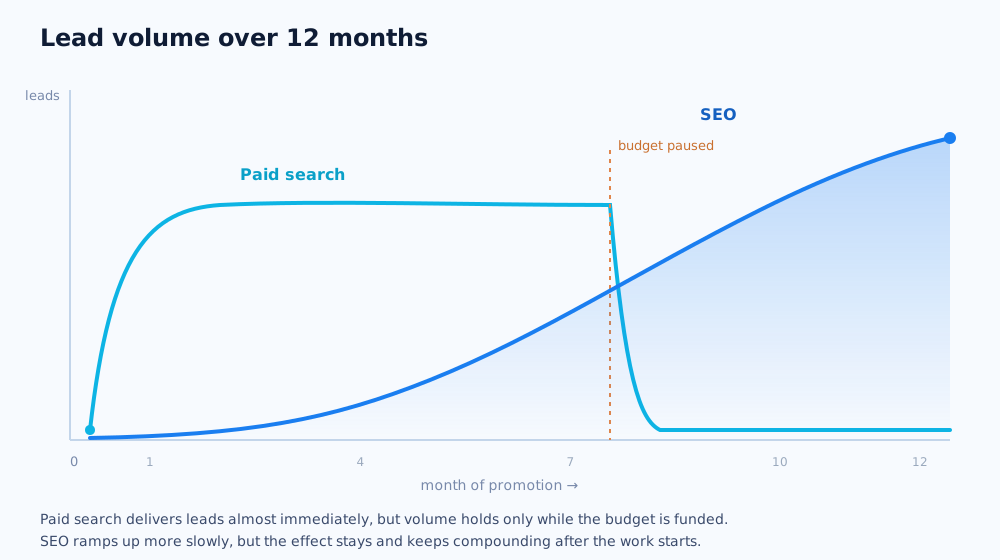
- What happens when the money runs out. Ads switch off and their traffic drops to near zero the same day. SEO positions hold for months and decline gradually if the work stops.
From this follows a simple rule: PPC is renting traffic, and SEO is an asset you build over time. Renting delivers results at once, but you pay forever. The asset needs investment upfront, but over time it lowers the cost of acquiring a customer and makes the business less dependent on ad auctions.
02 How paid search works and what you pay for
PPC in Google Ads is paid listings shown above and beside the organic results for the queries you choose. A user enters a query, the system runs a split-second auction between advertisers, and ad position is set by the bid and the quality score — how relevant the ad and its landing page are to the query. You pay only for a click, not for an impression, so the budget goes toward real visits. Google explains the auction mechanics in detail in the Google Ads Help Centre. How to build the account and the first campaign from scratch is covered in the step-by-step guide how to set up Google Ads yourself.
The channel's strengths are predictability and control. You can see the approximate cost per click in advance, estimate a rough cost per lead, switch delivery on or off in a minute, raise the budget for a peak season and lower it in a lull. That makes ads a convenient tool for launching a new product, testing demand in a niche, and scaling quickly once the unit economics add up.
The weaknesses follow directly from the pricing model. The moment you stop paying, the flow of visitors from ads stops — there is almost no accumulated effect. Cost per click in competitive niches — legal services, healthcare, real estate, finance — rises year over year as more advertisers join the auction. And part of the audience deliberately skips blocks marked "Sponsored", trusting the organic results more.
03 How SEO works and what you pay for
Search engine optimisation is the work of getting a site into the state where Google considers it the best answer to your audience's queries — and keeping it there. The work splits into three big blocks: the technical base (speed, indexing, no errors), content that matches real user queries, and external trust signals — mentions and links from other sites. Google does not charge for organic positions and says so plainly in its SEO Starter Guide — ranking depends on how useful the page is, not on an ad budget.
You pay for the work of specialists and for producing content, not for clicks. Those investments build an asset: pages that rank keep bringing traffic a month and a year after they were made. The average cost of acquiring a visitor from organic search falls over time, because the spend was in the past and the traffic is in the present.
The main downside is inertia in both directions. Results take time: on a young site the first noticeable movement usually shows in 3–6 months, and reaching stable traffic takes 6–12 months. We cover this in detail in a separate piece — how long SEO takes. The second trait: SEO is a poor fit for one-off promotions and short campaigns where the result is needed by a specific date.
04 A comparison across eight criteria
Below is a summary table across the criteria that most often drive the choice of channel. It does not declare a "winner": each criterion carries a different weight depending on what matters more to your business — fast sales, a low acquisition cost later, or resilience to outside changes.
| Criterion | Paid search (PPC) | SEO |
|---|---|---|
| Speed of first result | 1–2 days | 3–6 months to noticeable traffic |
| Pricing model | Per click, continuously | For the work; clicks are free |
| What happens if the budget stops | Traffic drops the same day | Positions hold and decline over months |
| Acquisition cost over time | Flat or rising with bids | Falls as organic grows |
| Predictability | High: budget and CPC known in advance | Medium: timing depends on niche and competition |
| Flexibility and speed of change | Campaigns turn on and change in minutes | Changes take effect over weeks |
| Audience trust | Lower: some users skip ads | Higher: organic reads as Google's choice |
| Resilience to external factors | Tied to the auction, platform rules, review | Tied to algorithms, not to daily bids |
05 When to choose paid search
PPC is the right first move when the result is needed quickly and can be measured in money this month. It removes uncertainty: within a couple of weeks you learn whether demand exists, roughly what a lead costs, and whether the economics add up, before committing to slower channels.
Betting on ads as the primary channel makes sense in these cases:
- you need sales in the coming weeks, not months — a new business, a cash gap, a new line launch;
- you are testing a niche, a product, or a new market and want demand data fast;
- the offer has a short shelf life: a promotion, an event, a seasonal product, a sale;
- the site is technically weak or brand new, SEO results are far off, but you need to sell now;
- the niche is highly competitive in organic search and reaching the top for key queries quickly is unrealistic.
There is one limitation to keep in mind: ads solve the "here and now" problem but do not make acquisition cheaper over time. If demand in the niche is steady, sooner or later the question becomes how to stop paying for every visit — and that is where SEO comes in.
06 When to choose SEO
SEO is the right choice when the business has a horizon of at least six to twelve months and the goal is not "leads tomorrow" but "make leads cheaper and steadier a year from now". It is an investment in reducing dependence on ad budgets.
SEO as the priority channel is justified in these situations:
- demand in the niche is steady and recurring: people regularly search Google for your products or services;
- the business is built to last for years, not one season, and can afford spend that pays off in a few months;
- cost per click in your niche is already high and keeps rising;
- there is something to build content around — expertise, a catalogue, services you can turn into useful pages;
- you want to be present in the results all the time, not only while an ad budget is running.
SEO's limitation is that it does not deliver fast, and it is a poor fit when you have to sell by a fixed date. That is why SEO is usually launched not instead of ads but alongside them, with ads covering the gap in the first months.
07 When a business needs SEO and PPC together
In most projects with steady demand, the right answer to "SEO or PPC" is "both, but in different roles". Ads cover the need for leads here and now while SEO gains positions; as organic grows, part of the ad budget frees up. Here is how that looks in practice for different situations.
The chart shows why the pairing works: the two channels deliver leads at different times and offset each other's weaknesses.
Budget split for a new site
If the site is young and there is almost no organic traffic, it makes sense to point most of the budget at paid search early on, and a smaller share at the SEO foundation: the technical audit, structure, and baseline content. A rough ratio for the first months is around 70–80% to ads and 20–30% to SEO. Ads feed the business with leads in this period, while the SEO spend does not yet pay back but lays the groundwork for later.
Budget split for an established site
If the site is a few years old, some pages already rank and there is organic traffic, the balance shifts. Here you can hold roughly even — or even tilt toward SEO if the niche is competitive in ads — and use paid search selectively: on the highest-converting queries, remarketing, and seasonal peaks. Ads stop being the only source of leads and become an amplifier.
How to move budget from ads to SEO
Move the budget gradually, as organic starts covering the same queries you pay for in ads. A practical approach: once a quarter, look at which key queries the site has reached the organic top 3 for, and lower bids or pause ads on those queries while watching total lead volume. If the overall flow does not drop, organic has picked up the traffic, and the freed-up money can go into expanding SEO or into new ad segments.
Branded queries deserve separate attention. When you already hold the first organic position for your company name, brand ads often just buy back clicks that would have come for free. The pairing here is tuned carefully: keep brand ads if competitors are actively bidding on your name, and limit them if the results page is already under your control.
For a broader look at channel choice — including SMM, not just SEO and paid search — see the guide on which channel to start a business with.
08 How to decide for your business: a checklist
To move from theory to a decision, answer the seven questions below. The more answers lean toward "needed fast and for a short period", the stronger the case for paid search; the more lean toward "demand is steady and the horizon is long", the stronger the case for SEO. If the answers split roughly evenly, that is a direct signal you need both.
- How soon do you need the first leads — weeks, or can you wait months?
- Is demand in the niche constant, or is this a one-off promotion or seasonal spike?
- Is the business built for years or for a single launch?
- What is the current cost per click in your niche — tolerable or already high?
- Is there a resource for content: expertise, a catalogue, services you can write useful pages about?
- What technical shape is the site in — ready to promote or in need of serious work?
- How important is it to be present in the results all the time, not only while an ad budget is running?
If the checklist points to "you need both channels", it matters that they are run in sync: on a shared keyword set, shared landing pages, and a single view of leads. When SEO and ads live separately with different contractors, they start getting in each other's way — we wrote about this in the piece on integrated digital marketing. Setting up and running both under one owner can be delegated: see Grottix services, or start with SEO promotion if the priority is lowering acquisition cost over time.
09 Frequently asked questions
Is SEO or PPC cheaper?
In the short term PPC is cheaper: there is no months-long wait before the first result. In the long term SEO is cheaper: you pay for work rather than for every click, and once you rank, traffic keeps coming without a rising budget. The point where SEO beats PPC on cost per lead usually arrives after 6–12 months.
Which one delivers results faster?
PPC: the first visits and leads arrive on the day you launch. SEO shows the first ranking movement in 2–4 months, and meaningful traffic usually from month 4–6, depending on the age of the site and how competitive the niche is.
Can I run PPC only, with no SEO?
Yes, if the business is short-term, demand is one-off, or you are testing an idea. But with steady demand, skipping SEO means paying indefinitely for traffic you could earn for free, and staying exposed to rising auction bids.
Which should I choose on a small budget?
If you need sales now, start with PPC on a narrow, highest-converting set of queries. If you have 6–12 months and the goal is to lower acquisition cost later, invest in SEO. Splitting a small budget across both channels at once is usually inefficient.
Do I still need SEO if PPC already brings leads?
Yes, if demand in your niche is stable. SEO in that case lowers the share of paid traffic and the overall cost per lead: as organic positions grow, part of the ad budget can be redirected to other tasks.
Do SEO and PPC compete with each other in search results?
No, they occupy different blocks and reinforce each other: appearing in both the ad slot and the organic results raises overall CTR and trust. Cannibalisation is only a risk on branded queries, where it can make sense to limit ads if organic is already in the top spot.