
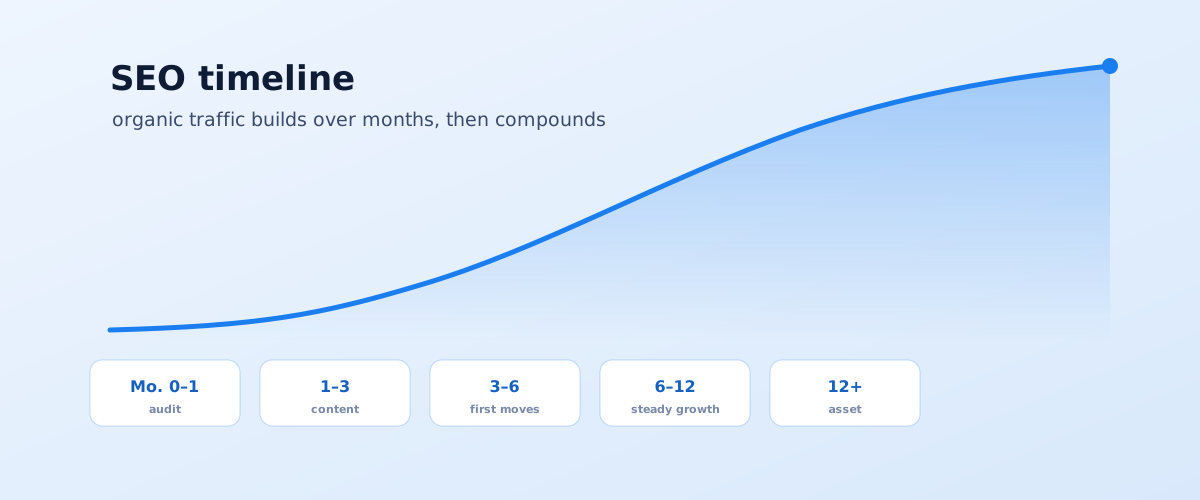
The "how long does SEO take" question usually comes up in two situations: before starting, to decide whether it is worth beginning at all, and around month three, when there is still no traffic and the worry sets in that money is being wasted. The short answer: a noticeable result is 4–6 months for a site without serious problems and 6–12 months for a new domain or a competitive niche. The rest of this article covers why it takes exactly that long, what happens each month, and how to tell that the work is on track before the traffic arrives.
01 The short answer: timelines in numbers
If you need a rough guide with no nuance, keep three checkpoints in mind. They are averages: real timelines depend on the niche, the age of the domain, and the budget, and below we break down how each of these shifts the timeline. But as a starting point for planning, these numbers hold.
- 2–4 months — the first ranking movement on low-volume and informational queries, and rising impressions in search.
- 4–6 months — the first meaningful organic traffic and leads on a site without serious technical problems.
- 6–12 months — steady growth and top positions on mid- and high-volume commercial queries; for a new domain or a competitive niche, closer to the upper bound.
There is a reverse rule worth remembering: if a contractor promises the top in a month or two, that is either bad faith or promotion on queries the site already almost ranked for. A durable organic result in that timeframe is technically unachievable, and Google states plainly that changes take time to reflect in search.
02 Why SEO does not deliver right away
The reason is not that specialists work slowly but how ranking is built. Between a change being made and its effect on positions there are several processes on Google's side, and each takes time regardless of how quickly the work on the site is done.
The main links in this delay:
- Recrawling and indexing. Google has to recrawl the changed pages and update them in the index. For a new or rarely updated site that is weeks, not hours — Google describes crawling and indexing as a distinct stage, not an instant one.
- Recalculating positions. The algorithm evaluates a page in the context of the whole results page and hundreds of factors; it responds to a trend, not a one-off change, so a new version of a page is weighed in gradually.
- Accumulating trust signals. Links, brand mentions, and user behaviour build up over months. For a young site this is the key speed limit: content can be written in a week, authority cannot.
The practical conclusion: the first months of SEO are not "waiting" but work whose effect is deferred by nature. Judging it by traffic in this period is pointless; there are other indicators for control, covered in the section on tracking progress.
03 A month-by-month timeline
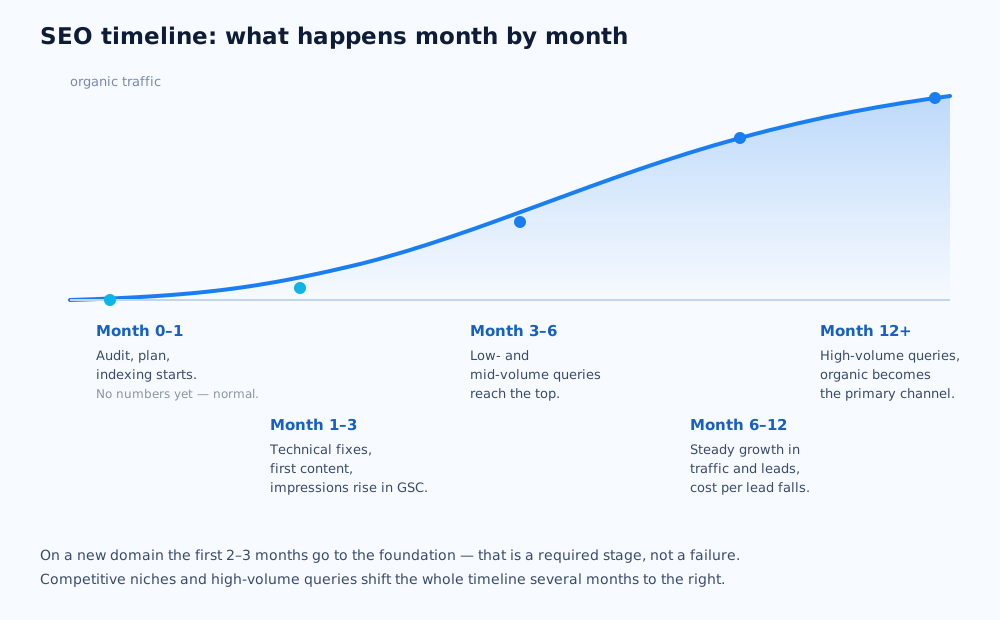
Below is what a typical project looks like by month. It is not a rigid schedule but a sequence of stages: on a slow site or in a competitive niche each stage is longer, but the order holds. The absence of visible traffic in the early stages is part of the plan, not a deviation from it. What exactly to do at each stage if you run the promotion yourself is covered in the step-by-step plan how to promote a website to the top of Google yourself.
What happens at each stage:
- Month 0–1. Technical audit, keyword research, a plan for structure and content. Search Console and analytics setup. No visible results — and that is normal.
- Month 1–3. Fixing technical errors, optimising existing pages, the first new material. Impressions start rising in Search Console — the site appears in results for a growing number of queries, even if positions are still low.
- Month 3–6. Low-volume and informational queries reach the top 10, the first organic traffic and the first leads appear. Work on the link profile begins.
- Month 6–12. Mid-volume commercial queries enter the top, traffic grows steadily, the cost of acquisition from organic falls. The project reaches a predictable trajectory.
- Month 12+. Competing for high-volume queries, expanding the keyword set, consolidating positions. Organic becomes the primary channel for leads, or one of them.
04 What the timeline depends on
The 4–12 month spread is wide precisely because several factors affect the speed, and they stack. Two projects with the same budget can take twice as long to reach a result purely because of domain age and competition. Below are the four main factors and how each shifts the timeline.
Age and history of the domain
A site that is a few years old and already has some traffic and links responds to optimisation faster: it has an accumulated store of trust, and Google reassesses its positions more quickly. A new domain starts almost from zero — it first needs to build a critical mass of content and external signals, and that adds 2–3 months compared with a site that has history.
Competition in the niche
In niches where the top is held by large portals with big link profiles and years of history — finance, healthcare, real estate — reaching the top 10 for commercial queries takes longer simply because you have to catch up with competitors across the sum of factors. In narrow regional or B2B niches with weaker competitors, the result comes noticeably faster. For YMYL niches such as medicine the timeline is longer still, because Google builds trust in such sites more slowly — this is covered in the article on SEO for a medical clinic.
Budget and volume of work
The timeline depends not on the sum directly but on how much work is physically done per month: how many pages are optimised, how much new content is published, how many links are placed. With an insufficient budget the same stages simply stretch out — for example, instead of ten pieces a month you get three, and filling out the keyword coverage takes eighteen months rather than six.
Technical state of the site
If the site is slow, indexes poorly, has duplicates and structural errors, the first months go to simply removing the barriers — and only then does the actual promotion begin. On a technically healthy site this stage is short, and work on content and links starts almost immediately.
05 A new site versus a site with history
The difference between these two scenarios is large enough that they should be planned differently. On a site with history, some pages already rank, and optimisation takes effect within 2–4 months — you are working with what is already in the index and carries some weight. A new site is barely visible in search in the first months not because of errors but because it has nothing to show: few pages, no links, no accumulated behavioural data.
A practical guide for the first organic leads: for a site with history, that is month 3–5; for a new domain, month 5–8. If the business is new and leads are needed sooner, it is reasonable to cover the gap with paid traffic at the start and run SEO in parallel as an investment in lowering acquisition cost — a scenario we cover in detail in the piece on choosing between SEO and paid search.
06 How to track progress in the first months
The main mistake at the start is looking only at traffic and leads, which by definition are not there yet. Until the result arrives, the project is tracked by leading indicators: they change before traffic does and show whether the site is moving in the right direction.
What to watch in the first 1–4 months:
- The number of indexed pages in Search Console — is coverage growing, is there a spike in indexing errors.
- Impressions in the Performance report — the site should appear in results for a growing number of queries, even if positions are still outside the top.
- Average position for target queries — it should slowly decrease (that is, improve) month over month.
- Technical metrics — load speed, the share of pages without errors, structural correctness.
How to check positions properly and read average position in Search Console without drawing false conclusions is covered in a separate article — how to check your Google rankings. If impressions are not growing at all after 2–3 months, that is a signal to go back to the audit, not to keep waiting. Also keep in mind that for some informational queries the AI answer block takes the clicks even when impressions grow — how to handle this is covered in the piece on AI Overviews and GEO.
07 What to do if there is no growth after six months
Six months with no movement of any kind is not "wait a bit longer" but a reason to work out what is wrong. Most often the cause is in one of a few places, and they can be checked in order without waiting out another wasted quarter.
- Indexing. Check in Search Console that target pages are in the index at all and getting impressions. Pages outside the index cannot rank, period.
- Content-to-query match. The text may be written "around the topic" rather than for the specific queries people use to find your product. This is fixed by rebuilding the keyword set and reworking the pages.
- Technical blocks. An erroneous noindex, a section blocked in robots.txt, canonical issues, slow load on mobile.
- Manual actions. Check the "Manual Actions" section in Search Console — a penalty stops growth completely.
- Volume of work. If in practice it comes down to one piece a month and two links, the pace is simply too low for the niche.
If the basics are in order and there is still no result, it is worth commissioning an independent audit from another specialist — a fresh pair of eyes often finds what has been overlooked. To see how we approach it, look at the SEO promotion page and the section of case studies with numbers and timelines.
If the timelines are long past and there's still no traffic, it's not about time — check the site against the list in why your site isn't ranking on Google.
Timelines for B2B sites often differ from mass-market niches — a comparison of SEO against paid search by speed of results and payback is covered in Google Ads or SEO for B2B.
08 Frequently asked questions
How many months before SEO shows its first result?
The first ranking movement on low-volume queries is usually visible in 2–4 months. Meaningful organic traffic and leads arrive from month 4–6 on a site without serious issues, and from month 6–9 on a new domain in a competitive niche.
Can SEO be sped up?
You can speed it up by removing technical barriers to indexing, publishing more quality content per month, and working on pages that already almost rank. You cannot skip the time Google spends recrawling, recalculating positions, and accumulating trust signals.
There is still no traffic after 3 months — is that normal?
For a new or technically flawed site, yes. The first 2–3 months go to the audit, fixing errors, structure, and the first content. During this period you look not at traffic but at leading indicators: a growing number of indexed pages and rising impressions in Search Console.
How long to wait for results on a new site?
A new domain grows more slowly: the first organic leads usually appear in month 5–8, and stable traffic by month 9–12. A young site needs time to accumulate content and external signals, so the timeline shifts 2–3 months to the right compared with a site that already has history.
When does SEO pay off?
Usually within an 8–14 month horizon: by then the accumulated organic traffic covers the investment, and the cost of acquiring a customer from organic drops below that of paid channels. In low-competition niches the payback point comes sooner.
What to do if there is no growth after six months?
Check the basics: whether pages are indexed, whether impressions are growing in Search Console, whether the content matches real queries, and whether there are manual actions or technical blocks. If impressions are not growing at all, the problem is not the timeline but the strategy or the tech, and an independent audit is needed.