
SEO for a medical clinic is harder than for most other businesses, and it is not about the volume of work but the fact that Google judges medical sites by special rules. It is not enough here to build a keyword set and write the pages: the search engine checks whether real medical expertise stands behind the content, whether the clinic has a reputation, and whether it can be trusted with someone's health. Below we break down what that means in practice: what site structure to build, how to show expertise, what to do about local SEO, and why dentistry is one of the toughest niches to promote.
01 Why medicine is harder to promote: YMYL and E-E-A-T
Medical sites fall into the YMYL category — "Your Money or Your Life" — meaning resources whose content can affect a person's health, safety or financial well-being. Google applies stricter requirements to such sites and builds trust in them more slowly. It evaluates them on the E-E-A-T model: experience, expertise, authoritativeness and trustworthiness.
In practice this shifts the priorities of promotion. An ordinary commercial site just needs to be technically sound, useful and convenient. A medical one needs more: it has to prove that real qualified doctors stand behind the information, that the clinic has licences and a real address, that patients leave reviews. Google describes the principles of helpful, reliable content in its Search Central guide — and for medicine those principles apply more strictly than anywhere else.
The main takeaway follows from this: in medical SEO you cannot push positions with technical work and links alone. Most of the effort goes into systematically building trust — through doctor pages, real case studies, local SEO and a correct keyword set.
02 The clinic website structure
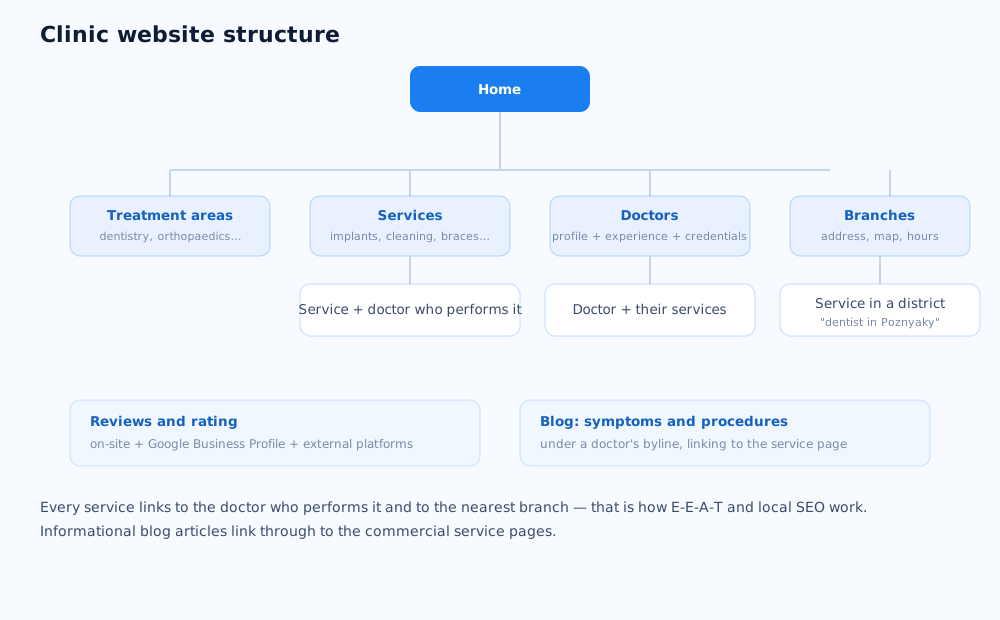
A good structure is not just a menu but a way to connect services, doctors and branches so that both the user and the search engine understand who provides a specific service and where. The diagram below shows the base framework to build from.
Service pages
Every significant service needs its own page optimised for a specific query: not a single "Dentistry" page but separate ones for "dental implants", "cavity treatment", "professional cleaning". Such a page should have a plain-language description of the procedure, indications and contraindications, the stages, a price guide, and — always — which of the clinic's doctors performs it, with a link to that doctor's profile.
Doctor pages
A doctor's profile is not a formality but one of the main E-E-A-T elements for a clinic. It should have a photo, specialty, years of practice, education, continuing-education courses, certifications, and a list of the services the doctor provides, with links back to those service pages. This linking shows Google that a specific qualified specialist stands behind the service, not an abstract clinic.
Branches and local landing pages
If a clinic has several addresses, each needs its own page with the exact address, a map, opening hours, a phone number and the list of services at that particular branch. In addition, for high-volume queries of the "service + district" type ("dentist in Poznyaky", "dentist in Obolon") you create local landing pages — they rank well in cities where people look for a clinic near home or work.
03 E-E-A-T in practice: how to show expertise
E-E-A-T is not a single setting but a set of signals that together tell Google and the patient that the clinic can be trusted. Below is what of this actually affects a medical site and how to implement it.
Authorship and medical review
Every piece about symptoms, diagnosis or treatment should have a named doctor author or a note that the text was reviewed by a relevant specialist. State the name, specialty, experience and link to the doctor's profile on the site. A copywriter can write the draft, but the factual part has to go through a doctor — for YMYL topics Google assesses not the smoothness of the text but whether real expertise stands behind it.
Facts about the clinic: licences, equipment, history
The site should carry verifiable facts: licence numbers, the year of founding, the number of branches and doctors, the equipment used, membership of professional associations, publications and press mentions. A dedicated "About the clinic" page with this data and a page with documents (licences, certifications) is what both the search engine and the patient read as a sign of a real organisation rather than a fly-by-night site.
04 Local SEO and Google Business Profile
A large share of patients look for a clinic with location-based queries and with "near me", and the first contact often happens not on the site but in the map pack. So local SEO for a clinic is not an add-on but half of the whole job.
Google Business Profile listing and categories
The Google Business Profile listing needs to be fully completed and maintained: the exact category (for example, "Dental clinic", not just "Clinic"), the list of services, opening hours, photos of the rooms and the team, a link to the site. Google describes the requirements for such listings in its guidelines for representing your business — breaking the rules leads to a demotion or a suspension of the listing.
Reviews and the "Questions and answers" section
Reviews and the average rating are one of the decisive factors for both a place in the map pack and the patient's choice. You need a regular process for getting reviews from real patients and mandatory replies from the clinic to every review, including negative ones. The "Questions and answers" section in the listing should be filled in by you with common questions — about prices, booking, guarantees — rather than left for random users to answer for you.
Consistent NAP and local pages
NAP is the clinic's name, address and phone. They must be exactly the same everywhere: on the site, in Google Business Profile, in directories, in listings. Discrepancies (a different phone format, an old address in one directory) dilute the local signals. On top of that come the same "service + district" local landing pages that connect the keyword set with geography.
05 Content: informational articles that lead to services
A patient rarely searches straight for "book a dental implant" — first they google "how long does a filling last", "does getting braces hurt", "why are my gums bleeding". Informational articles on such queries bring people in at the early stage of choosing, and the job of the content is not just to answer but to lead through to the right service.
For the blog to work for promotion rather than exist on its own:
- every article closes a specific patient question and is written in plain language, without medical jargon;
- the text has a contextual link to the service page that solves the problem ("if your gums bleed regularly, a professional cleaning will help");
- the material is doctor-reviewed, and this is stated on the page — with a name and a link to the profile;
- articles are grouped into topic clusters and interlinked, not scattered across the blog one by one.
06 Technical and legal specifics of a medical site
Some requirements for a medical site are common to any SEO, but there are specifics that are easy to miss. Below is what to check separately.
- Speed and the mobile version. Most patients look for a clinic on a phone, often on the move; a slow site loses them before they book.
- Structured data. Structured data for the organisation, services, reviews and the Q&A section helps Google understand the clinic site correctly.
- Booking forms. A simple form and a fast reply matter more than on an ordinary site: a patient in acute pain will not fill in ten fields.
- Legal block. Advertising of medical services is regulated: the site needs licence details, and claims about effectiveness and treatment "guarantees" must be accurate. Dubious promises hurt both legally and in terms of Google's trust.
- Personal data. Enquiries contain medical information — form handling and data storage must be secure.
07 Timelines and budget: why dentistry is one of the hardest niches
Medical SEO in general is slower because of YMYL status, and dentistry within medicine is a separate level of difficulty. In large cities a single residential district has 15–20 clinics competing for the same queries, and all of them are YMYL sites with history and reviews. You have to compete at the same time in organic results, in the map pack, in directories and, increasingly, in AI answers.
Realistic guidance: the first noticeable ranking movement comes in 4–6 months, a meaningful flow of enquiries from organic and the map in month 6–9, and the top for competitive commercial queries ("dental implants + city") in 8–14 months. The budget is higher than the commercial-niche average because a significant part goes not to "standard SEO" but to doctor-reviewed content, review management and local pages. The general logic of SEO timelines is covered in the article how long does SEO take, and how to track ranking progress is in how to check your Google rankings.
How this looks on real projects can be seen in the case studies of promoting a dental clinic network and a cosmetology clinic; the approach itself is described on the SEO promotion page.
How to set up and optimise a Business Profile, work with reviews and local pages for any local business is covered in the dedicated piece on local SEO and Google Maps promotion.
For a YMYL niche like medicine, search reputation matters even more — how to monitor mentions and manage reviews is covered in the SERM guide.
Medicine is a special case of the broader services industry; the general principles of site structure, trust, and local SEO for law firms, consultancies, and service businesses are covered in the SEO for professional services guide.
Author expertise isn't an abstract requirement — it comes down to specific elements on the page; a detailed breakdown of E-E-A-T and personal brand is in a separate article.
08 Frequently asked questions
How long does SEO for a medical website take?
Longer than in most commercial niches: the first noticeable results come in 4–6 months, and reaching the top for competitive queries such as "dental implants + city" takes 8–14 months. The reason is YMYL status: Google builds trust in medical sites more slowly and judges them more strictly on E-E-A-T.
Do articles have to be written by a doctor?
A copywriter can write the draft, but content about symptoms, diagnosis and treatment must be reviewed by a relevant doctor, and this must be visible on the page: name, specialty, experience, a link to the doctor's profile. For YMYL topics Google assesses whether real expertise stands behind the content, not just well-written text.
What matters more for a clinic — the website or Google Business Profile?
You need both; they cover different queries. Google Business Profile brings people in on "near me" queries and in the map pack, where first contact often happens. The website is needed for queries that specify a service and a district, for trust, and for converting the enquiry. Work on them in parallel.
Can you promote a clinic without reviews?
Technically yes, but the result will be weaker: reviews and rating are one of the key factors for both local ranking and the patient's decision. Without a flow of fresh reviews a clinic loses to competitors in the map pack even with a well-optimised site. Review collection should be set up as an ongoing process.
Why is dentistry a hard niche for SEO?
In large cities a single district has 15–20 clinics competing for the same queries, and all of them are YMYL sites with heightened requirements. You have to compete not only in organic results but also in the map pack, in directories and in AI answers. That is why timelines and budgets here are higher than the medical average.
Does a medical website need a blog?
Yes. Informational articles about symptoms and procedures bring people in early, while they are still choosing, and those articles link through to the service pages. A blog under a doctor's byline is also a direct expertise signal for E-E-A-T. The articles must be doctor-reviewed and lead to commercial pages rather than standing alone.