

A law firm, a consulting agency, an accounting or cleaning company is not selling a product a customer can touch and compare on specs — it is selling trust in the specific people who will take on the client's problem. That changes almost everything about the SEO approach, from site structure to what content is even worth writing.
01 How SEO for services differs from ecommerce and healthcare
For an online store, the core content unit is a product page with clear specs; for a medical clinic, it is tightly specialised content under strict YMYL requirements. For a services site, the unit of promotion is closer to a specific service page plus proof that this particular company can deliver it well.
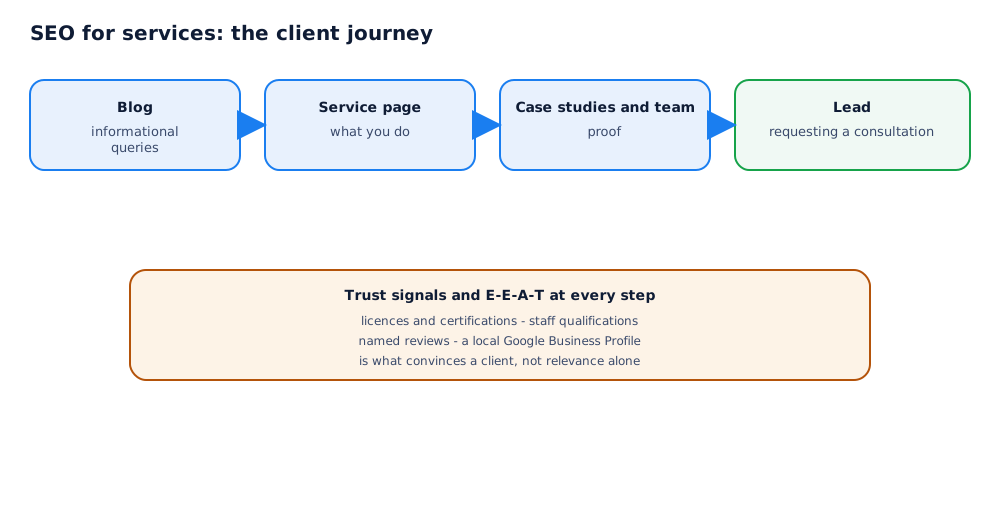
Three practical consequences follow: comparing services directly on price and features, the way products are compared, is nearly impossible, so the decision usually rests on trust in the brand and its specialists; the decision cycle is typically longer than buying a product — a client may research the question for weeks, especially for legal or financial services; and the site's structure is built not around a catalogue but around the chain "service → proof → team".
02 Site structure: services, case studies, team, blog
A services site's structure needs to answer several different questions from the same prospective client: what do you do, who will actually do it, and is there proof it will work out.
The basic set of sections: a dedicated page for every meaningful service, rather than one generic "services" page listing everything with commas; a case studies section with concrete results and, where possible, numbers; a team page with real photos, credentials, and experience rather than stock images; and a blog with expert content that answers the audience's questions before they even decide to reach out for the service.
03 Local SEO for an office and branches
For most service businesses operating in a specific city or region, local SEO is one of the fastest, most predictable sources of traffic, because competition there is lower than for general industry-wide queries.
Practical steps: a filled-out, regularly updated Google Business Profile with categories, services, and office photos; a dedicated page on the site for each physical branch, if there is more than one; and active work on customer reviews, since for a local business, rating and review count feed directly into map rankings. A detailed walkthrough of setting up a local profile is in the article on local SEO and Google Business Profile, and how to systematically manage reviews and brand mentions is covered in the SERM guide.
04 Trust and E-E-A-T: licences, credentials, reviews, case studies
Google evaluates pages through the lens of experience, expertise, authoritativeness, and trust — the principles Google describes in its guidance on creating helpful, people-first content. For a services business, these are not abstract principles — they are literally what convinces a client to pay.
Specific trust signals worth putting on the site: real licences, certifications, and membership in professional bodies wherever relevant to the niche; the names and qualifications of the specialists who will actually work on the project, not a faceless team; detailed case studies describing the original problem, the process, and the result; and customer reviews with a name and, where possible, a link to a profile or company — anonymous quotes inspire less trust and read worse to Google itself.
05 Keyword research: from "what is" to "cost of service"
Keyword research for a services site follows the same core principles covered in the general guide to building a keyword list, but the intent here is spread out over a longer stretch of time than in most commercial niches.
Keywords roughly break down into three layers: informational queries like "what is" and "how to choose", where familiarity with the topic begins; comparative and clarifying queries, once a client understands the task and is weighing options; and direct commercial queries with the service name plus words like "cost", "hire", "in [city]", which signal readiness to reach out. All three layers need their own content — trying to cram them all into a single service page does not work.
06 A content strategy for a long decision cycle
Since choosing a provider in professional services is rarely decided in one visit to the site, a content strategy needs to accompany a client along the whole journey rather than count on converting on the first touch.
A working principle: informational blog articles bring in a reader at the research stage and naturally link to the relevant service page; the service page, in turn, links out to case studies and reviews as the next step for someone already interested; and case studies close the loop with a direct call to action. How to build that sequence systematically, rather than as scattered pieces, is part of the SEO service, which includes building a content strategy for a specific business.
07 Common mistakes in promoting services sites
Most problems with services sites are the same recurring pattern, regardless of whether it is a law firm, a consultancy, or a local service business.
The most common mistakes: one generic "services" page instead of dedicated pages for each offering, leaving no single service with enough content or link equity to actually rank; no pricing or price ranges at all, which puts off part of the audience before they ever make contact; anonymous copy with no real specialists or their qualifications named; and ignoring local SEO even with a physical office that could be bringing in steady local traffic.
08 Frequently asked questions
How is SEO for services fundamentally different from SEO for an online store?
A store sells a standardised product that is easy to compare on price and specs; a service is much harder to compare, so trust in the specific company and its people ends up mattering more than the offering itself. That is why case studies, reputation, and expert content matter more here than a catalogue or product pages.
Does a services site need a blog if most clients come from word of mouth?
Yes, because word of mouth brings in warm leads but does not scale and does not reach anyone who has not heard of the company yet. A blog with useful content attracts people actively searching for a solution to their problem on Google — a source of leads that does not depend on referrals.
How do you show expertise if the company does not have big-name case studies yet?
Start with an honest, detailed explanation of how the work actually happens, publish the team's real qualifications and credentials, and write expert articles on the subject even without tying them to a specific client. One detailed, well-argued piece on a narrow question often convinces more than a generic "10 years of experience" claim with no specifics.
Should pricing for services be listed on the site?
Yes, even as a range or a "starting at" figure. Having no pricing signal at all is a common reason a prospect goes to a competitor without ever submitting an inquiry — not everyone is willing to spend time on a call just to learn the ballpark cost.
How do you promote a services site if the company operates nationwide rather than in one city?
Local SEO matters less in that case, and most of the weight shifts to keyword research by service type and industry content. If the company still has physical offices in several cities, each one is worth a dedicated Google Business Profile and a local page on the site.
How long does SEO for a services site take?
The first results for less competitive queries are usually visible after 2–4 months, and for the niche's main commercial queries after 5–8 months of consistent work. The timeline depends heavily on how competitive the specific field is — legal and consulting niches in major cities are usually more competitive than local service businesses.