

Before ever reaching out, almost every potential customer who has already found you through an ad, a recommendation, or a plain search for a service types your company's name into Google first. What they see on that first page of results — reviews, a map rating, forum mentions — often decides more than the company's own website does. Managing that picture is exactly what SERM does.
01 What SERM is and how it differs from SEO and ORM
SERM (Search Engine Reputation Management) is the work of shaping what a user sees in Google's top 10 for a branded query — a company's name, a specialist's name, a product name. The goal of SERM isn't simply to show up in results, but to make sure what shows up there is accurate and favours the business.
SERM is often confused with two neighbouring concepts:
- SEO promotes a site for informational and commercial queries about the niche in general — "buy windows", "SEO agency"; SERM works specifically on queries about one particular brand;
- ORM (Online Reputation Management) is the broader discipline covering a brand's reputation across every online channel — social media, press, forums; SERM is the part of it focused specifically on search results.
In practice the lines blur: a reviews page on a company's own site is both an SEO asset and a SERM tool at the same time, because it helps the page rank and shapes what shows up for the brand in search.
02 How reputation affects rankings and E-E-A-T
Google has no single algorithmic "reputation factor" that directly raises or lowers a site's rankings. But reputation shapes rankings through several indirect, and quite measurable, mechanisms.
Sites and business profiles with a strong reputation gain an edge through: rich snippets with star ratings in search results, which lift CTR and, in turn, behavioural signals; higher user trust, which converts into longer time on site and a lower bounce rate; and alignment with the E-E-A-T principles (experience, expertise, authoritativeness, trust) that Google describes in its guidance on creating helpful, people-first content. The reverse effect is just as real: heavy, visible negativity on the first page of branded results drives users away before they ever reach the site, which indirectly hurts traffic and conversion even if rankings themselves haven't formally changed.
03 Where a reputation forms: review sites, maps, social media, forums
Before managing a reputation, it helps to know exactly which sources make it up in branded search results in the first place. For most companies, a handful of platform types end up in Google's top 10 for a branded query.
Most often these are: a Google Business Profile with map reviews and a rating; industry-specific review sites and aggregators; a company's social media pages with open comments; forums and community groups where people discuss their experience with the business; and finally, the company's own site, with a reviews or case-study section. For a local services business, the first two types tend to dominate — maps and industry review sites — covered in more depth in the local SEO and Google Business Profile article.
04 How to monitor brand mentions
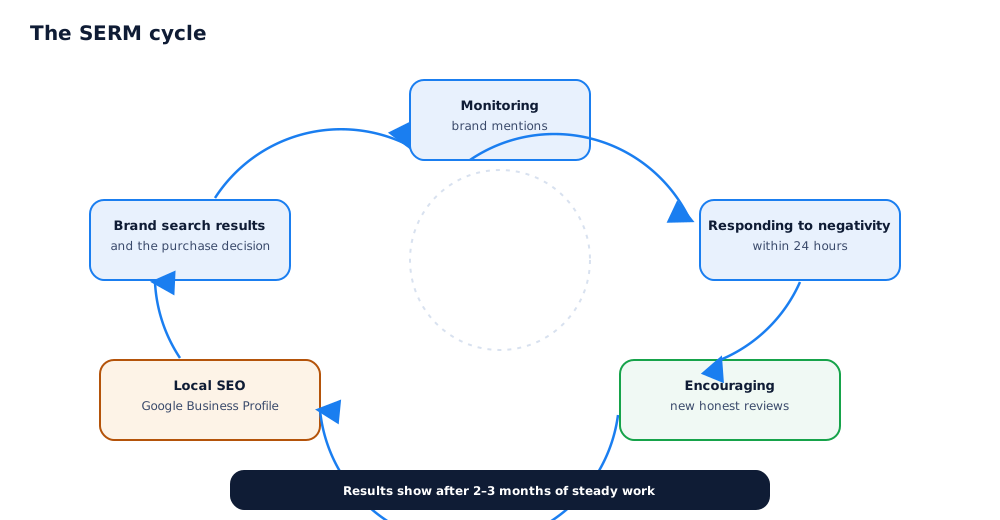
There's no way to manage a reputation without knowing what's already being said about the company. Monitoring mentions is the mandatory first step before taking any action.
A basic monitoring setup: regular manual searches for the company's name and the names of key staff in an incognito window, to see results without personalisation; free Google alerts for key phrases containing the brand name; and dedicated mention-monitoring tools once the volume of reviews and discussion is too large to track by hand. Frequency matters — a fast-growing company should check its branded search results at least once every 1–2 weeks, so it can react to new negativity before it settles into the top positions.
05 How to handle negative reviews
Responding to negativity is the most visible part of SERM, because it's the part other potential customers see later when they read the company's profile.
A working process for replying to a negative review: respond within 24 hours instead of putting it off; acknowledge the problem without excuses and without arguing publicly with the reviewer; offer a concrete fix, or move the conversation to a private message if it needs detail; and, once the issue is resolved, politely ask the author to update the review. Google's own guidance on managing Business Profile reviews is covered in the help article on reading and replying to reviews. A review left by someone else can't be removed directly unless it breaks the platform's rules — a good public reply is the one durable tool here.
06 How to encourage customers to leave reviews
Prevention beats treatment: a site with a steady stream of new, honest reviews is far more resilient to an occasional bad one than a site with almost no reviews at all.
Practical ways to increase the flow of reviews: ask for one at the moment of highest customer satisfaction — right after an order or service is completed successfully, not weeks later; send a direct link to the review form instead of asking customers to "find the company's profile" themselves; and thank people for reviews publicly, showing that someone actually reads what customers say. Only the act of leaving a review can be encouraged — not its content or rating. Buying positive reviews or demanding a specific score breaks most platforms' rules and can get an entire profile removed.
07 SERM and local business: the Google Business Profile connection
For a local business — a clinic, a salon, a legal or service company — SERM and local SEO are most tightly connected, because the main platform for reputation and the main source of local traffic are the same Google Business Profile.
Reviews and the rating on that profile factor directly into local ranking alongside relevance and proximity to the user — a detailed explanation of how Google evaluates local results is in the help article on local ranking factors. That's why, for a local business, working on reviews isn't a separate task — it's part of the same profile optimisation as filling in categories, services, and photos, covered in the article on SEO for a medical clinic, using a YMYL niche with especially high trust requirements as the example. If handling reputation and local SEO alone isn't appealing, this work can be folded into a broader SEO campaign.
For law firms, consultancies, and other service businesses, reputation is only one trust signal among several; the full picture of building trust and site structure is covered in the SEO for professional services guide.
Brand reputation is only part of the bigger E-E-A-T picture; what makes it up in full and how to strengthen an expert's personal brand is covered in a separate piece.
Beyond classic search results, brand reputation increasingly shows up in AI-generated answers too; how to check whether ChatGPT or Gemini mention your brand is covered in a separate article.
08 Frequently asked questions
How is SERM different from ORM?
ORM (Online Reputation Management) is the broad discipline covering a brand's reputation across every online channel — social media, press, forums, review sites. SERM is the narrower part of that work, focused specifically on search engine results: what a user sees in Google's top 10 for a branded query.
Can a business remove a negative review?
A review posted by someone else cannot be removed directly unless it breaks the platform's rules — fake, abusive, or unrelated to the business. In every other case, the only legitimate option is to reply to the review politely and specifically, offer a resolution, and ask the author to update their rating once the issue is resolved.
How many reviews does a business need for its reputation to look credible?
There's no universal number, but users and search engines both trust profiles with several dozen reviews and a rating that looks plausible — not a perfect 5.0, but something like 4.6–4.8 with genuine, detailed text. A handful of reviews or a suspiciously uniform run of five-star ratings raises more doubt than a few negative reviews handled with a good response.
How quickly should negative reviews be answered?
Within 24 hours is the target. A fast, substantive reply shows both the reviewer and anyone reading the profile later that the business responds to problems instead of ignoring them. A delay of days or weeks reads as indifference, even if the underlying issue was actually resolved quickly.
Does SERM work without changing the product or service itself?
No, and that's SERM's key limitation. Reputation management changes how a reputation is presented in search results, but it doesn't remove the reason customers are unhappy. If the underlying problem is systemic — missed deadlines, say — new negative reviews will keep arriving faster than SERM can work through the old ones.
How long before reputation work shows results?
The first noticeable changes in branded search results usually appear after 2–3 months of consistent work, with a durable result taking six months or more. It's a slow process because it depends on accumulating new positive signals over time, not on one-off technical fixes the way many SEO tasks do.