
01 Short answer: what AI visibility is
AI visibility is how often, and in what context, AI systems like ChatGPT, Gemini, and Perplexity mention your brand when someone asks a question related to your niche. It's a separate metric from classic Google rankings: a site can rank in the top 10 for the right queries and still never come up in ChatGPT's answer to a closely related question — and vice versa.
Below: how AI visibility differs from familiar SEO visibility, how to check mentions manually, what specialized monitoring tools have emerged, and what genuinely improves your odds of being mentioned rather than just looking like "AI optimization."
02 How AI visibility differs from SEO visibility
Classic SEO measures a page's rank for a specific query — a familiar, well-studied metric. AI visibility measures something less deterministic: whether a brand shows up in a generated answer that's phrased fresh each time and can vary from one run to the next even within the same system.
The sources an AI answer draws on are also structured differently from a classic results page: a model may cite a page that's never ranked in Google's top 10 for that query if it gives the clearest, best-structured answer to the specific question. This ties closely into AI Overviews and zero-click search, covered in AI Overviews and GEO.
03 How to manually check mentions with prompts
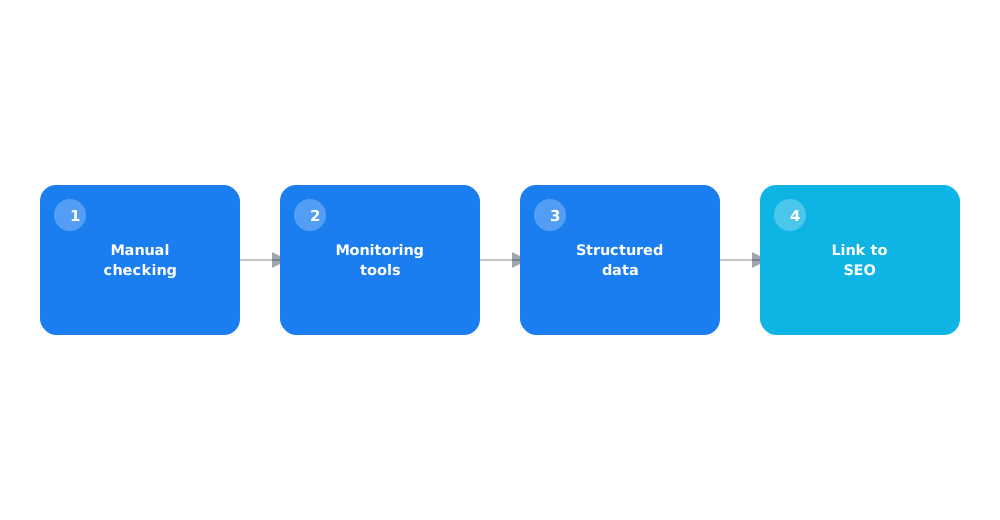
The most accessible way to start needs no tools at all — just a browser and accounts on ChatGPT, Gemini, and Perplexity.
- Write 15–20 prompts a real customer might actually ask an AI about your niche — not about the brand directly, but about the problem it solves.
- Run each prompt on each system at least twice, since AI answers are non-deterministic and can vary from one run to the next.
- Log four things per answer: whether the brand appears, its position in any list, which competitors are named alongside it, and which sources the system cites.
- Repeat the check at least monthly to track change over time, not as a one-off snapshot.
The method's limitation is that results depend on phrasing, region, and even the specific session — what ChatGPT answers from the US can differ from what it answers in Ukraine. Manual checking gives a direction, not a precise metric.
04 Specialized monitoring tools: an overview of the category
Manual checking doesn't scale to dozens of prompts across several systems every month, which is why a dedicated category of tools — AI visibility and GEO monitoring — has emerged, running hundreds of prompts through several AI systems automatically and rolling up the results into a report.
Established SEO platforms, already known for classic work like rank tracking and link analysis, have started building this kind of monitoring into their existing subscriptions rather than launching it as a separate product — similar to how featured snippet tracking got folded into SEO tools years ago. Before paying for a separate service, it's worth checking whether the tools you already use for classic SEO have added this.
05 How to improve your odds of being mentioned
AI systems build an answer from what they find in open sources, so most of the levers here are a stronger version of basic SEO hygiene, not separate "AI magic."
- structured data (Organization, Product, FAQPage) that explicitly describes who you are and what you offer — this makes it easier for a model to tie a page to a brand entity;
- clear, direct answers to specific questions near the top of a page, not buried in the middle of a long piece;
- real reviews and brand mentions on third-party sites — models tend to cite what independent sources back up;
- a consistent, non-contradictory description of the brand and its services across the site.
Organization markup for a site can be checked against Google's official structured data documentation for organizations. Working with outside mentions and reviews is covered in detail in reputation management (SERM), and for a local business, a properly filled-out Google Business Profile contributes to brand-entity recognition too.
06 How this connects to classic SEO
AI visibility doesn't replace classic SEO — it builds on the same foundation. A site Google doesn't index can't serve as a source for an AI answer either, since models are largely trained and augmented on data from the open web, which first passes through that same search index.
The practical takeaway: effort put into E-E-A-T, structured data, and brand reputation works for both classic rankings and AI visibility at the same time. Optimizing "just for AI" without a solid SEO foundation almost always produces a short-lived, unstable result.
07 The method's limits: why it isn't a precise metric
Before building reporting around AI visibility, it's worth understanding its structural limits — otherwise it's easy to mistake noise for a trend.
- answers from the same model vary between sessions, regions, and model versions;
- there's no shared measurement standard — different monitoring tools can report different numbers for the same brand;
- the correlation between AI visibility and actual traffic or sales is still poorly studied, unlike classic Google rankings.
That's not a reason to ignore the metric, but it is a reason to treat it as an early directional signal rather than a precise number for a report to leadership.
08 FAQ
What does the term AI visibility mean?
AI visibility is how often, and in what context, AI systems (ChatGPT, Gemini, Perplexity) mention a brand in answers related to its niche. It's a separate metric from ranking position in classic search results.
Can I check AI visibility for free?
Yes, manually: write a list of realistic prompts for your niche and run them through ChatGPT, Gemini, and Perplexity a few times, logging brand mentions, their position in the answer, and named competitors. It doesn't scale to large volumes, but it gives you a direction.
Why does ChatGPT answer the same question differently each time?
AI model answers are non-deterministic: even the same prompt can produce different phrasing and a different set of mentioned brands from one run to the next, and can also vary by region and model version.
Does structured data on a site help with AI visibility?
Yes — Organization, Product, and FAQPage markup explicitly describes a brand's identity and offerings, making it easier for a model to tie a page to a specific company or product when generating an answer.
Do I still need SEO if AI visibility matters?
Yes — they're connected, not alternatives: AI models draw on data from the open web, which first passes through the same search index, so a solid SEO foundation (E-E-A-T, indexing, reputation) supports both classic rankings and AI visibility.
How accurate are the current AI visibility monitoring tools?
As a category, they're still fairly new, and different services can report different numbers for the same brand due to the lack of a shared measurement standard. Treat results as a trend indicator rather than a precise metric.