
01 Short answer: which is faster, which pays more
Google Ads delivers the first leads faster — a campaign can launch and start generating inquiries within days. SEO for B2B takes months to rank for meaningful queries, but lowers cost per lead over time, since organic rankings don't charge per click. Over the short run (0-3 months), paid search wins; over the long run (12+ months), SEO almost always does, provided the niche has enough organic demand to capture.
Below: why this rarely ends up being a final either-or for a B2B company, what drives speed and cost for each channel, and how to run both without spreading a limited budget too thin.
02 Why this isn't really an either-or choice for B2B
In theory, a company could pick one channel and put its entire budget behind it. In practice, most B2B companies have a limited budget and a long sales cycle — weeks to months — and that changes the math.
A long sales cycle means even a fast lead from paid search doesn't turn into a signed contract instantly — the lead-to-customer conversion is stretched out over time, and Google Ads even offers a dedicated conversion lag report for exactly this kind of long sales cycle. SEO takes patience upfront, but once it reaches stable rankings, it keeps bringing traffic with almost no additional spend for a long time after. For most B2B companies, the real question is which channel to start with first, not which one to pick forever.
03 Google Ads for B2B: speed and cost of the first leads
Paid search for B2B behaves differently from B2C: the audience is smaller, and the buying decision usually involves several people, both of which directly affect cost per click and how fast results show up.
- commercial B2B queries usually have lower search volume than mass-market B2C ones — that both lowers competition for them and limits total traffic;
- cost per click on narrow B2B queries can run higher than in B2C, since a single deal is worth enough to competitors that they're willing to pay more for it;
- the first leads arrive within days, but lead quality needs to be judged by what happens next in the CRM, not just the inquiry itself — covered in how to choose a CRM and connect it to ads.
A broader look at paid search and paid social specifics for B2B, including platform and format choices, is covered in B2B advertising: paid search and paid social.
04 SEO for B2B: a slow start, falling cost per lead
SEO for B2B works differently: results don't show up right away, but every ranking that lands keeps sending traffic with no per-click charge, unlike ads that stop the moment the budget runs out.
The main challenge in B2B SEO is the low search volume of commercial queries and the need to prioritize keywords precisely across different deal stages, not just for buyers who are ready now. A detailed breakdown of that prioritization and B2B content structure is covered in SEO for a B2B site. Because the keyword set is narrower, B2B SEO results usually show up later than in mass-market niches — realistic timelines are covered in how long SEO takes.
05 A payback table by timeframe
Putting both channels into one table by specific time period makes it easier to see where cost per lead crosses over between them.
| Timeframe | Google Ads | SEO |
|---|---|---|
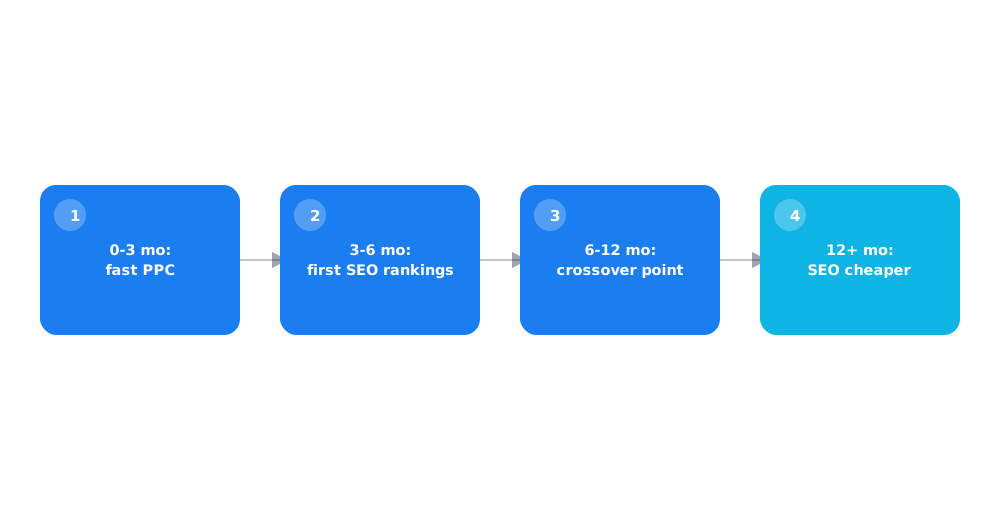
| 0-3 months | First leads within days, stable cost per lead | Keyword and content setup, almost no leads yet |
| 3-6 months | Cost per lead stabilizes or rises with competition | First rankings on narrow queries, leads start arriving |
| 6-12 months | Cost per lead doesn't fall without more budget | Cost per lead falls as rankings improve |
| 12+ months | Linear: no budget, no leads | A steady stream of leads with little added cost |
The point where SEO becomes cheaper per lead depends on the niche, competition, and paid search budget — there's no universal number of months, and it needs to be estimated for the specific market.
06 When to start with PPC and when with SEO
The right entry point depends on the business's actual situation at the start, not preference.
- Start with Google Ads if leads are needed in month one, the product or service is new with no sales history to test assumptions against, or the site isn't technically ready for SEO.
- Start with SEO when the ad budget is limited, the planning horizon is a year or more, and the niche has measurable organic demand for B2B queries.
- Run both from day one if the budget allows — PPC produces real demand and conversion data within the first weeks that can then guide SEO keyword prioritization.
07 How to run both channels without spreading budget too thin
Running both channels works best when data from one informs decisions in the other, rather than running them fully independently.
Queries that already convert well in Google Ads are a strong signal for SEO content priority: if paid traffic for a specific phrase converts well, ranking organically for the same query pays off faster. The reverse also holds — pages that pull organic traffic but convert poorly signal that the commercial page they link to needs work. Figuring out which channel brings more valuable leads, not just more of them, relies on the ROI methodology covered in calculating marketing ROI.
08 FAQ
Which pays off faster for B2B — Google Ads or SEO?
Google Ads produces the first leads faster, within days of launch. SEO pays off more slowly at first but lowers cost per lead over a 6-12 month horizon and beyond, since organic rankings don't charge per click.
Can a B2B company get by with just one channel?
Technically yes, but most B2B companies benefit from combining both: paid search produces fast demand and conversion data that then helps prioritize SEO keywords toward the most profitable queries.
Why is cost per click often higher in B2B than B2C?
Because a single deal is worth enough to competitors that they'll pay more per click on narrow commercial queries, and overall traffic volume for those queries is lower than in mass-market B2C niches.
How long does B2B SEO take to start producing leads?
There's no universal timeline — it depends on niche competition, the site's current state, and how much organic demand exists for B2B queries. General SEO timelines are covered in a separate article on how long SEO takes.
How do I use Google Ads data to prioritize SEO?
Look at which specific query phrasings already convert well in ads, and prioritize organic growth for those first — paid traffic gives a fast read on demand and lead quality before committing to SEO content.
What should a B2B company with a very tight marketing budget do?
Start with whichever channel solves the more urgent problem: Google Ads if leads are needed right now, SEO if the planning horizon is a year or more and there's time to wait for results.