

Most SEO advice online is written with an online store or a local business in mind: capture high-volume queries, speed up conversion, shorten the path to purchase. For a B2B company — an equipment supplier, a manufacturer, a contractor — that logic doesn't hold up well: the customer doesn't buy in one visit, the decision isn't made by one person, and the query that matters might be searched by 20 people a month nationwide.
01 How B2B SEO differs from B2C
The key difference isn't in the technical side of optimisation — that's the same for any site — it's in the logic of choosing keywords and building content. A B2C buyer often decides alone, and fast; a B2B customer researches a question for weeks or months, comparing several suppliers in parallel.
Three practical consequences follow: a keyword's value in B2B is set by the size of the potential deal, not its search volume — a query with 20 monthly impressions for one specific material grade can lead to a contract worth hundreds of thousands; content needs to demonstrate technical competence, not just sales copy; and the path from a first visit to an inquiry can span weeks, which makes simple last-click attribution unreliable.
02 A long sales cycle and multiple decision-makers: the effect on content
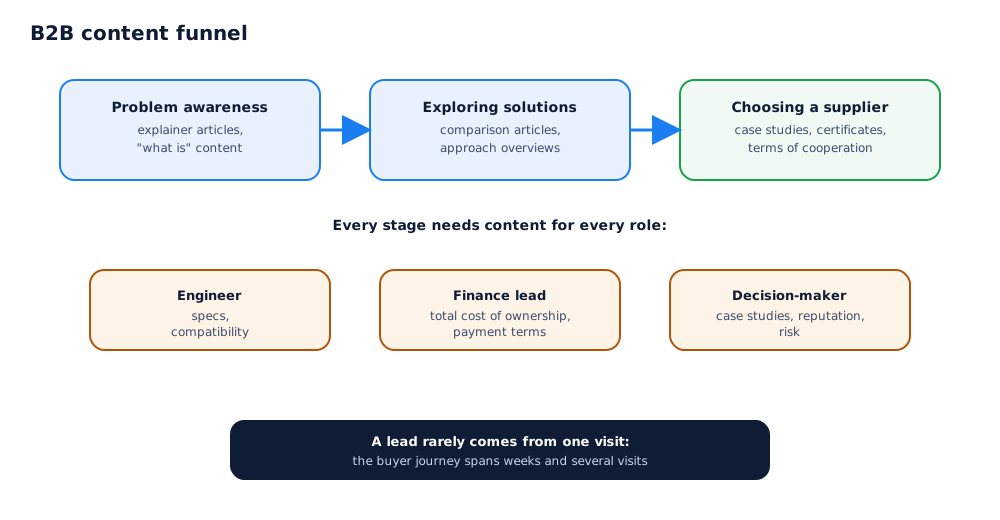
A purchasing decision in B2B is rarely made by one person — usually a team of specialists is involved, each with different priorities: a technical expert evaluates specs and compatibility, a finance lead looks at total cost of ownership and payment terms, and a decision-maker weighs the supplier's reputation and risk.
The site and its content need to answer each of those roles separately, not just one averaged "buyer": technical specs and documentation for the engineer, total cost of ownership and terms for the finance lead, case studies and certifications for the person making the final call. Content aimed at only one of these profiles loses the part of the audience that genuinely influences which supplier gets chosen.
03 B2B keyword research: low- and mid-volume commercial queries
Keyword research for B2B follows the same core process covered in the general guide to building a keyword list, but with a different focus at the selection stage: prioritising how closely a query matches a real buyer's profile over raw search volume.
B2B keyword research puts extra weight on: queries built around specific part numbers, SKUs, and material grades, written by people who already understand the product and are ready to buy; industry technical terminology and standards; and procurement phrasing like "supplier", "wholesale", "custom order", which signal commercial intent immediately. High-volume generic queries in this space often bring in students, competitors, or private individuals — an audience that will never convert, so chasing that traffic for its own sake usually isn't worth it in B2B.
04 Content by funnel stage: from "what is" to "compare suppliers"
A B2B buyer moves through several distinct information needs before ever requesting a quote, and each stage calls for a different type of material.
A working content structure for the funnel: at the awareness stage, "what is" articles and explainer content about the technology or product category itself; at the consideration stage, comparison articles and approach overviews that answer "how do I solve this problem"; and at the supplier-selection stage, case studies with measurable results, certifications, terms of cooperation, and direct comparisons against alternatives. How to turn that sequence into an actual plan instead of a pile of disconnected articles is covered in the guide to building a content plan for a blog.
05 Technical pages, case studies, and white papers as SEO assets
In B2B, content formats that other niches treat as secondary often become the main source of organic traffic and trust at the same time.
Technical specification and documentation pages rank for the narrow queries that procurement staff and engineers actually search — there's barely any competition for them, because writing them requires real expertise. Case studies with concrete results serve as social proof for every role in the buying committee at once. And in-depth industry material (white papers, guides) reinforces a company's standing as an expert — exactly what Google's guidance on creating helpful, people-first content asks for. A real example of this approach in practice is covered in the equipment supplier case study.
06 Local and industry SEO for B2B
Even companies that operate nationwide or export their products often underuse the local side of SEO: most B2B customers still have some preference for a supplier in the same region, or at least one with predictable logistics.
Practical steps here include setting up and filling out a Google Business Profile even without a storefront, as long as there's an office or warehouse a client could visit; building dedicated pages for the regions the business actually supplies, when the geography justifies it; and stating shipping terms and service areas explicitly on the site, since that's one of the first things a prospective buyer wants to know.
07 How to measure B2B SEO results
A simple traffic-to-lead calculation works worse in B2B than in other niches, because the customer journey rarely fits into one visit and one last-click channel.
A more accurate picture comes from a few different angles: not just lead count but lead quality — how many actually reach real negotiations; assisting visits — how many times a prospect returned to the site before reaching out, and from which pages; and time-to-lead, which in B2B can be measured in weeks. That kind of analysis needs the site connected to a CRM, not just a form-submission counter; the general principles of setting up cross-channel analytics are covered in the article on calculating marketing ROI. If building that system alone isn't feasible, it can be handled as part of a broader SEO campaign.
If the B2B product is specifically a SaaS product, extra nuances apply — product-led growth, CAC and LTV metrics, and picking a first channel at launch are covered in the marketing for SaaS and IT startups guide.
SEO in B2B plays the long game, while paid advertising can cover shorter stages of that same long sales cycle — which channels and formats fit is covered in B2B advertising: paid search and social ads in B2B sales.
For a B2B site, the hiring decision matters even more given the long sales cycle; a general comparison of hiring models is covered in SEO agency, freelancer, or in-house specialist.
How fast B2B keywords rank is a common question when choosing a strategy; a comparison of SEO against paid search by payback timeline is covered in Google Ads or SEO for B2B.
08 Frequently asked questions
How long does B2B SEO take?
The first results for low-volume commercial queries usually appear after 3–6 months of consistent work, and a noticeable, stable flow of leads after 6–12 months. That's longer than the average B2C timeline, because of narrower keyword targeting and a longer decision cycle on the customer's side.
Should a B2B company target high-volume keywords at all?
In most niches, no — high-volume queries in B2B often bring students, competitors, or private individuals who will never become customers, not real buyers. Ranking for them costs more and takes longer, and their conversion into an actual deal is far lower than for narrow queries built around part numbers and industry terminology.
Who should write content for a B2B site — a marketer or a technical specialist?
The best results come from a pairing: a technical specialist or engineer supplies the accurate facts and terminology, while a marketer or copywriter shapes the structure, intent, and readability. Content written by a marketer alone, without expert input, reads as shallow to a B2B audience very quickly.
Does a B2B company need a blog if deals close through meetings and tenders?
Yes, because a blog doesn't replace personal selling — it works before it, getting the company onto a buyer's shortlist of potential suppliers while they're still researching on their own. Even when the final decision happens in a meeting, making that shortlist without an organic search presence gets harder.
How do you measure B2B SEO performance when leads are few but valuable?
Track more than lead count — track lead quality and the path to a deal: which pages a prospect visited before reaching out, how many times they returned to the site, and how long passed between the first visit and the inquiry. That kind of analysis needs a CRM and cross-channel attribution, not just a form-submission counter.
Does the same link building approach work for B2B as for regular commercial sites?
Partly. The general quality principles are the same, but in B2B, links from industry publications, trade associations, and professional communities carry extra value — they boost SEO and build the company's reputation with the exact same audience that makes the purchasing decision.