
A SaaS startup almost always has the same problem early on: enough resources for one or two marketing channels, and enough advice online for ten. Before splitting an already tight budget across SEO, paid ads, content, and partnerships, it helps to understand how marketing a SaaS product actually differs from promoting a regular business.
01 How SaaS marketing differs from a regular business
The key difference is not the channels — those are the same — it is the revenue model and what counts as a result. SaaS does not sell a one-off purchase, it sells a subscription, so marketing gets judged not by the number of sales but by how many users keep paying month after month.
That leads to a few practical consequences: acquiring a user who cancels after a month can cost more than not acquiring them at all, which makes lead quality matter more than lead volume; the product usually has a free or demo stage that becomes part of the marketing funnel itself; and customer lifetime value (LTV) plays out over time, which changes how payback is calculated for every channel.
02 Product-led vs. marketing-led growth: what to choose at launch
These are two fundamentally different ways to acquire and convert users, and the choice between them decides where a startup's limited resources should go first.
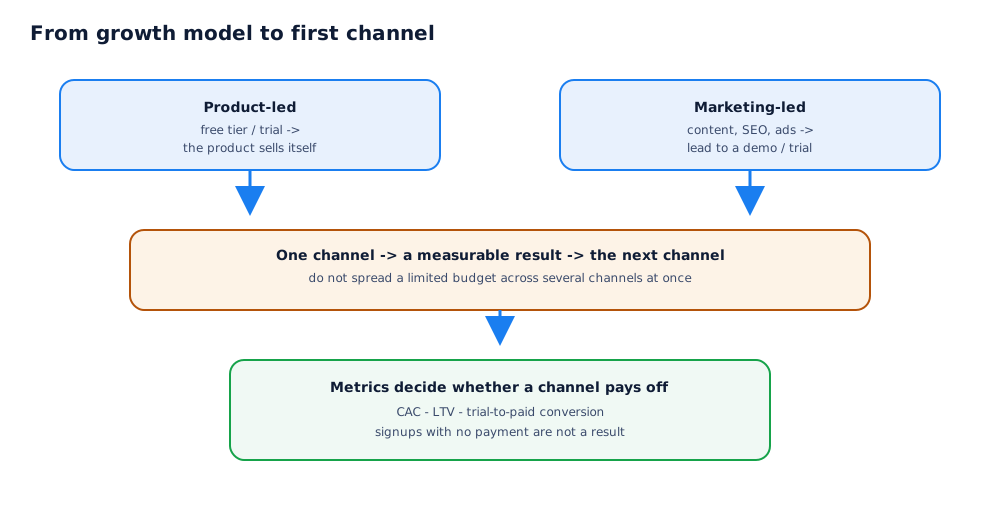
Product-led growth bets on the product itself: a free tier or trial lets a user start working with the product without ever talking to sales, and the purchase decision comes after the product has already proven its value in practice. Marketing-led growth bets on content and communication: a blog, webinars, ads, and direct sales bring a prospect to a trial or a demo. For complex products with a long sales cycle and multiple decision-makers, marketing-led usually works better — the same logic is covered in the article on B2B SEO. For simple, self-serve products with a broad audience, a product-led model is more often the better fit.
03 SEO for SaaS: content by funnel stage
SEO for a SaaS product works more slowly than paid ads, but it produces traffic that does not disappear the moment the budget stops — especially valuable for a startup with limited, inconsistent marketing resources.
Content makes sense to build out by funnel stage: material about the underlying problem and how to solve it, for people who do not yet know this kind of product exists; comparison articles and approach overviews, for people who already understand the problem and are weighing options; and material that directly names the product, including comparisons against specific competitors, for people ready to choose. It is at the top of the funnel that content delivers the most durable long-term traffic, because competition for those queries is usually lower than for the product category's own name. That content only works if it is genuinely useful to the reader rather than written purely for keywords — a core principle Google covers in its guidance on creating helpful, people-first content.
04 Paid traffic for SaaS: where it works and where it does not
Paid ads for SaaS do not perform the same way universally — how well they work depends heavily on how cheaply a user can be acquired relative to how much revenue they ultimately generate.
Paid traffic is usually justified once a product already has data on trial-to-paid conversion — without that data, it is easy to spend a budget on visitors who technically convert into signups but never become paying customers. The landing page an ad sends traffic to needs to be separately optimised for signup conversion — how to structure it is covered in the landing page guide, and Google's requirements for ad landing page quality are covered in the help article on landing page experience and relevance.
05 SaaS metrics: CAC, LTV, trial conversion
For a SaaS product, ordinary metrics like lead count or site visitors give a poor picture of what is actually happening, because they do not account for a customer paying repeatedly, not once.
Three metrics that are hard to do without: CAC — how much it costs to acquire one paying customer across every channel combined; LTV — how much revenue a customer generates on average over their whole time using the product, not just the first month; and trial-to-paid or free-to-paid conversion — usually the single biggest factor in whether an acquisition channel pays off. The general logic for calculating channel payback is covered in detail in the article on calculating marketing ROI.
06 How a startup on a small budget should pick its first channel
With limited resources, trying to develop several marketing channels in parallel almost always means none of them gets pushed far enough to draw a real conclusion about how well it works.
A practical approach is to pick one channel based on the product and audience, take it to a measurable result, and only then add the next one. For a product with a long sales cycle and a well-defined audience, that is usually expert content and SEO; for a product with a broad audience and a low barrier to entry, a product-led model with a free tier; and for a niche B2B product, direct outreach and a presence in the professional communities where the audience already spends time. A real example of this logic in practice is covered in the SaaS startup case study.
07 Common early marketing mistakes for SaaS startups
Most early-stage mistakes are not about picking the wrong channel — they come from trying to cover too much ground with resources that clearly are not enough for it.
The most common ones: launching several channels at once instead of testing one after another; judging marketing by signup count without checking whether those users ever convert to paid; SEO content built around generic niche topics with no connection to the actual product or what sets it apart from competitors; and ignoring LTV and CAC data entirely until the acquisition budget is already spent with nothing to compare payback against. If there are no resources to build a marketing strategy for the startup in-house, this can be delegated as part of an SEO campaign.
08 Frequently asked questions
Which channel should a SaaS product start marketing with right from the launch?
There is no universal answer, but it is usually more sensible to start with whichever channel gives the fastest feedback from real users — that might mean content in niche professional communities or direct outreach, rather than jumping straight into paid ads or large-scale SEO, both of which take time to ramp up.
Does a SaaS startup need SEO if the product is sold through sales calls and demos?
Yes, if the sales cycle is long enough that a prospect has time to research the problem on their own before ever talking to sales. SEO in that case works ahead of sales, not instead of it, putting the company in front of a prospect while they are still researching the problem.
What should you do with almost no marketing budget?
Focus on one channel that does not require direct spend on traffic, most often content and an organic presence in relevant communities. Trying to run SEO, paid traffic, social, and partnerships all at once with limited resources usually means none of them ever gets pushed far enough to show results.
How do you know a marketing channel is actually working?
Look beyond lead count to CAC and whether those leads convert into paid subscriptions, not just free signups. A channel that produces plenty of signups but rarely turns them into paying customers is usually bringing in the wrong audience, even if it looks effective on top-line metrics.
How long before SEO shows results for a SaaS product?
The first organic traffic for low-competition queries usually shows up after 3–4 months, and a noticeable flow of signups from search after 6–9 months of consistent work. That is slower than paid traffic, but the result is more durable and does not disappear the moment the budget stops.
Can product-led and marketing-led approaches be combined?
Yes, and most mature SaaS companies do exactly that in practice: a free trial lowers the barrier to entry, while marketing content brings new users to that trial in the first place. The difficulty is that early on, with limited resources, spreading effort across both approaches at once usually is not realistic.