

01 Short answer
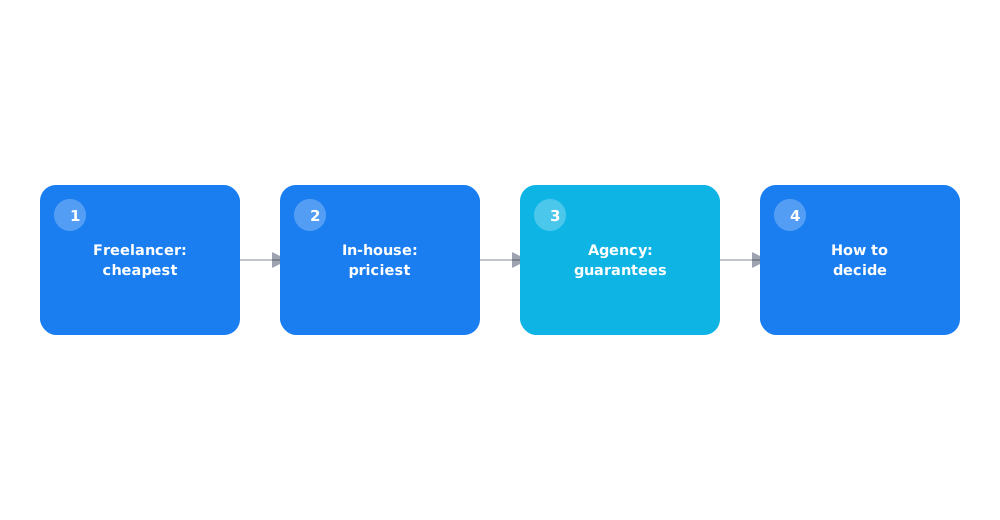
A freelancer is the cheapest option and works for a small site on a tight budget, but adds the risk of depending on one person. An in-house specialist costs the most once you factor in a workstation, training, and benefits, and only makes sense with a large, steady workload. An SEO agency sits in the middle or above, but provides a team, processes, and contractual commitments — usually the most predictable option for a mid-size or larger business.
Below, each option is broken down separately: when it pays off, its real risks, and how to decide based on your actual business rather than in the abstract.
02 Freelancer: when it pays off and the risks
A freelancer sells their time and skill directly, without a markup for a team or office, which usually makes them the cheapest of the three options. That makes them a logical choice for a small site, a one-off audit, or a clearly scoped project.
- Pros: lower cost, direct communication with no middleman, flexibility on scope.
- Cons: dependency on one person — vacation, illness, or juggling too many clients directly slows work down; harder to formalize accountability in a contract; expertise is limited to whatever that one person specializes in.
A freelancer works well for a one-off, well-defined task — a technical audit or setting up a keyword list, for example. For ongoing, comprehensive work, the risk of depending on one person becomes more noticeable.
03 In-house specialist: the real cost and when it's worth it
An in-house SEO hire can look cheaper than an agency if you only compare it to a single salary line, but the real cost is always higher than the nominal rate. It should include a workstation, taxes and benefits, tool subscriptions (Serpstat, Ahrefs, and similar), ramp-up time, and vacation or sick leave, during which work on the site simply stops.
An in-house role pays off when workload is consistently large — a big online store with thousands of product pages, say, that needs ongoing work across content, technical SEO, and analytics every day. For a site with 5–10 services, that volume of work rarely adds up to a full-time role — the specialist either sits idle or ends up handling tasks outside SEO.
04 SEO agency: what you get for the fee
An agency sells a team and a process, not one person: a technical specialist, a copywriter, a link-building specialist, and an analyst work together instead of one person trying to cover every angle alone. Google's own SEO Starter Guide notes that bringing in outside help makes sense when a business lacks the in-house expertise or time — which is exactly what an agency sells through a wider range of coverage without a drop in quality.
- Pros: a team with varied expertise, backup coverage if one specialist is out, and formal contractual commitments with KPIs.
- Cons: usually costs more than a freelancer, communication may run through a project manager rather than directly with whoever does the work, and quality depends heavily on the specific agency rather than the model in general.
Telling a strong agency from a weak one before work starts deserves its own breakdown — the criteria and red flags are covered in detail in how to choose a targeting or PPC specialist, and most of that logic applies to picking an SEO vendor too.
05 Comparing price, speed, and risk
Putting all three models into one table makes it easier to compare them against the same criteria instead of relying on scattered impressions.
| Criterion | Freelancer | In-house | Agency |
|---|---|---|---|
| Cost | Low | High (all costs included) | Medium–high |
| Time to start | Fast | Slow (hiring and ramp-up) | Medium |
| Breadth of expertise | Limited to one person | Limited to one person | A team with multiple roles |
| Downtime risk | High (vacation, illness) | Medium | Low (backup coverage) |
| Formal guarantees | Weak | Internal company KPIs | Contract and SLA |
No single column wins across every row — the right choice always depends on your site's scale, budget, and how critical uninterrupted progress on SEO is for the business.
06 How to decide for your business
Instead of an abstract "which is best," it helps to look at common scenarios and pick the one closest to your situation.
- A startup or small services site with a tight budget — usually a freelancer for one-off tasks (an audit, keyword setup) plus occasional consulting.
- A mid-size online store with a growing budget — an agency, since technical work, content, and link building are all needed at once.
- A large site with thousands of pages and a constant stream of tasks — an in-house hire or a hybrid: in-house covers day-to-day work, and an agency steps in for specific projects like a technical audit or large-scale link building.
- A B2B site with a long sales cycle — expertise in content and keyword prioritization matters especially here, covered in detail in SEO for a B2B site.
Combining models is normal practice: many companies keep an in-house marketer who owns the process and the data, while outsourcing the actual SEO work to an agency or specialized freelancers.
07 Can you combine models
In practice, the lines between the three models aren't always rigid. An in-house marketer can act as the owner and reviewer of the strategy, while specific work — an audit, link building, technical optimization — gets outsourced to an agency or specialized freelancers. That often strikes a better price-quality balance than trying to cover every skill with a single in-house hire.
Before picking a specific vendor under any of these models, it's worth confirming the site is actually technically ready for promotion — a basic checklist is in a self-run SEO audit, and a general roadmap is in how to rank a site on Google yourself.
08 FAQ
Which is cheaper — a freelancer or an agency?
A freelancer is almost always cheaper on paper, since they sell their time without a markup for a team. But the comparison should factor in downtime risk and the limits of one person's expertise — an agency's broader expertise sometimes pays for itself through faster results.
When does an in-house SEO specialist actually beat an agency?
When workload is consistently large and steady — a big online store with continuous content and technical work, for example. For a site with a handful of services, an in-house role often sits idle or expands beyond SEO.
Can I start with a freelancer and move to an agency later?
Yes, that's a common path: a freelancer handles one-off tasks at the start (an audit, initial setup), and as the business grows and needs get more complex, an agency with a broader team takes over.
How does an agency guarantee results in a contract?
Through KPIs and SLAs written into the contract — timelines, scope of work, areas of responsibility. Important: neither an agency nor an in-house specialist can guarantee a specific search ranking — Google doesn't give that guarantee to anyone.
How much does an in-house SEO specialist really cost?
The real cost usually runs 30–50% above the nominal salary once you add tool subscriptions (Serpstat, Ahrefs, and similar), a workstation, taxes, and ramp-up time for a new hire.
What should a B2B site with a long sales cycle choose?
B2B especially rewards expertise in prioritizing keywords and content for different stages of the deal — that specifics is covered in the guide to SEO for B2B, and an agency experienced in B2B often outperforms a generalist freelancer.