

01 Short answer: what to look for
A good targeting or PPC specialist stands out not through talk of a "custom approach," but through specifics: real case studies with numbers, questions about your business before quoting a price, willingness to give you access to the ad account, and a clear explanation of how they'll measure success. Vague answers in the first meeting are a signal to keep looking.
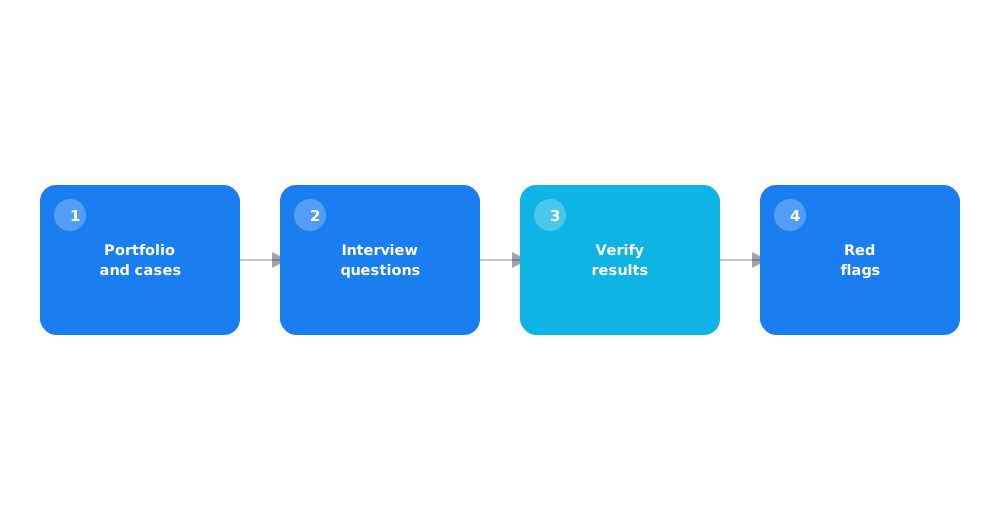
Below is a step-by-step checklist: where to start when choosing a working format, what to ask in an interview, how to check a portfolio, and which warning signs matter before you sign anything.
02 Freelancer, agency, or in-house — where to start
Before evaluating a specific person, it helps to decide on a working format — it shapes both the price and how carefully you need to vet.
- Freelancer. Usually the cheapest option and works well for a single project with a clear scope. The risk is depending on one person: if they get sick or take on too many clients, your campaigns sit unattended.
- Agency. Provides a team and backup coverage if a key specialist is out, plus more formal contractual commitments. Usually costs more than a freelancer but lowers the risk of downtime.
- In-house hire. Makes sense when ad campaign volume is large and steady — for example, several active product lines for an online store. It's the most expensive option once you factor in a workstation, taxes, and training.
For a small or mid-size business with one or two ad channels, a freelancer or agency is usually the more rational choice — an in-house role pays for itself once there's consistently enough work to fill full-time hours.
03 What portfolio and case studies to ask for
A portfolio is the first thing people look at, and it's also the easiest place to be misled by a polished deck with no real numbers behind it. What matters is the structure of the case study, not a list of recognizable brand logos.
- the case describes a specific goal and starting conditions, not just a flattering end result;
- there are before-and-after numbers — cost per lead, ROAS, CPA — not just a screenshot of rising impressions;
- the time period is stated: a one-month result and a six-month result mean very different things;
- there are cases in a similar niche, or at least a similar sales model (services, e-commerce, B2B).
If a candidate sends a PDF of well-known client logos with no numbers inside, that's a client list, not a case study. Ask to see at least one breakdown with real metrics, even anonymized by project name.
04 8 questions to ask in an interview
The questions below quickly separate a specialist who understands the business logic of advertising from one who only knows how to click buttons in an interface.
- How will you measure the results of our advertising, and which metrics matter most?
- What audience and creative hypotheses will you test in the first month?
- How often do you optimize campaigns, and what do you look at when you do?
- How do you set up conversion tracking — pixel, Conversions API, CRM?
- How many other projects are you running in parallel right now?
- What's your plan if the first month doesn't hit expectations?
- Who owns the creative work — you, a separate designer, or is that on me?
- What does your weekly or monthly report actually look like?
Pay attention not just to the answers, but to whether the specialist asks you questions back about your business, audience, and current sales numbers. Someone who quotes a fee right away without asking about the project is likely running a one-size-fits-all playbook.
05 How to verify real results, not a polished deck
Numbers in a slide deck are easy to draw up; verifiable access to data is harder to fake. A few ways to confirm case study results are real:
- ask for a screenshot of the ad account for a specific period, not just a summary table;
- ask whether you can reach out to a current or past client for a short reference;
- compare the claimed ROAS or CPL against general market benchmarks for your niche — an unexplained result that's dramatically better is worth questioning;
- agree on a 1–2 month trial period with clearly defined success metrics before committing long term.
A trial period is the most reliable way to test in practice. Write down in advance which metrics, and what range, count as success, so there's no argument a month in about whether the result was actually good.
06 Red flags in a targeting or PPC specialist's work
A few signals almost always point to trouble, either before work starts or in the first weeks after.
- Guaranteeing a specific result. No one can guarantee an exact CPL or ROAS before launch — there are too many variables: seasonality, competition, product fit.
- Refusing to grant ad account access. It's your account and your data — the specialist should work inside your Business Manager with a role you assign, not in an account you can't see.
- One audience, no testing, for months. A lack of hypothesis testing signals that not enough time is going into the account.
- Vague reporting. A report built only from reach and impressions, with no link to sales or leads, is theater, not analysis.
- Going silent the moment problems come up. A specialist who disappears at the first tough question is likely avoiding an uncomfortable conversation.
It also helps to check how technically sound a specialist is with the ad account itself: the basics, like a correctly configured Meta Pixel, are covered in Meta Pixel and Business Manager — if a candidate can't explain why that matters, take it as a warning sign.
07 What a good specialist costs
Price shouldn't be the deciding factor, but it helps to know the market so you don't overpay — or hire someone who physically can't give your account enough time for what they're charging.
A full breakdown of pricing models and what should be included in the service is covered in how much managing paid ads costs. If you're weighing an in-house hire against a freelancer or agency, the same decision logic applies to SEO hiring — compared in SEO agency, freelancer, or in-house specialist.
08 FAQ
How can I quickly tell a targeting specialist isn't good?
The first sign is quoting a fee without asking anything about your business. The second is a portfolio with client logos but no numbers. The third is guaranteeing a specific CPL or ROAS before campaigns even launch, which is physically impossible to predict with precision.
Should I give a targeting specialist access to my ad account?
Yes, that's standard practice: the account and its data are yours, and the specialist should work inside it with an admin or editor role. Refusing to work inside your own account is a serious red flag.
How long does it take to judge a new specialist's work?
A reasonable trial period is 1–2 months with success metrics defined in advance. A shorter window often doesn't produce enough data for a fair judgment, especially while audiences and creatives are still being tested.
Does niche experience matter more than general experience?
Experience with a similar sales model (services, e-commerce, B2B) matters more than literal experience in your exact niche. A specialist who understands how to sell that kind of offer adapts quickly to a new topic if they're strong on data and testing.
Can I trust a case study with a high ROAS but no details?
Not without the time period, starting conditions, and how the metric was calculated. A high ROAS over one week on a warmed-up audience and one over six months from zero are very different achievements that can't be compared without context.
Is an in-house specialist better than an agency for paid social?
Not necessarily — an in-house hire pays off with a large, steady volume of campaigns that justifies full-time work. For one or two channels, an agency or freelancer is usually cheaper at comparable quality.