
Advertising for B2B works differently than for a retail buyer: the decision isn't made by one person, but often several — from the specialist searching for a solution to the manager who approves the budget. The sales cycle can stretch over months, and the audience with the right job title or industry is an order of magnitude narrower than for a mass-market product. Below: how paid search and social ads work in B2B, how to set up audiences, and how to judge results when a lot of time passes between a click and a deal.
01 Short answer
B2B advertising doesn't run on the same playbook as B2C — the logic shifts in a few specific ways.
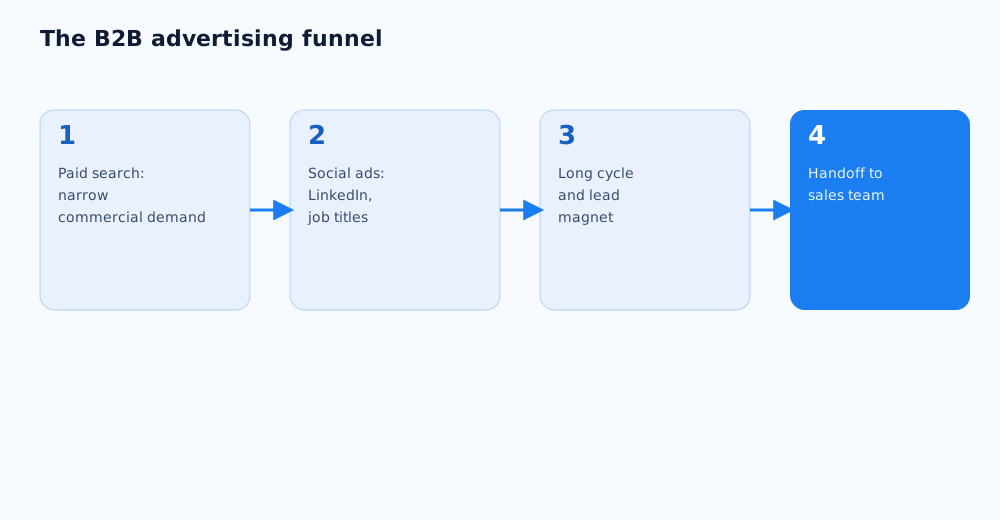
- Paid search works well for queries with clear intent to solve a specific business problem — it captures demand that's already formed.
- Social ads in B2B more often build awareness and repeat touchpoints than generate a direct lead from the first impression.
- Audiences are better narrowed by industry, job title, or company size than targeted with broad demographics.
- Results need judging across the whole funnel, not just direct leads — from first touch to the actual deal, which can take months.
Below: the detail behind each channel, and how to put this into practice.
02 How B2B advertising differs from B2C
The difference between B2B and B2C advertising isn't just a "less exciting" product — it changes the actual mechanics of how a purchase decision gets made.
- Multiple decision-makers. The person who clicked the ad is often not the one who approves the budget — the decision passes through several people at the company.
- A long sales cycle. Weeks or months can pass between first touch and a signed contract, not minutes, like an impulse purchase.
- A narrow audience with low search volume. Far fewer people search for specialised queries in a specific B2B niche than for a mass-market product, so traffic volume is physically lower.
- A higher cost of a mistake. A decision to buy equipment, software, or a service worth tens of thousands of dollars needs more justification than buying a t-shirt, so the ad needs to do more than earn a click — it needs to establish the supplier's credibility.
A similar logic applies to organic promotion too — covered in detail in B2B SEO: how to promote complex products and services.
03 Paid search for B2B
Paid search in B2B works best where a prospect has already phrased a query tied to a specific business problem, rather than a vague interest in the topic.
- Queries with clear commercial intent ("X supplier for business", "implementing system Y") usually deliver better leads than broad informational queries.
- The landing page needs to answer "why this company specifically", not just describe the product — in B2B, trust in the supplier often matters more than the feature list.
- Long, niche-specific keyword phrases are usually cheaper and more precisely targeted than short, generic, highly competitive terms.
- The specifics of audience targeting in paid search, including custom segments by interest and intent, are covered in Google Ads help on custom segments.
04 Social ads for B2B
Social ads rarely produce a direct lead from the first impression in B2B, but they do another important job — keeping the brand visible to the right audience throughout a long decision cycle.
- The format works well for building awareness among a narrow circle of decision-makers in a specific industry, even before they have an explicit need.
- Expert content — case studies, breakdowns, industry analysis — performs better in social ads than direct sales pitches, because B2B decisions are built on trust in expertise.
- Remarketing is especially effective in B2B: someone who visited the site but didn't submit a lead can come back after a few more touchpoints through social ads — the general principle is covered in retargeting and remarketing: what it is and how to set it up.
05 Setting up audiences for B2B
Targeting precision matters more than reach in B2B — showing ads to an irrelevant audience costs more here than in mass-market niches, since the cost per click for a narrow professional audience is usually higher.
- Interest and behaviour targeting tied to an industry. Paid search platforms support custom segments built from keywords, sites, and apps characteristic of the target professional audience.
- Remarketing by funnel stage. Visitors who looked at pricing are different from those who only read the blog — they're worth running as separate segments rather than one blended remarketing list.
- Lookalike audiences based on current customers. If there's a base of existing B2B customers, a lookalike audience built from it is usually more precise than random demographic targeting — the full setup is covered in lookalike audiences on Facebook and Instagram.
- A general overview of how audience segments work in Google Ads is in Google Ads help on audience segments.
06 Measuring results with a long sales cycle
Judging B2B advertising only by the number of leads in a given month is an easy way to reach the wrong conclusion — some of this month's leads won't close into a deal until a quarter later, or longer.
- Track lead quality, not just lead count — what share moves on to the next funnel stage, not just whether a form got filled in.
- Intermediate micro-conversions — downloading a case study, booking a demo, a repeat site visit — help judge a campaign's performance before enough deals have actually closed.
- Connecting ad data end-to-end with a CRM that tracks the deal's real status gives a far more reliable picture than reports inside the ad platform alone.
- Exactly which metrics to track at each funnel stage is covered in KPIs for paid search and social ads.
07 Common mistakes in B2B advertising
Most failed B2B campaigns don't fail because of a weak product — they fail because B2C ad logic got applied to a context where it just doesn't work.
- Expecting a fast payback. Judging a campaign a month after launch, when the niche's sales cycle runs a quarter, almost always leads to a false conclusion that it's not working.
- Targeting too broadly. Trying to reach as many people as possible instead of the narrow circle of actual decision-makers spreads the budget across an irrelevant audience.
- A sales-y tone with no expertise. Ads and content written like they're for a retail buyer earn less trust with a B2B audience, which is looking for proof of competence, not an emotional trigger.
- No connection to the sales team. If marketing doesn't know what happens to leads after handoff to sales, there's no way to judge the real effectiveness of the advertising.
If it's worth building an advertising strategy around a long B2B sales cycle, this work can be handed off — see Grottix's paid search and social ads services.
Paid search delivers fast leads, but the long-term payback question comes down to a comparison with SEO, covered in Google Ads or SEO for B2B.
08 FAQ
Which works better in B2B — paid search or social ads?
There's no single answer — paid search captures demand that's already formed around specific queries, while social ads build awareness and repeat touchpoints across a long sales cycle. In most B2B niches, combining both channels beats betting on just one.
How long does it take to judge B2B advertising performance?
It depends on the niche's typical sales cycle — if a decision takes months, judging a campaign 2-3 weeks after launch is almost always premature. It's smarter to watch intermediate signals — lead quality and funnel progression — before enough deals have actually closed.
Do social ads work for narrow B2B niches?
Yes, but more as an awareness and repeat-touchpoint tool than direct lead generation. For very narrow professional audiences, targeting precision matters more than reach, so interest-based segments, remarketing, and lookalike audiences built from current customers tend to work better than broad demographic targeting.
How do I know a lead is genuinely qualified rather than random?
Look past whether the form got filled in, to whether the lead moves on to the next funnel stage — a scheduled call, a product demo, a proposal. Connecting ad data to a CRM shows this more accurately than reports inside the ad platform alone.
Does B2B advertising need a separate site or landing page?
Not necessarily a separate site, but the landing page needs to answer questions that matter specifically to a B2B buyer — company track record, case studies, terms of engagement — rather than being a generic page written for a retail shopper.
How does narrow B2B targeting affect cost per click?
It usually raises it — the more precise and narrow a professional audience, the higher the competition for it among the handful of advertisers in that niche. That's offset by higher traffic quality: fewer clicks from an irrelevant audience that was never going to become a customer.