

KPIs in paid search and social ads get confusing not because there are too few metrics, but because there are too many and not all of them matter at once. A metric that's critical for a brand-awareness campaign is nearly useless for a performance campaign focused on direct sales, and vice versa. Below: which KPIs to track at different stages of the funnel and the campaign, so the dashboard shows decisions instead of just numbers.
01 Short answer
The right set of KPIs depends on the campaign's goal, not one fixed list for every launch.
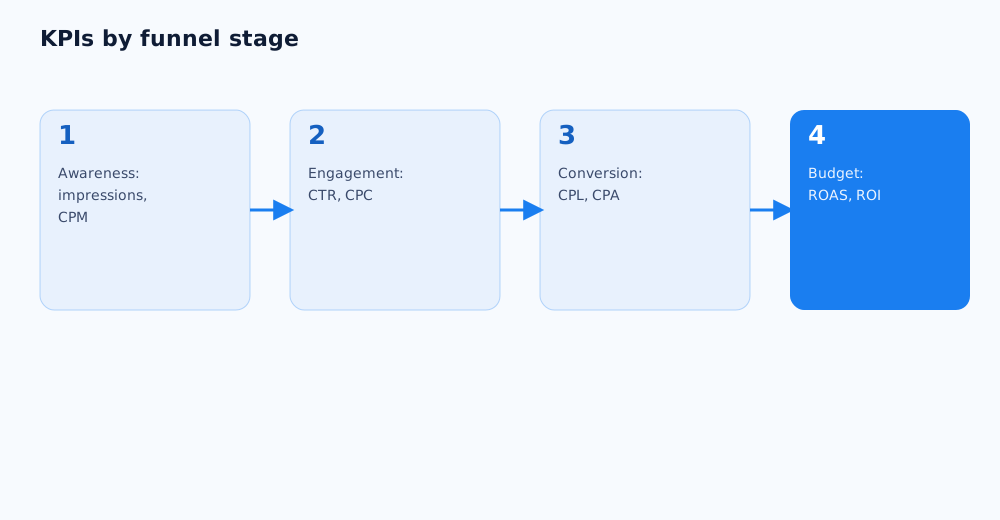
- Awareness campaigns — track impressions, reach, frequency, and cost per thousand impressions (CPM).
- Traffic and engagement campaigns — CTR, cost per click (CPC), and how deeply visitors engage on the landing page.
- Conversion campaigns — conversion rate (CR), cost per lead (CPL), and cost per action (CPA).
- Overall budget efficiency — ROAS and final return on investment (ROI), not individual per-channel metrics.
Below: why mixing these groups is the most common cause of bad conclusions, and what to track in detail at each stage.
02 The main mistake when choosing KPIs
The most common mistake is using the same set of metrics for campaigns with different goals, which leads to decisions based on numbers that don't actually reflect that specific campaign's success.
- Judging a brand-awareness campaign by cost per lead — it was never aimed at direct leads, so a "bad" CPL here isn't a sign of failure.
- Judging a performance campaign only by reach — wide reach with no conversions doesn't move the business closer to sales if sales is the actual goal.
- Comparing CPC across different funnel stages — the cost of a click on a hot commercial search term and on a broad awareness audience simply aren't comparable.
The right approach is to define the specific campaign's goal first, then pick 3–5 metrics that actually reflect it, instead of watching every available number at once.
03 KPIs for awareness
At the stage where the audience is just getting introduced to the brand, conversion metrics are nearly meaningless — what matters is how many people saw the ad and how often.
- Impressions. The total number of times the ad was shown — the baseline measure of campaign reach volume.
- Reach. The number of unique people who saw the ad at least once — a more accurate picture of actual audience size than impressions alone.
- Frequency. The average number of times one person saw the ad — too high a frequency usually signals audience fatigue and falling performance.
- Cost per thousand impressions (CPM). The base unit of price for reach, useful for comparing awareness campaigns against each other.
04 KPIs for engagement and traffic
Once the audience already knows the brand, the next stage is capturing attention and pulling them to the site, which is where ad-interaction metrics come into play.
- CTR (Click-Through Rate). The share of impressions that turned into a click — a direct signal of how relevant the ad is to its audience and how strong the creative is.
- Cost per click (CPC). How much one visit to the site costs — driven by how much competition there is for the audience and the quality of the ad itself.
- Bounce rate and time on site. Show how well the landing page matches the expectations the ad set — a high CTR paired with a high bounce rate usually means the ad's promise and the page's content don't match.
05 KPIs for conversion
Once the goal is leads or sales, reach and engagement metrics become secondary, and metrics directly tied to business results move to the front.
- Conversion rate (CR). The share of visitors who completed a target action — the baseline indicator of how well the ad-plus-landing-page combination turns traffic into results.
- Cost per lead (CPL). How much a single lead costs — the formula and reduction tactics are covered in detail in cost per lead: how to calculate and reduce it.
- Cost per action (CPA). A broader concept than CPL — can refer to a purchase, a signup, or another configured action, depending on the campaign's goal.
- Tracking conversions by channel separately. Setting up tracking at the campaign and ad-group level, not just the account level, shows exactly which combination is driving the result.
06 KPIs for budget efficiency
A separate group of metrics answers not "how many people saw the ad" but "is the money invested paying off", and these are usually the numbers a business owner cares about most, not just the person running the ads.
- ROAS (Return on Ad Spend). Revenue generated per unit of ad spend — the key metric for online stores and any business selling directly through ads.
- ROI (Return on Investment). A broader payback measure that accounts for the cost of the product or service, not just ad spend — covered in detail in how to calculate marketing ROI.
- Ad spend as a share of revenue. The percentage of revenue spent on advertising — a quick way to check whether ads are eating into the business's margin.
07 Building one dashboard
Metrics are only useful once they're pulled into one place and updated regularly — scattered data from different ad platforms is hard to compare, and hard to act on in time.
- Connect every ad channel to a single analytics system, like GA4 — how to set that up is covered in setting up Google Analytics 4 from scratch.
- Use UTM tags to split traffic precisely by channel and campaign, rather than relying only on each ad platform's built-in attribution.
- Pick 5–7 key metrics for a regular weekly check-in and save the rest for a deeper monthly review — trying to watch dozens of numbers at once usually means none of them get watched carefully.
If it's worth building one consistent KPI-tracking system across every ad channel, this work can be handed off — see Grottix's paid search and social ads services.
08 FAQ
Which KPIs matter most in paid search and social ads?
There's no single list — a metric's importance depends on the specific campaign's goal. Reach and frequency matter more for a brand-awareness campaign, while CPL, CPA, and ROAS matter more for a performance campaign. The mistake is applying the same set of numbers to every campaign regardless of its goal.
How many metrics should be tracked at once?
For regular monitoring, 5–7 key metrics tied to the campaign's goal are usually enough. The rest are useful for a deeper one-off analysis, but constantly watching dozens of numbers usually lowers decision quality rather than improving it.
How is ROAS different from ROI?
ROAS shows revenue per unit of ad spend and doesn't account for the cost of the product or service. ROI is a broader measure that includes all production or service costs, not just advertising, so it reflects real profitability more accurately.
How do I know if an awareness campaign is actually working?
Look at reach, frequency, and cost per thousand impressions (CPM) rather than conversions, plus the delayed effect — a rise in branded search terms or direct site visits some time after the campaign ran.
Should the same KPIs be tracked in Google Ads and social ads?
The broad categories (awareness, engagement, conversion, budget efficiency) match, but the specific metrics and how they're calculated differ between platforms. Channels are best compared through a single analytics system, not each platform's own built-in reporting.
How often should the set of tracked KPIs be reviewed?
It's worth reviewing whenever the campaign's goal or the business's stage changes, rather than on a fixed schedule. Moving from a new product launch (awareness) to scaling sales (conversion), for example, changes the whole set of key metrics.