

CPL (Cost Per Lead) is how much a business spends to acquire a single lead — a call, a submitted form, a message in chat. The metric is simple to calculate but easy to misread if it's looked at apart from lead quality and the rest of the sales funnel. Below: the formula, how CPL differs from its neighbouring metrics, what drives the price of a lead, and practical ways to bring it down.
01 Short answer
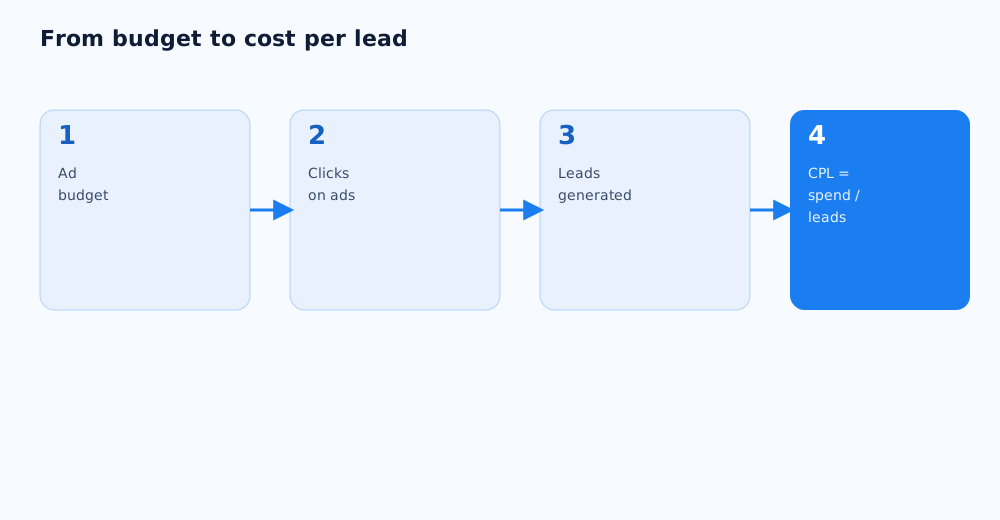
CPL follows a simple formula: ad spend for a period divided by the number of leads generated in that same period.
- Example: an ad budget of $1,000 for the month produced 60 leads — CPL comes out to about $16.70.
- The spend side should include more than just the ad budget itself — the cost of the specialist or agency running it too, if the goal is the real cost of acquisition, not just the click price.
- There's no universal "good" CPL — it varies enormously by niche, region, and product type, so it's more useful to track the trend in your own numbers than to chase someone else's average.
Below: the formula in more detail, the neighbouring metrics, and practical ways to lower CPL without losing lead quality.
02 The CPL formula
The basic CPL formula is simple: CPL = ad spend ÷ number of leads. The complexity isn't in the arithmetic — it's in deciding exactly what belongs in the numerator and what counts as a lead in the denominator.
- Spend should include the full ad budget for the period, not just the campaigns that worked — failed tests are still part of the cost of acquisition.
- Only genuine expressions of intent should count as a lead — a form, a call, a message — not any interaction like a click or a newsletter signup, if the goal is to measure the cost of an actual prospect.
- With more than one channel running, CPL is worth calculating separately for each — a single blended CPL across all channels hides which one is actually performing better.
A deeper breakdown of this and other advertising metrics is in ROAS, ACoS, CPL and CPA explained in plain words; here the focus is CPL specifically — how to calculate and lower it precisely.
03 CPL, CPA, CAC, and CPC — the difference
These metrics get mixed up often because they're all about cost of acquisition, but each measures a different step of the funnel.
- CPC (Cost Per Click) — the cost of a single click on an ad, before the visitor has done anything on the site yet.
- CPL (Cost Per Lead) — the cost of a lead, meaning the first concrete expression of interest from a prospect.
- CPA (Cost Per Action) — the cost of a target action, which can be broader than a lead: a purchase, a signup, an app install, depending on how the campaign goal is configured.
- CAC (Customer Acquisition Cost) — the full cost of acquiring an actual paying customer, including every lead that never converted into a sale.
The gap between CPL and CAC matters most: a low CPL says nothing about profitability if only a small share of leads convert into customers — the real cost of acquiring a customer (CAC) can end up far higher than CPL alone suggests.
04 What drives CPL
CPL is shaped by several factors at once, and lowering it without understanding them usually turns out to be temporary, or comes at the cost of quality.
- Acquisition channel. Paid search targeting hot demand usually runs a higher CPL than social ads on a colder audience, but lead quality in paid search is often higher too.
- Competition in the niche. The more advertisers competing for the same audience, the higher the click cost — and CPL along with it.
- Landing page quality. A low-converting page raises CPL even with an unchanged click cost — see how to structure a high-converting landing page for the details.
- Seasonality and region. Demand and competition shift throughout the year, so CPL is better compared with the same period a year earlier than with the previous month.
05 How to reduce CPL
Lowering CPL almost always comes down to one of two paths: reducing click cost, or raising the conversion rate from click to lead — a durable result usually comes from working on both at once.
- Check and set up a negative keyword list in Google Ads if part of the budget is going toward irrelevant clicks that never turn into leads.
- Run a Google Ads account audit to find systemic issues in campaign setup, rather than only tweaking bids by hand.
- Improve the landing page — the form, the offer, load speed — page conversion rate multiplies directly into the final CPL.
- Narrow targeting toward an audience with higher buying intent, even if that lowers overall reach — fewer impressions, but a higher share of clicks that turn into leads.
06 Low CPL vs low-quality leads — telling them apart
Chasing a lower CPL without watching quality is a common mistake that quietly hurts real business results, even when the ad report looks good.
- Widening the audience or simplifying the lead form almost always lowers CPL, but it also lowers the share of leads genuinely ready to buy.
- What matters is tracking both CPL and the lead-to-sale conversion rate — if that rate drops alongside CPL, the savings are an illusion.
- It's worth tracking both metrics together and judging a channel's efficiency by its final return on investment (ROI), not the price of a lead alone.
07 Tracking CPL by channel
For CPL to be a useful metric for decisions rather than just a number in a report, it needs to be calculated separately by traffic source, not just for the business as a whole.
- Set up separate conversion tracking for each channel — paid search, social ads, organic search — to see each one's real contribution.
- Use UTM tags and a single analytics system so data from different ad platforms rolls up in one place for a fair comparison.
- Compare CPL over time within one channel, not just across different channels — a rising CPL in a single channel over time often signals audience fatigue or rising competition.
If it's worth figuring out why CPL is rising, or calculating it precisely for a specific situation, this work can be handed off — see Grottix's paid search and social ads services.
CPL is just one of the metrics worth tracking depending on the campaign stage; the full breakdown of KPIs by funnel stage is in KPIs for paid search and social ads.
If a meaningful share of leads comes in by phone rather than through a form, an accurate CPL calculation needs call tracking — how to set it up and connect it to cross-channel analytics is covered in a separate article.
The same calculation logic applies to marketplace sales if you swap "lead" for "order" — paid promotion tools there are covered in advertising on Prom.ua and Rozetka Ads.
A CPL estimate matters most when testing a new niche with no existing benchmark for lead cost — how to turn that into a full test budget is covered in how much budget you need to test a niche.
08 FAQ
What counts as a good CPL?
There's no universal benchmark — an acceptable CPL depends on average order value, margin, and lead-to-sale conversion rate in a specific niche. It's better judged through overall payback than in isolation: if CAC and ROI stay within a healthy range for the business, the exact CPL figure matters less on its own.
How is CPL different from CPA?
CPL is specifically the cost of a lead — the first concrete expression of interest from a prospect (a form, a call). CPA is a broader concept, the cost of any target action, which might match a lead or might mean a purchase, a signup, or an app install, depending on how the campaign goal is configured.
Can CPL be lowered without losing lead quality?
Yes, if the reduction comes from a better landing page, more precise negative keywords, or narrower targeting toward a relevant audience — not from widening reach or simplifying the lead form. The first path improves efficiency; the second usually trades quality for a lower price.
How do I calculate CPL when running several channels at once?
CPL is best calculated separately for each channel using dedicated conversion tracking and UTM tags, rather than producing one blended figure across the whole ad budget. A blended CPL hides which channel is actually generating cheaper, better-quality leads.
Should a marketer's salary be included in the CPL calculation?
For evaluating a specific ad campaign, it's usually enough to count only the ad spend. But if the goal is the full cost of acquiring a customer for the business, the cost of the specialist or agency running it belongs in the calculation too — at that point it's closer to CAC than to pure CPL.
Why does CPL rise over time with an unchanged budget?
The most common causes are audience fatigue from the same ads, rising competition in the niche, or a seasonal shift in demand. Regularly auditing campaigns and refreshing creatives and negative keywords helps catch and correct this drift before it goes too far.