
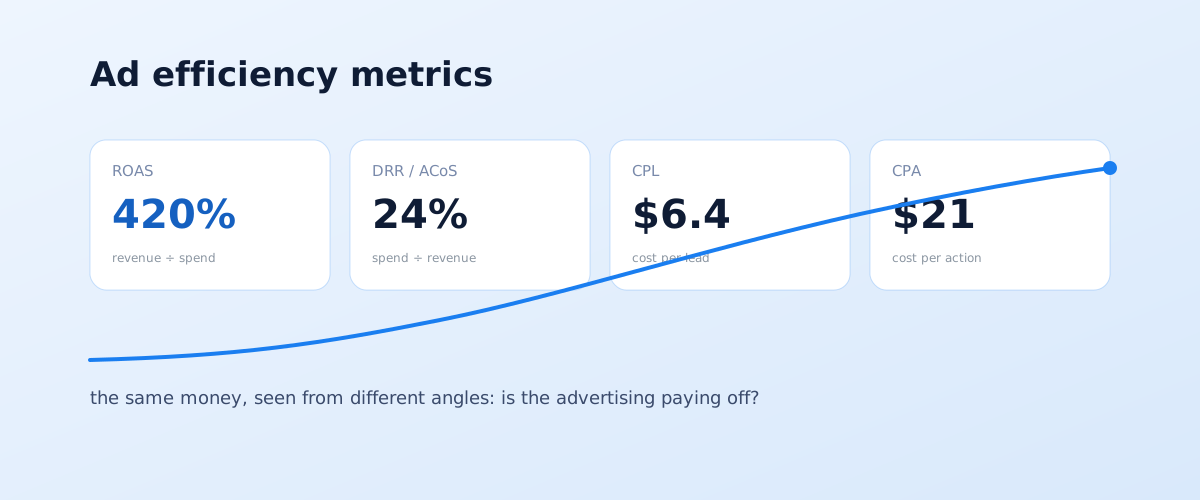
ROAS, ACoS, CPL, CPA, ROMI, CAC — behind these acronyms is one question: is the advertising making the business money, or just creating the appearance of activity. The problem is that the metrics are easy to mix up, and one of them — ROAS — regularly misleads even experienced owners. Below we break down each formula in plain words, show how they differ, where the main trap is hidden, and how to work out in five minutes whether your advertising actually pays off.
01 The short answer: what each metric shows
All the metrics in this article fall into three groups: how much acquisition costs, whether the investment pays off, and how good the traffic is. Below is a summary, and then each group is broken down in detail with formulas and examples. You do not need to hold all of them in your head: for a specific task, two or three are usually enough.
| Metric | What it shows | Formula |
|---|---|---|
| CPC | Cost of a click on the ad | spend ÷ clicks |
| CPM | Cost of 1,000 impressions | spend ÷ impressions × 1,000 |
| CPL | Cost of an enquiry (lead) | spend ÷ number of leads |
| CPA | Cost of a target action | spend ÷ number of actions |
| CAC | Cost of acquiring a paying customer | all acquisition costs ÷ new customers |
| ROAS | Return on ad spend (on revenue) | ad revenue ÷ ad spend |
| ACoS / DRR | Ad cost as a share of revenue | ad spend ÷ ad revenue |
| ROMI | Return on marketing investment (on profit) | (profit − marketing spend) ÷ marketing spend |
| ROI | Return on all investment (on profit) | (profit − all costs) ÷ all costs |
| CTR | Click-through rate of the ad | clicks ÷ impressions |
| CR | Conversion rate to a target action | actions ÷ visits |
02 Cost metrics: CPL, CPA, CPC, CPM, CAC
This group answers the question "how much do we pay for a result". Every metric here is spend divided by a count of something, and they differ only in what they count as a unit of result. The further down the funnel the event sits, the more it costs and the closer it is to real money.
How they relate to each other:
- CPM — the cost of a thousand impressions. The base metric for reach campaigns; on its own it says nothing about sales.
- CPC — the cost of a click. It shows how much it costs to bring a person to the site, but not what they do there.
- CPL — the cost of a lead, meaning any enquiry: a form, a call, a request. The first metric that speaks to interest.
- CPA — the cost of a target action you designate as the main one. Often a lead, but it can also be a paid order — then CPA is close to the real cost of a customer.
- CAC — the cost of acquiring a paying customer including all costs: ads, the team's work, tools. The most honest metric for assessing the economics.
The practical point of telling them apart is that you should optimise the metric that is closest to money and for which you already have enough data. Chasing a low CPC is pointless if cheap clicks do not turn into leads; relying on CAC alone is impossible at the start, when paying customers number in the single digits.
03 Return metrics: ROAS, ACoS, ROMI, ROI
This group answers the main question — did the invested money come back, and how much on top. Here it matters not to mix the metrics up, because they are calculated from different quantities: some from revenue, some from profit, some for one channel, some for the whole business.
ROAS and ACoS — the same thing from two sides
ROAS is ad revenue divided by ad spend, expressed as a percentage or a multiple. A 400% ROAS means every unit of currency invested returned four in revenue. ACoS (also called DRR) is the same pair of numbers the other way round: spend divided by revenue. A 25% ACoS means a quarter of revenue went to ads. Mathematically ACoS equals one divided by ROAS: a 400% ROAS is always a 25% ACoS. You do not need to calculate both, one is enough; ACoS is more convenient because you compare it directly with the product margin.
ROMI and ROI — the difference
ROMI and ROI are calculated on profit, not revenue, and that is fundamental. ROI is the return on all investment: from profit you subtract every cost, including buying the product, salaries and rent, and divide by those costs. ROMI is the same but counts only marketing costs. ROMI shows whether marketing as a function pays off, ROI whether the business as a whole does. Both ROAS and ACoS are simplified channel metrics, while ROMI and ROI are business metrics, and their levels must not be confused.
04 The ROAS trap: revenue is not profit
The most common mistake with ROAS is treating any value above 100% as a success. ROAS is calculated on revenue, not profit, so a campaign with a 300% ROAS can be deeply unprofitable if the product is low-margin. If the margin is 20%, then from 300 in revenue you get just 60 in gross profit — and you spent 100 on ads. A loss.
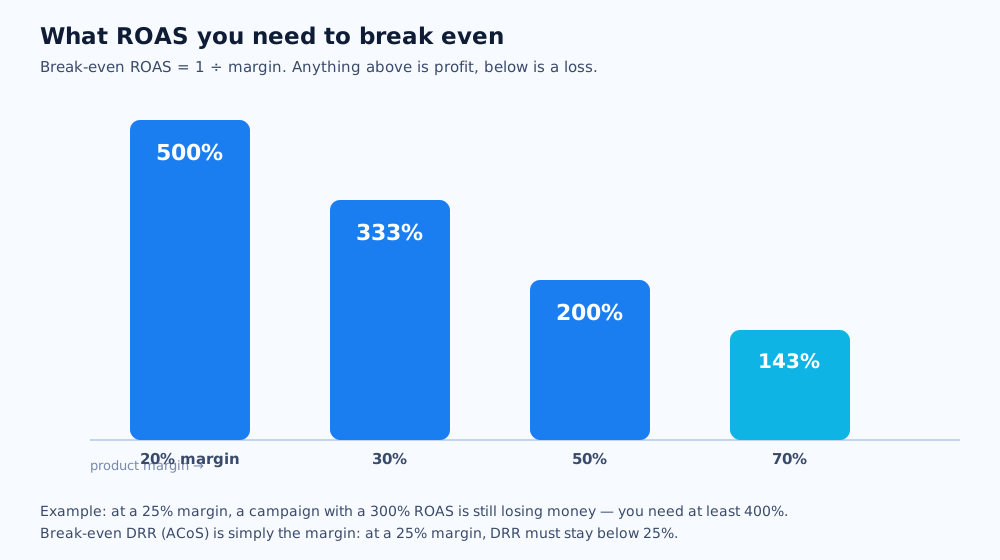
The rule is simple: break-even ROAS = 1 ÷ margin. At a 25% margin you need a ROAS of at least 400%, at a 50% margin 200% is enough. Anything above that line is profit. For ACoS the line is simpler still: break-even ACoS equals the margin itself. If the margin is 25%, any ACoS below 25% means the channel is in the black.
05 Traffic-quality metrics: CTR, CR, LTV
This group is not about money directly but about how well each step of the funnel works. They help you see where the result is lost when the cost per lead turns out too high.
- CTR — the share of people who clicked the ad out of those who saw it. A low CTR usually means the offer or the creative does not resonate with the audience.
- CR — the conversion rate: the share of visitors who took the target action. A low CR with a normal CTR points to a problem on the landing page or in the form.
- LTV — the total profit from one customer over the whole relationship. LTV is needed to work out how much you can pay for acquisition at all: if a customer's LTV is 5,000, a CAC of 1,000 is fine.
The CAC-to-LTV ratio is the basis of a healthy acquisition economy. The benchmark used most often: LTV should exceed CAC by at least three times, otherwise almost nothing is left for operations, tax and profit.
06 Which metrics to watch for which goal
A mistake is to track every metric at once and with equal attention. The set of key indicators depends on what you sell and the campaign goal. Below are the typical scenarios.
- Online store, direct sales. The key metrics are ROAS or ACoS against the margin, and CAC against LTV. CPC and CTR are supporting.
- Services and B2B, lead generation. The key ones are CPL and CPA, plus the landing-page CR. ROAS is harder to calculate because time passes between the lead and payment and salespeople are involved.
- Reach campaign, awareness. The key ones are CPM and reach; applying sales metrics to such a campaign is incorrect — its job is not leads but recall.
- SEO. ROAS and ACoS are calculated from the cost of work over a period, not from a per-click budget. The key indicator is ROMI over a 6–12 month horizon and a falling cost per lead month over month. More on timing in the article how long does SEO take.
07 A worked example with real numbers
To tie it all together, let us calculate the payback of a sample campaign step by step. Say an online store spent 10,000 on ads over a month, got 50,000 impressions, 1,000 visits, 80 leads, of which 20 became paid orders with an average order value of 2,500 and a 30% margin.
| Metric | Calculation | Result |
|---|---|---|
| CPM | 10,000 ÷ 50,000 × 1,000 | 200 |
| CPC | 10,000 ÷ 1,000 | 10 |
| CTR | 1,000 ÷ 50,000 | 2% |
| CPL | 10,000 ÷ 80 | 125 |
| CR to order | 20 ÷ 1,000 | 2% |
| CPA (per paid order) | 10,000 ÷ 20 | 500 |
| Revenue | 20 × 2,500 | 50,000 |
| ROAS | 50,000 ÷ 10,000 | 500% |
| ACoS | 10,000 ÷ 50,000 | 20% |
| Gross profit | 50,000 × 30% − 10,000 | 5,000 |
| ROMI | 5,000 ÷ 10,000 | 50% |
The takeaway: a 500% ROAS looks impressive, but the break-even ROAS at a 30% margin is 333%, so the real profit is 5,000 and ROMI is only 50%. The campaign is in the black, but the buffer is thin: a one-third rise in cost per lead already takes it to zero. That is exactly why you should look at ACoS against the margin and at ROMI, not just at a good-looking ROAS. Google describes how conversion measurement is set up and order value is passed through in its conversion tracking help; the definition of a conversion as a metric is in a separate help article.
If you would rather not work through your own project's numbers alone, you can start with Grottix services or with the breakdown of SEO vs PPC, where the same metrics are applied to choosing a channel. And if the ads are already running but the numbers do not add up, the article why your targeted ads are not working will help.
All these metrics are calculated from analytics data, which depends on correct setup: how to set up GA4 is in the article on Google Analytics 4, and how to tag traffic so channels don't get confused is in the one on UTM parameters.
How to build overall channel payback from these metrics and not confuse it with ROAS is covered in the article on how to calculate marketing ROI.
Before calculating these metrics, it is worth confirming that the site itself is in good shape in Google Search, which is what the Google Search Console guide covers.
A deeper dive into one of these metrics specifically is in cost per lead (CPL): how to calculate and reduce it.
Which of these metrics to track at each specific stage of a campaign — from awareness to conversion — is covered in KPIs for paid search and social ads.
08 Frequently asked questions
How is ROAS different from ROI?
ROAS is calculated on revenue and for a single channel (usually ads): it is ad revenue divided by ad spend. ROI is calculated on profit and across all investment: profit minus all costs, divided by those costs. ROMI is the in-between: profit relative to marketing spend only. ROAS shows channel efficiency, ROI shows whether the business as a whole pays off.
What counts as a good ROAS?
There is no universal benchmark: a good ROAS depends on the margin. The minimum acceptable ROAS is the break-even point, equal to one divided by the margin. At a 25% margin, break-even ROAS is 400%; at a 50% margin, 200%. Anything above that line is profit.
Are ACoS and ROAS the same thing?
They are the same data seen from two sides. ROAS is revenue divided by spend, as a percentage. ACoS (also called DRR) is spend divided by revenue, as a percentage. ACoS equals one divided by ROAS. A 400% ROAS is a 25% ACoS. Both answer the same question; ACoS is just easier to compare with the margin directly.
What is the difference between CPL and CPA?
CPL is the cost of a lead — any enquiry: a form, a call, a request. CPA is the cost of a target action you designate as significant: it can be a lead, or it can be a paid order. CPL is always earlier in the funnel and cheaper, CPA is closer to the money. Separately, CAC is the cost of acquiring a paying customer including all costs.
Which matters more — ROAS or ACoS?
ACoS is more convenient for decisions because you compare it directly with the margin: if ACoS is below the margin, the channel is profitable. ROAS is used more in reports and ad platforms. You do not need both — one is enough, the other follows from it in a second.
How do these metrics apply to SEO?
SEO has no cost per click, so ROAS and ACoS are calculated not from an ad budget but from the cost of work over a period. CPL and CPA in SEO fall over time, because the spend was in the past and the traffic is in the present. The key SEO metric is ROMI over a 6–12 month horizon and the month-over-month trend in cost per lead.