

01 Short answer: why marketing needs a CRM
A CRM isn't just a sales tool for managing a customer list — it's the only real way to see which ads bring in actual paid deals, not just leads. Without one, marketing sees the number of leads and their cost, but not how many of them turned into revenue, which is what ultimately decides whether the ad spend is justified.
Below: criteria for choosing a CRM for a small or mid-size business, how to technically connect it to ad accounts, and how to use that data to calculate real ROI rather than just a lead count.
02 Why a CRM matters to marketing, not just sales
A sales team uses a CRM to avoid losing customers and to keep a record of conversations. For marketing, the same system solves a different problem — closing the loop from an ad click to actual revenue.
- without a CRM, ads get optimized for lead count rather than lead quality — cheap leads that never convert look just as good in an ad account report as expensive ones that actually buy;
- a CRM holds each deal's status, from first contact through payment or rejection, and that data can be passed back into ad platforms as offline conversions;
- without a CRM connection, there's no accurate way to calculate real ROI by channel, campaign, or even a specific ad — the methodology is covered in calculating marketing ROI.
03 Selection criteria for a small or mid-size business
Choosing a CRM for a business with a limited team and budget differs from choosing one for a large company — an impressive, powerful-looking system can turn out to be overkill and simply go unused without a dedicated administrator.
- Easy to set up without a dedicated admin. If setup requires an in-house developer, the risk that the CRM ends up underused goes up.
- Ready-made integrations with ad platforms and messengers. A built-in module for Google Ads, Meta, or a specific messenger saves time and money over building one from scratch.
- A mobile app for reps. If part of sales happens over the phone on the road or in meetings, no convenient mobile access quickly becomes a reason deals don't get logged in time.
- A clear pricing model with no hidden limits. Caps on contacts or deals in a free or basic tier can unexpectedly stop growth if they aren't checked in advance.
04 Setting up lead handoff from Google Ads and Meta
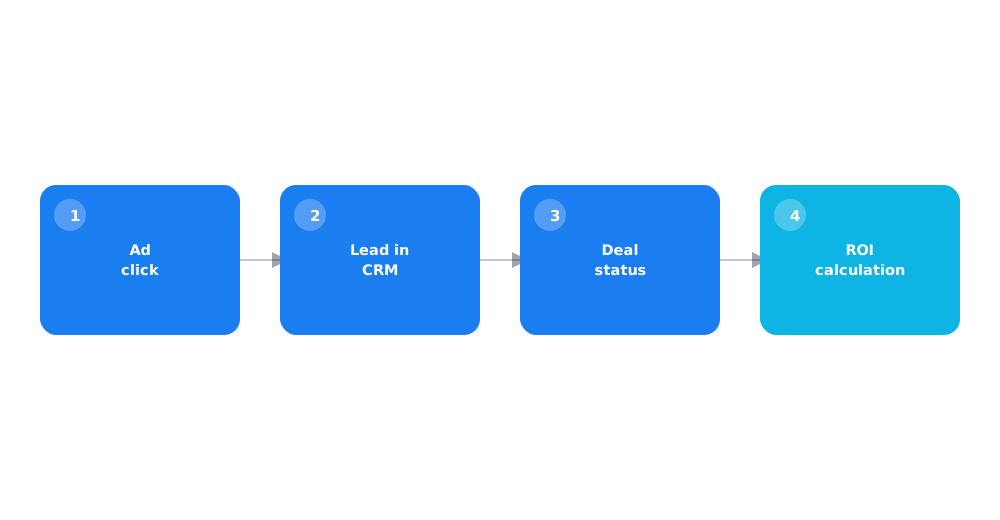
Data flows both ways between ads and a CRM: a lead moves from the ad into the CRM, and the deal's status later flows back into the ad platform as a conversion.
- Set up the site's form or chat so a submission automatically creates a lead record in the CRM, not just an email to a rep.
- Pass source parameters along with the submission — UTM tags, a campaign ID — so the CRM shows which channel a specific lead came from.
- Set up offline conversion import in Google Ads so a deal's CRM status (won, lost) flows back into the ad account and factors into bid optimization.
- For Meta ads, the same task is handled through the Conversions API — covered in more detail in Meta Pixel and Business Manager.
05 Connecting a CRM to phone calls
If a meaningful share of leads come in by phone rather than through a form, simply passing form submissions isn't enough — calls need their own technical connection.
Call tracking identifies which ad channel a caller came from, but that information is only useful once it lands in the same CRM where a rep logs the deal status. How to build that connection and pass calls into ad platforms as conversions is covered in detail in cross-channel analytics and call tracking — the CRM becomes the central point where data from the site and from calls both converge.
06 How to calculate ROI from CRM data
CRM data turns an ROI calculation from a lead-based estimate into one based on real revenue — the difference between "how much did the lead cost" and "how much money did the channel actually bring in, net of what was spent on it."
That calculation needs, at minimum, the closed deal amount and the source the customer came from. If a deal has a long cycle — common in B2B — its CRM status needs updating as it moves through the funnel rather than being logged once at first contact, or the ROI calculation ends up built on incomplete data. The formula itself and common mistakes in it are covered in calculating marketing ROI.
07 Common implementation mistakes
Most CRM problems come not from picking the wrong system, but from how it gets rolled out and used by the team in practice.
- Rolling it out with no rep training. If staff keep logging some deals in a notebook or messenger alongside the CRM, the data for analytics stays incomplete.
- No required lead-source field. Without an explicit requirement to log channel and campaign when a deal is created, that data quickly gets lost or filled in as an afterthought.
- Manual data entry instead of integration. Copying submissions from email into the CRM by hand is a source of errors and delays that undermines the whole point of connecting it to ads.
- Setting up the integration once with no follow-up check. A site or ad account update can quietly break the data flow with no obvious error in the interface.
Another lead source worth logging into a CRM right away is chatbot conversations on a site or in a messenger; how to set that up is covered in chatbots and first-touch automation.
08 FAQ
Does a small business with few deals need a CRM?
Yes — even with a small deal volume, a CRM helps avoid losing conversation history and, importantly for marketing, shows which ad channel actually brings in customers, not just leads.
How do I pass deal status from a CRM back into Google Ads?
Through offline conversion import: the CRM exports deal data (won, lost) tied to a click or campaign identifier, and Google Ads counts it as a conversion for bid optimization.
Can a CRM connect to Facebook and Instagram ads?
Yes, through Meta's Conversions API — it passes conversion data, including offline events from a CRM, back into the ad account for more accurate campaign optimization.
What matters more when choosing a CRM — features or ease of setup?
For a small or mid-size business, ease of setup usually matters more than a wide feature set — a complex system reps don't fully use produces no analytics data regardless of how many features it has.
How does a CRM help calculate ad ROI?
A CRM stores the closed deal amount and its source, which makes it possible to calculate actual return from a channel net of what was spent on it, rather than just cost per lead — a lead-only calculation can't reach that precision.
What if B2B deals take months to close?
The deal's status in the CRM needs to update as it moves through the funnel rather than being logged once at first contact — otherwise the ROI calculation ends up built on incomplete, outdated data.