

01 Short answer: what first-touch automation solves
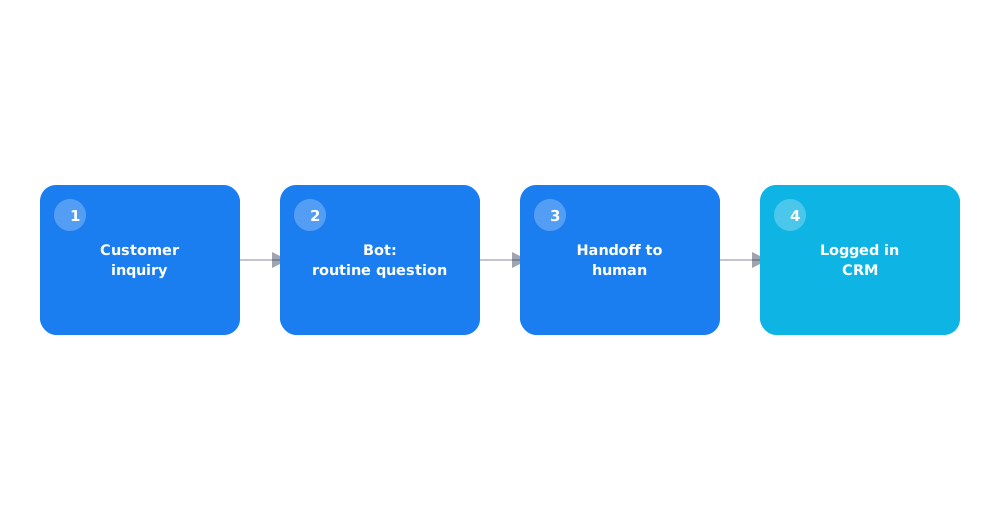
First-touch automation closes the gap between the moment a customer messages or calls and the moment a real person starts working with them. A bot answers routine questions instantly, gathers basic details about the request, and hands off the conversation to a rep when needed — instead of a customer waiting minutes or hours, especially outside business hours.
Below: where it makes sense to place a bot, when simple rules are enough without AI, what a bot should handle well versus what always needs a human, and how to connect it to a CRM and ads so lead data doesn't get lost between systems.
02 What first-touch automation actually solves
The point of first-touch automation isn't replacing a rep entirely — it's closing the most common point where a customer gets lost: a delayed response right when interest is highest.
- an instant reply outside business hours, when there's physically no rep available;
- sorting inquiries by type before a conversation reaches a person, saving rep time on routine questions;
- gathering basic customer details — name, contact info, the gist of the request — before handing the conversation to a person;
- reducing load on reps during peak hours when many inquiries arrive at once.
03 Where to place a chatbot: site, messengers, social media
Choosing where to put a bot should follow where first contact actually happens, not wherever is technically easiest to install it.
- A site widget. Fits when a customer is already on a landing page and ready to ask a follow-up question before submitting an inquiry.
- Messengers. Make sense if customers already message on Viber, Telegram, or WhatsApp — a comparison of these channels for a Ukrainian business is covered in Viber, Telegram, or WhatsApp.
- Social media. Fit when the bulk of inquiries come from comments or DMs on Instagram or Facebook rather than the site itself.
Deploying a bot on every platform at once without real inquiry volume on each is a common mistake that spreads resources thin across several integrations for little visible benefit.
04 Simple rules vs. AI bots: when each approach fits
Not every first-touch automation task needs a sophisticated AI — often a simpler solution is more reliable and predictable.
- A rule-based bot fits when the set of questions is limited and predictable: business hours, product availability, order status, a basic intake form. It doesn't make mistakes outside its script, because it simply doesn't try to go beyond it.
- An AI bot is worth it when customer questions vary widely and scripting every scenario in advance isn't realistic — a consultation on a complex product with many variations of the same question, for example.
An AI bot with no clear boundaries risks confidently giving a wrong answer where a rule-based bot would simply say "I don't know, let me connect you with a specialist" — often a more serious problem for a business than the apparent simplicity of a rule-based bot.
05 What a bot should handle well, and what needs a human
A clear split of responsibilities between a bot and a human lowers the risk of a customer getting stuck in a conversation the bot can't actually resolve.
- A bot handles routine, repetitive questions well when the answer doesn't depend on a specific customer's context.
- A bot should explicitly recognize when a question falls outside its scope and offer to connect to a person right away, rather than guessing.
- A human is required wherever the decision affects price, deal terms, or needs an individual read on the customer's situation.
- The handoff from bot to human needs to keep the conversation's context — asking the customer to repeat the same information annoys them and undermines trust in the automation as a whole.
06 Connecting a bot to a CRM and ads
Data a bot gathers at first touch is only useful if it lands in the same system a rep later manages the deal in — not stuck in isolation inside the bot's own interface.
Every bot conversation is worth automatically logging as a lead record in a CRM, tagged with its source — which ad campaign or channel the customer came from — so marketing can see which ads actually bring in inquiries, not just clicks. General criteria for choosing a CRM for this and connecting it to ad accounts are covered in how to choose a CRM and connect it to your ads.
07 Common implementation mistakes
Most failed bot rollouts come down not to weak technology, but to a recurring set of mistakes at launch.
- No clear path to a human. If a customer can't quickly escape a bot conversation to a rep, they just leave for a competitor.
- A generic script that ignores the business's specifics. A templated bot copied from a different niche answers formally correctly but doesn't solve real questions from actual customers.
- Launching without a test period. A script never checked against real conversations usually contains dead ends that only surface after customer complaints.
- Ignoring data on where the bot loses customers. Without regularly reviewing conversations, it's hard to know which step of the script needs fixing.
08 FAQ
Does a small business with few inquiries need a chatbot?
Not always — if inquiry volume is low and a rep can reply quickly during business hours, a bot's benefit is limited to covering off-hours. For a business with peak loads or a high volume of routine questions, automation pays off faster.
How is a rule-based bot different from an AI bot?
A rule-based bot works strictly within scripted scenarios and doesn't make mistakes outside them, because it simply doesn't go beyond its scope. An AI bot handles varied questions more flexibly, but without clear boundaries it can confidently give a wrong answer where a rule-based bot would say "I don't know."
Should a bot go on a site or a messenger?
It depends on where first contact actually happens: if customers already message through a messenger, it makes more sense to put a bot there rather than only on a site, where inquiry volume might be lower.
How do I know when to hand a conversation to a human?
A bot should explicitly recognize when a question falls outside its scripted scope and immediately offer a handoff to a rep, rather than trying to guess an answer to a non-standard request.
Does a bot need to connect to a CRM?
Yes — without that, lead data stays isolated inside the bot's own interface, and marketing can't see which ads or channels actually bring in inquiries rather than just clicks.
How do I avoid common mistakes when rolling out a bot?
Always build in a fast handoff to a human, test the script against real conversations before a full launch, and regularly review where customers most often abandon the bot conversation.