

01 Short answer: which messenger to pick
There's no single "best" messenger for everyone — the right choice depends on where your audience actually is and which task matters more: mass broadcasting, one-on-one conversations with customers, or bot automation. Viber has historically had wide reach in Ukraine among older and middle-aged users, Telegram is stronger with an audience used to channels and bots, and WhatsApp is the standard for international business and part of B2B correspondence.
Below is a comparison by concrete criteria — audience, formats, and technical integration with ads and a CRM — so the decision rests on numbers and capabilities rather than personal preference.
02 Audience and reach in Ukraine
The three messengers' audiences in Ukraine aren't evenly distributed, and that's the first thing worth weighing when picking a channel.
- Viber has long been the messenger with the widest reach in Ukraine thanks to an early launch and convenient free calling — particularly strong with the 35+ audience.
- Telegram has grown quickly in recent years, especially among younger, more tech-savvy users, and thanks to news channels.
- WhatsApp is the global standard for corresponding with foreign partners and customers, but has historically been less widespread inside Ukraine than the other two.
It's worth checking audience distribution for a specific niche against actual customers — a short poll through existing contact channels, for example — rather than relying only on country-wide trends.
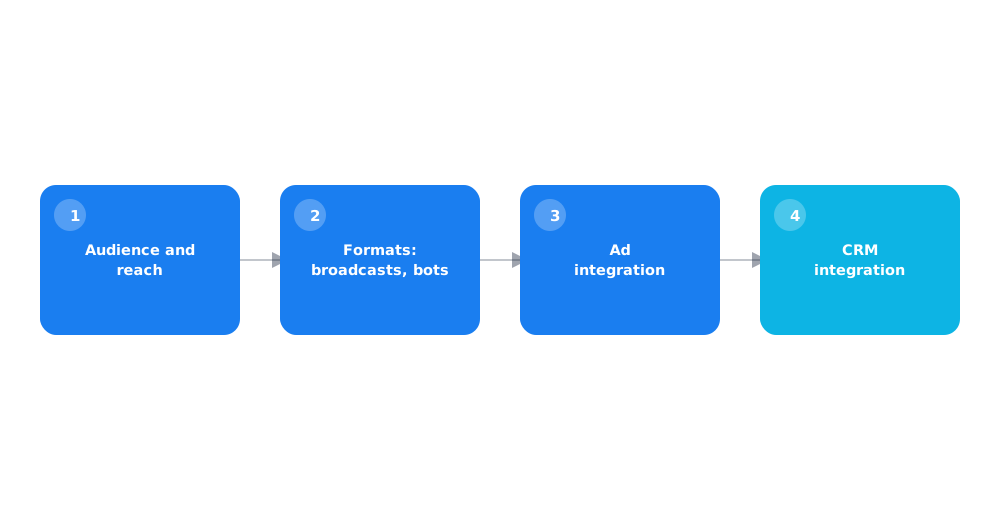
03 Formats: broadcasts, bots, catalogs, chat
The three messengers offer a different set of business tools, and that can be the deciding factor for a specific task.
- Viber offers business broadcasts, chatbots, and public accounts with basic product-catalog elements;
- Telegram is strong on bots (an open, well-documented API), content channels, and community groups;
- WhatsApp, through its Business Platform, supports automated template messages, product catalogs, and CRM integration via the official WhatsApp Business platform.
For simple customer updates (order status, appointment reminders), all three channels work about equally well. For complex, branching bot logic, Telegram usually offers more flexibility thanks to its open API.
04 A comparison table by business task
Putting the three messengers into one table by specific task makes it easier to get your bearings without digging into every channel's details separately.
| Task | Viber | Telegram | |
|---|---|---|---|
| Mass broadcast to a customer list | Strong | Good, via channels and bots | Limited by template policy |
| Chatbot with complex logic | Moderate | Strong (open API) | Good, via Business API |
| Corresponding with foreign customers | Weak | Moderate | Strong |
| Product catalog inside chat | Available | Limited | Available, via Business Platform |
| Ease of launch for a small business | Moderate | Simple | Requires business verification |
No single messenger wins across every row — the choice always comes down to which task matters most for a specific business.
05 Connecting a messenger to ads and a CRM
A messenger with no connection to ads and a customer record system stays an isolated channel that's hard to pull cross-channel sales data from.
- a click on a Facebook or Instagram ad can open straight into a WhatsApp or Viber conversation — that's its own ad format, worth setting up alongside the Pixel and Business Manager;
- after the first contact in a messenger, it helps to pass the number and conversation status into a CRM so conversation history isn't lost when a rep changes;
- reaching back out to someone who's already messaged follows the same logic as classic remarketing — only the delivery channel differs, and the principles are covered in the remarketing and retargeting guide.
06 Which channel to start with
Instead of trying to run all three messengers at once with limited resources, it's more sensible to start with one and expand as load grows.
- A local business with a broad 30+ audience — start with Viber, where reach for this audience in Ukraine has historically been wider.
- A business with a younger audience or a need for complex automation — Telegram offers more flexibility thanks to its open API and familiar bot format.
- A company working with foreign customers or partners — WhatsApp remains the standard for international correspondence.
- A business with no clear priority — start with whichever channel current customers already use to message you, rather than guessing.
07 Legal and technical limits on broadcasts
A mass broadcast on any messenger isn't the same as a one-on-one conversation, and every platform has rules that are easy to break without realizing it.
The WhatsApp Business Platform requires prior approval of message templates for mass broadcasts and limits contact frequency without an explicit reply from the user; similar anti-spam limits apply on Viber and Telegram, though the moderation mechanics differ. Beyond each platform's technical limits, there's also user consent to receiving messages — broadcasting without a customer's explicit consent creates a reputational risk regardless of whether a specific platform technically allows it.
Choosing a messenger is only half the task; how to automate the first reply to a customer there is covered in chatbots and first-touch automation.
08 FAQ
Which messenger is most popular for business in Ukraine?
There's no single leader — Viber has historically had wide reach among the 35+ audience, Telegram is growing fast among younger users, and WhatsApp remains the standard for international correspondence. It depends on where your specific audience actually is.
Can I send unlimited mass broadcasts on WhatsApp?
No, the WhatsApp Business Platform requires prior approval of message templates for mass broadcasts and limits how often you can contact a user without a reply from them — it isn't the same as a one-on-one chat.
Which messenger works best for a chatbot with complex logic?
Telegram usually offers more flexibility thanks to its open, well-documented API, making it easier to build bots with branching conversation logic than Viber or WhatsApp.
Do I need business verification to use these messengers?
For the WhatsApp Business Platform, business verification is usually required for full access to features, including template messages. Viber and Telegram are generally simpler for a small business to launch on without heavy verification.
Can ads open directly into a messenger conversation?
Yes, Facebook and Instagram support an ad format that opens straight into a WhatsApp or Viber conversation — set up through the ad account alongside the Pixel and Business Manager.
Should I run all three messengers at once?
Not necessarily at the start — it's more sensible to begin with the one channel where your audience actually is, and expand as load and the resources to support multiple channels grow.