

01 Short answer: where to actually start
Promoting a business from zero doesn't start with picking a channel — SEO, paid search, or paid social — it starts with a marketing audit: understanding who the customer is, what the business already has, and what competitors are doing. Skip that step and choosing a channel turns into guesswork, and budget often ends up on a platform that fits neither the audience nor the business's stage.
Below are five marketing audit steps in the order that actually produces results: from understanding the customer to picking a specific channel and the metrics you'll use to judge success a few months in.
02 Step 1: understand the customer and where they look for a solution
Before picking a channel, there's a question that sounds obvious but rarely gets spelled out clearly: who specifically buys this product or service, and how does that person actually go about solving their problem?
- does the customer actively search for a solution on Google — then SEO and paid search come into play;
- or do they discover the product by chance, scrolling a social feed — then paid social takes priority;
- how long is the decision cycle — from an impulse purchase in minutes to months of comparing options in B2B.
The answers rarely sit on the surface — they're worth checking against real data on where customers came from in the past, if that history already exists, rather than relying on intuition alone.
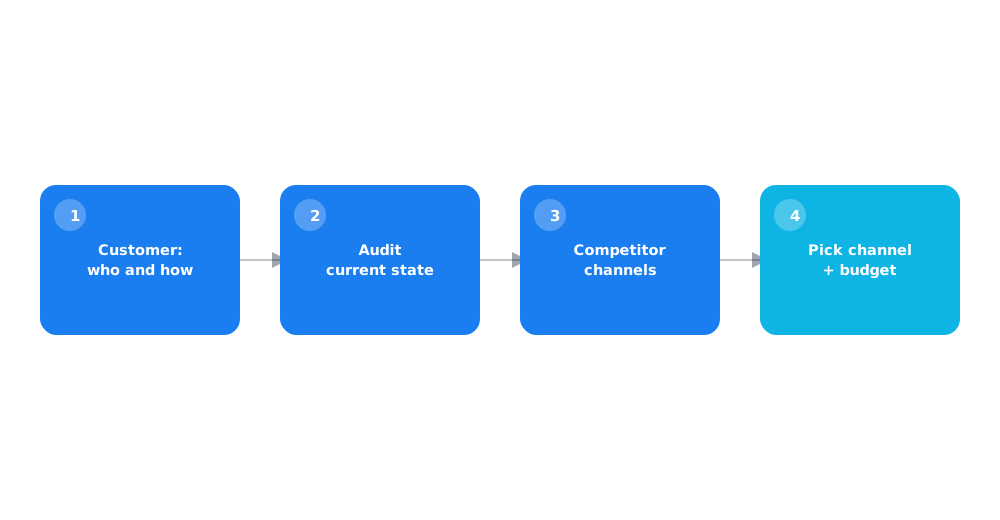
03 Step 2: audit what already exists
Before spending on ads, it's worth honestly assessing whether the business's existing assets are ready to receive that traffic and turn it into customers.
- the site — technically sound, clearly explains the offer, has a working form or way to get in touch;
- social media — actively maintained or abandoned, does it reflect the business's current positioning;
- reviews and reputation — is there negative feedback that would scare off a new customer before first contact;
- analytics — is it even installed, will it be possible to measure the return on future spend.
If the site isn't technically ready to receive traffic, spending on ads or SEO before fixing it risks not paying off — a basic technical breakdown of checking a site yourself is covered in how to rank a site on Google yourself.
04 Step 3: analyze competitors and their channels
Competitors who've operated in the niche for a while indirectly show which channels actually work there — as long as their actions get interpreted correctly rather than copied blindly.
It's worth looking not just at whether a competitor has a site or a social page, but at which channel looks most developed for them and how long they've been at it — sustained activity over a year or more usually means the channel is paying off, not a one-off experiment. A detailed method for this kind of analysis, including which tools to use and what to check first, is covered in competitor analysis in SEO and advertising.
05 Step 4: pick one or two channels to start with
The biggest mistake at launch is trying to cover every channel at once instead of concentrating a limited budget on the one or two that actually fit the data gathered in the first three steps.
- if the customer actively searches for a solution on Google — prioritize paid search for a fast demand test and SEO for long-term growth;
- if the product is visual and the purchase decision is impulsive — prioritize paid social;
- if budget is very tight but there's time to wait — SEO delivers cheaper traffic over time, but takes patience.
A direct comparison of SEO, paid search, and paid social by specific criteria, rather than general impressions, is covered in SEO, SMM, or PPC — what to choose.
06 Step 5: budget and success metrics for the first 3 months
Before launching the chosen channel, it's important to decide in advance how much money is set aside for the test and which numbers will measure success — without that, three months in it's hard to judge objectively whether the channel worked.
A sensible approach is setting aside a budget large enough to gather real statistics — dozens of leads or orders, not a handful — and defining a target cost per lead in advance, below which the channel counts as a success. How to split the overall budget across stages and channels at launch is covered in detail in marketing budget allocation.
07 Common mistakes when launching marketing from zero
Most failed launches come down not to a bad product or the wrong channel, but a recurring set of mistakes made during planning.
- Launching every channel at once on a small budget. Budget spread across five channels never gathers enough statistics anywhere for a fair conclusion.
- Advertising to a site that isn't technically ready. Traffic arrives but converts poorly because of problems that have nothing to do with the ad itself.
- No success metrics defined in advance. Without a clear "worked / didn't work" threshold, the decision to continue or stop gets made on emotion instead of data.
- Copying a competitor's channel without accounting for your own situation. What works for an established player with history and reputation doesn't always work for a new, unknown business.
08 FAQ
Where should a new business start promoting itself?
With a marketing audit: understand who the customer is and how they search for a solution, assess whether the site and other assets are ready to receive traffic, study competitors' channels, and only then pick one or two channels to start with.
Should I launch SEO and ads at the same time right away?
Not necessarily — with a limited budget, it's usually more effective to focus on one or two channels that best fit how the customer searches for a solution, rather than spreading budget across every channel at once.
How do I know if a site is ready for ad traffic?
Check that the site is technically sound, clearly explains the offer, and has a working way to get in touch or submit an inquiry — ads sent to an unready site often fail to pay off because of problems on the site, not the campaign.
How long does a marketing audit take before launch?
Usually a few days are enough to study the customer, the business's current assets, and 3-5 competitors — it shouldn't turn into a drawn-out study that delays the launch itself.
How do I set a budget for the first channel test?
Set aside enough to gather real statistics — dozens of leads or orders, not isolated cases — and define a target cost per lead in advance at which the channel counts as successful.
Can I just copy competitors' channels instead of picking my own?
Not entirely — a competitor's sustained activity on a channel for a year or more usually signals it pays off, but the final choice should also account for how your own customer actually searches, not just someone else's experience.