

01 Short answer: what a working headline is built from
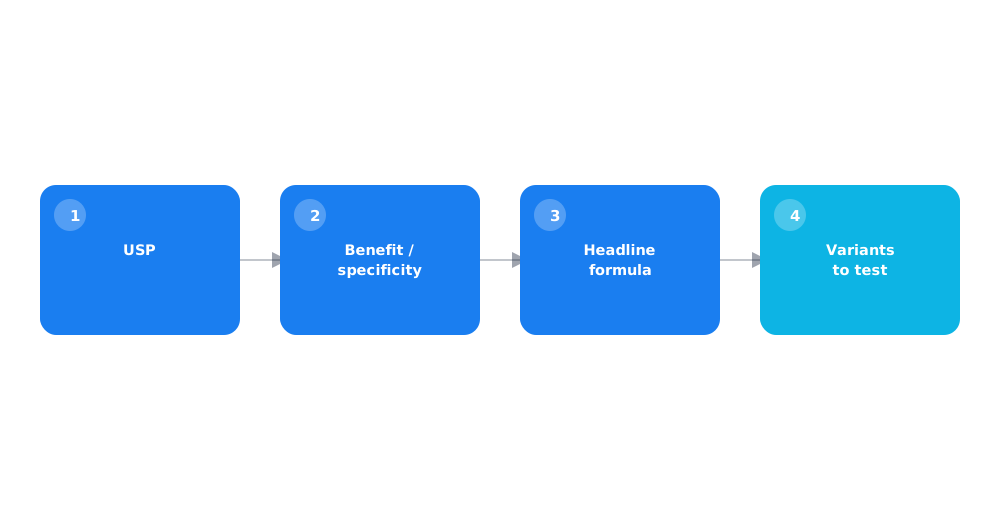
A working ad headline isn't built on clever phrasing — it's built by carrying a specific USP into the shortest, clearest form possible. A number, a guarantee, or a clear benefit almost always outperforms a generic adjective like "best" or "professional."
Below are five headline formulas that cover most Google Ads and Meta scenarios, the difference between a search headline and a social feed headline, and the mistakes that hurt CTR even in copy that's technically written correctly.
02 Formula 1: a number plus a specific benefit
A headline with a specific number almost always stands out against neighboring ads full of generic phrasing — a number makes the promise feel checkable even before the click.
- a timeframe: "Delivered within 24 hours" instead of "fast delivery";
- a guarantee: "12-month repair warranty" instead of "reliable repairs";
- savings: "20% off your first order" instead of "affordable prices."
The formula only works if the number is real and gets confirmed on the site — a mismatch between the headline and the landing page quickly raises the bounce rate, even after the click was successfully earned.
03 Formula 2: a question mirroring the real query
A question-form headline works when it literally echoes the phrasing a user searched with — that creates a feeling of a direct match to the query, before they even reach the site.
For example, for the query "how much does a washing machine repair cost," a headline reading "How much does a washing machine repair cost?" outperforms a neutral "Washing machine repair," because it directly mirrors what the user just searched for. This formula works worse on Meta, where there's no source query to mirror — there the question needs to be framed differently, closer to the problem itself rather than a search phrase the user never typed.
04 Formula 3: removing a specific objection
If an audience has a well-known hesitation before buying, a headline can address that objection directly instead of a general product benefit.
- "Pay only after the repair is done" — removes the fear of paying without getting results;
- "No upfront payment" — addresses worry about fraud from an unfamiliar company;
- "Free cancellation within 24 hours" — lowers the risk for a user who isn't sure yet.
This formula requires knowing exactly which objection actually blocks conversion in a specific niche — a generic "trust us" doesn't work because it never names the objection out loud.
05 Search headlines vs. social feed headlines
The formulas above apply to both Google Ads and Meta, but the specific wording needs to account for the different context a user sees the ad in.
In search, the user already has intent and a phrased query — the headline can directly mirror that query and offer a solution. In a social feed, the user typically has no active intent to search for that specific product — a headline works better there through a benefit or objection removal, rather than echoing a hypothetical search query the user never actually typed.
06 How many headline variations are actually needed
Google Ads responsive search ads support up to 15 headlines, and the system automatically assembles the most effective combinations — but that doesn't mean writing 15 variations of the same single idea.
Google's official guidance on responsive search ads — Best practices for creating effective responsive search ads — explicitly recommends varying headline length and covering different angles: some about a benefit, some about a number or guarantee, some with a call to action. That variety gives the system more material to combine than 15 similar phrasings of one idea.
07 How to scale testing headlines before rolling them out
Written headlines shouldn't be rolled out on intuition — the effect of each formula is worth checking with an A/B test, rather than assuming the version that's subjectively preferred is automatically the winner.
How to set up that kind of test, split an audience, and how much data is needed for a reliable result is covered in A/B testing ad campaigns. If edits need to go into dozens of ads at once — say, updating the same promo number across every headline — doing that manually in the web interface isn't practical; bulk edits are covered in Google Ads Editor: bulk campaign management.
08 FAQ
Which headline formula works best?
There's no universal best formula — a headline with a specific number or guarantee usually stands out more than generic words, but the final choice always needs to be validated with an A/B test on a specific audience.
Should Google Ads and Meta use different headlines?
Yes, the wording should be adapted to context: in search, a headline can directly mirror the user's query, while in a social feed a benefit or an objection removal works better than echoing a query.
How many headlines should I write for a responsive search ad?
Google recommends using the maximum available (up to 15) and varying them by length and angle — benefit, number, call to action — rather than 15 similar phrasings of one idea.
Can I just copy a competitor's successful headline?
It's not worth doing — a headline works together with a specific USP and landing page; a copied headline without a matching real offer on the site won't produce the same effect and can even hurt trust.
How do I know a headline isn't working?
The main signal is a lower CTR compared with other headlines in the same group once enough data has accumulated — a subjective "I like it / I don't" doesn't substitute for test data.