

01 Short answer: what makes a USP actually work
A unique selling proposition only works when it points to a specific, checkable difference from competitors — not a general trait that could describe any business in the niche. "Personal approach" and "wide selection" aren't a USP, because a competitor could write the exact same thing.
A working USP gets built in four steps: list the product's real benefits, check which of those competitors already claim, find what's left unclaimed, and phrase it as specifically as possible. Below is a walkthrough of each step and how a finished USP carries over into ads and a landing page.
02 Step 1: list every real benefit
Before looking for a point of difference, it's worth honestly listing every benefit the product or service actually delivers to a customer — without dressing it up or worrying yet about how it sounds.
- functional benefits — what the product does, which problem it solves faster or better than alternatives;
- economic benefits — what it costs the customer to own or use, compared with the alternative;
- emotional and reputational benefits — what the customer gets beyond the product itself: peace of mind, status, time saved on decisions.
At this stage the list tends to come out long and generic — that's expected. The next steps narrow it down to the one point that actually sets the business apart.
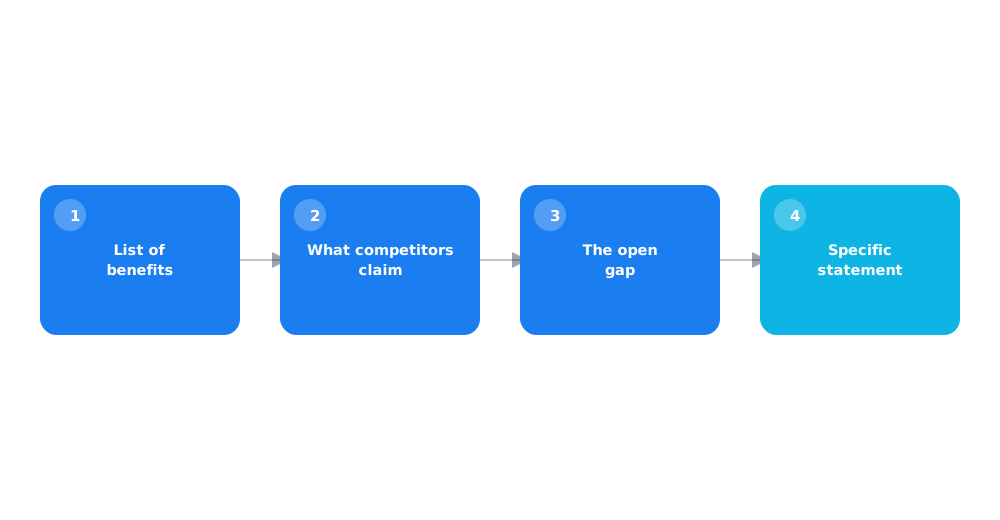
03 Step 2: check which of those competitors already claim
Every item on the benefits list needs to be checked against what 5-7 direct competitors already say on their sites and in their ads — if most of them make the same claim, using it as a USP won't set anyone apart.
Pay special attention to phrases nearly everyone uses: "quality service," "affordable prices," "experienced team" — these aren't differentiators, they're the baseline expectation for entering the niche. The goal of this step is to cross out anything that overlaps with competitors and keep only what's genuinely unique or framed differently.
04 Step 3: find what competitors aren't claiming
After crossing out the overlaps, there's usually one or two points left that either nobody states outright or that competitors phrase vaguely. That's where a potential USP lives.
- a specific number or guarantee where competitors only offer a vague promise — an exact turnaround time instead of "fast," for example;
- a narrow specialization instead of a broad one — a specific customer type, industry, or use case;
- a unique element of the process itself — how the service gets delivered, not just what the end result includes.
05 Step 4: phrase the USP as specifically as possible
The gap found needs to turn into a specific statement that couldn't be written about a different business in the same niche — with a number, a timeframe, a guarantee, or a precise description, not a general adjective.
Compare: "professional appliance repair" — vague, and fits any repair shop; "repair backed by a 12-month guarantee, free diagnostics with any repair order" — specific, checkable, and creates a real point of comparison. A good test: if the statement could be copied onto a direct competitor's site unchanged and sound just as plausible there, it's not a USP — it's a generic claim.
06 Carrying a USP into ads and a landing page
A well-written USP doesn't do anything on its own if it never shows up where a potential customer actually decides — in the ad headline and on the landing page's first screen.
- in an ad headline, the USP needs to be as compressed as possible without losing specificity — a number or guarantee matters more than an adjective;
- on the landing page, the USP is worth repeating in the first screen's headline, so a visitor arriving from the ad doesn't feel the ad and the page are promising two different things;
- further down the page, the USP can be unpacked in more detail — explaining how the guarantee or number actually gets delivered.
How the first screen and the rest of a landing page get structured for conversion is covered in landing page block structure for conversion. Specific formulas for carrying a USP into Google Ads and Meta headlines are covered in ad copywriting: headline formulas.
07 Common mistakes when writing a USP
Most USPs that don't work aren't the result of a business lacking real differentiators — they come from a handful of recurring mistakes made at the writing stage.
- Writing a USP without checking competitors. The statement feels unique to whoever wrote it, but a quick look at competitor sites shows everyone says the same thing.
- A statement that's too general. "Best quality," "great value" — words like these don't create a difference because there's no way to check them.
- A USP the business can't actually back up. Promising a guarantee or timeframe the business can't reliably deliver damages trust faster than not making the promise at all.
- A USP that never shows up in ads or on the landing page. A well-phrased USP that isn't carried into the actual points of contact has no effect on the customer's decision.
08 FAQ
How is a USP different from a regular list of benefits?
A USP is a specific, checkable point of difference from competitors, while a list of benefits can include general traits shared by every player in the market that don't create a real reason to choose one business over another.
Can a business have more than one USP at once?
In ads and on a landing page, it's better to focus on one main USP — several equally-weighted differentiators dilute attention and hurt how memorable the message is, though additional benefits can still be unpacked further down the page.
What if a business genuinely has no obvious point of difference from competitors?
Look for a difference in the process, guarantees, timeframes, or a narrow specialization in a specific customer type, rather than the product itself — that's usually where competitors only offer a vague promise.
How do you check whether a USP actually works?
Check whether the statement could be copied onto a direct competitor's site unchanged and still sound just as believable there — if so, it's not a USP, it's a generic claim.
Does a USP need to change over time?
Yes — if competitors start making the same claim or the market shifts, a USP is worth revisiting periodically by repeating the same four steps: benefits, competitors, the open gap, a specific statement.