

01 Short answer: where CRO actually starts
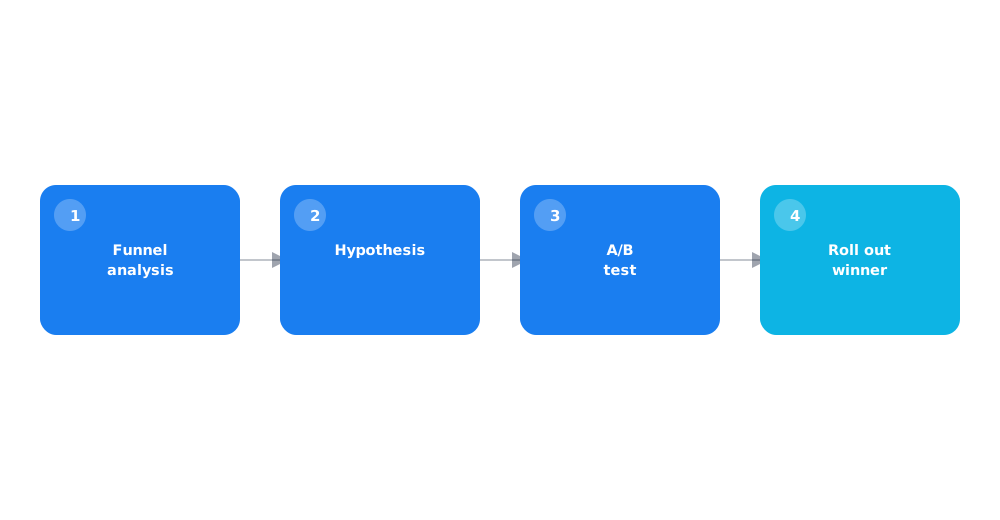
CRO (Conversion Rate Optimization) is a systematic process for raising the share of site visitors who complete a target action — submitting a form, buying, calling. CRO doesn't start with button design; it starts with analyzing the funnel to find exactly where visitors drop off before reaching the goal, and only then moves on to hypotheses and testing.
Below is a working checklist covering every stage of CRO: from diagnosing the funnel and writing hypotheses to A/B testing and the common mistakes that undo work already done.
02 Step 1: find where visitors drop out of the funnel
Before changing anything on the site, it's important to understand exactly which step of the funnel loses the most potential customers — without that, any edit is just a guess.
- landing page → product or catalog view — a high bounce rate here usually points to a mismatch between the ad and the page content;
- product or service view → adding to cart or starting a form — this is where price, trust, or missing information problems most often show up;
- starting a form → submitting it or paying — a typical drop-off point caused by a form that's too long or technical glitches.
Data for this analysis comes from web analytics — even a basic funnel in GA4 already shows which step has the sharpest drop. Without this step, every CRO hypothesis is built on guesswork rather than a specific site's real bottlenecks.
03 Step 2: write a testable hypothesis
A good CRO hypothesis isn't "let's make the button brighter" — it's a specific statement in the form "if we change X, metric Y will change, because Z," with a clear reason instead of a hunch.
For example: "if we shorten the inquiry form from 8 fields to 3, the form-completion rate will rise, because a long form on mobile is currently driving some visitors away." A statement like that immediately defines what to change, what to measure, and why an effect is expected — unlike a vague "improve form conversion."
04 Step 3: prioritize the hypotheses
There are usually more hypotheses than can be tested at once, so there needs to be a way to decide which one to start with.
- potential impact — how much traffic passes through this step of the funnel and how large the current drop-off is;
- confidence — how well the available data (analytics, session recordings, user surveys) supports the hypothesis's assumed cause;
- effort to implement — how much time and development work the change and the test itself will take.
Hypotheses with high potential impact, high confidence in the cause, and low implementation effort are worth testing first — that gets the most result for the least time spent.
05 Step 4: an A/B test, not "just change it and see"
A change rolled out without a test can't be judged objectively — a rise or fall in conversion could come from a dozen other causes: seasonality, a shift in traffic sources, a one-off promotion.
- an A/B test shows the original and the new variant to different visitor segments at the same time, which removes the effect of timing and seasonality from the comparison;
- a test needs to run until it reaches a statistically significant sample, not stop at the first encouraging result — stopping early often produces a false conclusion;
- if a specific page doesn't get much traffic, reaching statistical significance can take several weeks or months, and that needs to be planned for in advance.
06 Technical and UX factors worth checking right away
Beyond testing individual hypotheses, there are basic technical and UX factors worth checking first — their effect on conversion is often bigger than any single A/B test.
- Page load speed. Slow loading, especially on mobile, raises the share of visitors who leave before the page even fully renders.
- Correct mobile rendering. For most niches mobile traffic makes up a significant share — a form or button that's awkward on a small screen loses inquiries regardless of any other improvement.
- A clear offer above the fold. If a visitor can't tell within a few seconds what the page is offering and why it matters, they leave before ever reaching any element that could be A/B tested.
- Trust signals: reviews, guarantees, contact details. Missing visible trust signals — real reviews, clear terms, a company's actual contact info — often hurt conversion more than a button's color does.
07 Common CRO mistakes
A handful of CRO mistakes recur often enough that they're worth naming before running the first test.
- Testing small cosmetic details before big ones. A button's color rarely moves the needle if the page structure and offer are unclear to begin with — start with the bigger hypotheses.
- Stopping a test too early. Deciding based on the first few days of a test, while the sample is still small, often leads to rolling out a variant that isn't actually better than the original.
- Changing several elements in one test. Change the headline, the image, and the form all at once, and it becomes impossible to tell which change actually drove the result.
- Ignoring the mobile version during analysis. A hypothesis that tests well on desktop doesn't necessarily produce the same effect on mobile, where most traffic behaves differently.
Several items on this checklist are easier to verify with data than guesswork: heatmaps and session recordings show exactly where users get stuck before a single A/B test is even launched.
08 FAQ
What is CRO in simple terms?
CRO (Conversion Rate Optimization) is a systematic process for raising the share of site visitors who complete a target action, through funnel analysis, writing hypotheses, and testing them with A/B tests — not one-off cosmetic tweaks.
Where do I start with CRO if I've never done it before?
With a funnel analysis in web analytics: find the step where the most visitors drop off, and only then write the first hypothesis about that specific bottleneck.
Do I need an A/B test before every change?
For high-risk changes or ones with a non-obvious effect, yes — otherwise it's impossible to objectively separate the change's effect from seasonality or other factors. For an obvious technical bug, a test isn't necessary.
How long does an A/B test take?
It depends on the page's traffic volume — for lower-traffic pages, reaching a statistically significant sample can take several weeks or months, and that needs to be built into the plan in advance.
What are the most common CRO mistakes?
Testing small details instead of big hypotheses, stopping a test too early, changing several elements at once, and ignoring how the page behaves on mobile devices.
Can CRO replace bringing in new traffic?
No, CRO improves how well existing traffic converts, but it doesn't generate traffic — growing conversion and growing traffic solve different problems and usually need to run in parallel.