
01 Short answer: what AI does well, and what it doesn't always
AI is reliably good at generating drafts: headline variations, ad copy, basic images from a text prompt. It's weaker anywhere that needs precise brand guideline compliance, a real connection to the actual product, or a nuanced read on the audience — that's where generated material almost always needs human edits before it's fit to show customers.
Using AI for keywords and ad copy inside the ad platform itself is covered separately in AI in PPC — this article goes deeper specifically into the quality question for finished creative, regardless of platform.
02 What AI already generates well: ad copy
Text generation is the most mature use of AI in advertising, because the task is formally bounded: short copy, a clear goal, hard character limits.
- dozens of headline and description variations in minutes for A/B testing — where writing that many by hand would take too long;
- adapting the same message for different audiences, regions, or languages without losing the original meaning;
- quickly testing several angles on the same offer before committing to one for a campaign.
The weak point: AI doesn't know your product's real details unless they're spelled out in the prompt, and by default drifts toward generic, "safe" phrasing that's hard to tell apart from a competitor's in the same niche.
03 Generating visual creatives: capabilities and limits
Images and video are trickier than text: AI can produce a visually appealing image, but the accuracy of product details, logos, and brand colors stays questionable without manual cleanup.
- generating background images, abstract illustrations, and composition variations where exact product accuracy doesn't matter;
- quickly mocking up a concept for internal discussion before commissioning real photography or design work;
- adapting a finished creative into different formats and aspect ratios (square, vertical, story) without a reshoot.
Anywhere the real product needs to show precisely — packaging shape, a specific model's color, an app interface — a generated image almost always needs to be swapped for a real photo or manually fixed, or it risks an obvious mismatch with reality.
04 Where quality slips: signs of an "AI creative"
Unedited generated material has recognizable tells that give away its origin and undercut trust in the ad.
- Generic promises with no specifics. Phrases like "the best solution for your business" with no numbers, timelines, or details unique to your product.
- Visual "perfection" with no authenticity. Overly smooth, symmetrical images of people or products that look out of place next to a brand's real content.
- Details that don't match the product. The wrong number of buttons on packaging, a distorted logo, unrealistic proportions — typical image-generation artifacts.
- No brand voice. Copy that could belong to any company in the niche, not specifically yours — a direct contradiction of the expertise principles covered in E-E-A-T and personal brand.
05 A review checklist before launch
Before sending AI-generated material into an ad account, it helps to run through a short checklist.
- Check factual accuracy — prices, specs, promo terms — AI can confidently generate a wrong detail.
- Compare the copy and visual against already-published brand material for a consistent tone and style.
- Confirm the logo, colors, and fonts match the brand guide rather than being generated "close enough."
- Check compliance with the specific ad platform's policy — Google Ads and Meta each have their own requirements for content created or substantially altered by AI.
- Show the material to someone who wasn't involved in creating it — a fresh eye quickly catches what the person who made it stopped noticing.
06 Legal and reputational risks
Using AI in ad creative brings risks that go beyond the quality of the copy or image itself.
Meta explicitly requires advertisers to disclose when an image, video, or audio in an ad was created or substantially altered by AI — per Meta's official explanation of AI content in ads, skipping that disclosure can get an ad rejected. There's also a copyright risk with AI-generated visuals modeled on existing work's style, plus the risk of using realistic AI-generated images of people without the proper rights or consent.
07 A working process: AI draft plus human editor
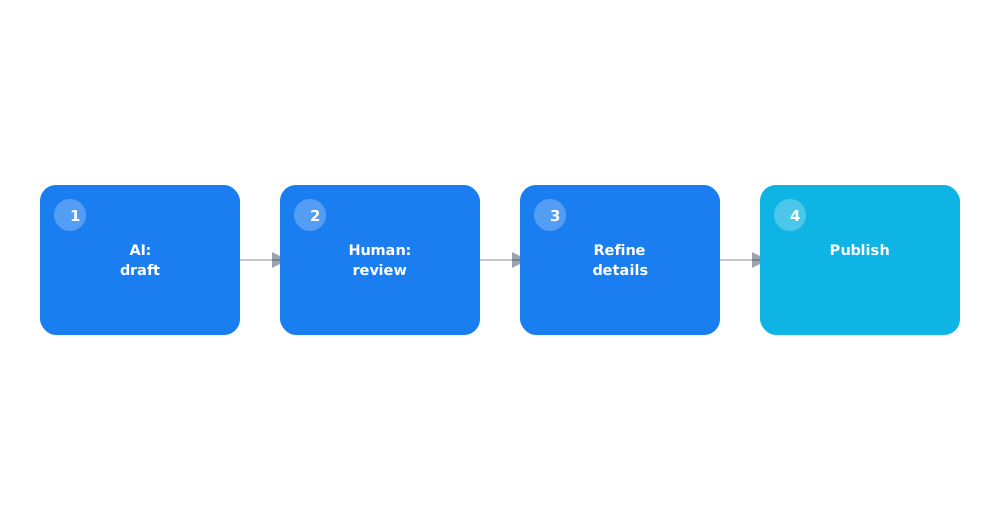
The most durable model splits roles so AI handles volume and speed, and a person handles accuracy and brand fit.
- AI generates a wide range of copy or visual options at the draft stage — quantity matters more than any single option's polish here;
- a person picks the 2-3 strongest options and refines them with real product detail, brand tone, and factual accuracy;
- a final check against the checklist above happens before launch, including platform policy compliance;
- A/B test results get logged so future AI prompts get written more precisely based on what actually works for your audience.
Before handing headline generation to AI, it helps to know the working formulas to judge the output against — covered in ad copywriting: headline formulas.
08 FAQ
Can AI fully replace a copywriter and designer?
No — for consistent quality and brand fit, AI-generated material almost always needs human edits, especially anywhere that needs precise product detail, brand tone, or ad platform policy compliance.
Do I need to disclose that an ad was made with AI?
Yes, for images, video, and audio created or substantially altered by AI, Meta requires an explicit disclosure in the ad settings — skipping it can get the ad rejected.
How can I quickly spot a low-quality "AI creative"?
By generic phrasing with no specifics, overly smooth and symmetrical images, details that don't match the real product, and no recognizable brand voice in the copy.
Can I use an AI-generated image of a realistic person in an ad?
There's reputational and legal risk here — realistic AI-generated images of people need extra scrutiny against platform rules and against creating a false impression of a real testimonial or endorsement.
How many copy variations should I generate before picking a final one?
A reasonable range is a few dozen options at the draft stage, from which a person picks 2-3 of the strongest for refinement and A/B testing, rather than one "perfect" version on the first try.
Do Google Ads and Meta have different AI content requirements?
Yes, each platform has its own policy wording and its own threshold for what counts as a "substantial alteration" by AI — check the specific platform's current rules before launch rather than assuming.