

01 Short answer: what AI already does in Google Ads
AI in Google Ads isn't some futuristic add-on — it's already the default in most accounts: automated bidding strategies read auction signals in real time, Performance Max combines formats and inventory without setting up a separate campaign for each, and generative features help draft ad copy variations. What changed since the early 2020s isn't that AI showed up — it's that it now makes more of the decisions a human used to make by hand.
Below is where automation actually operates, how to use outside tools like ChatGPT for copy and keywords, and — more importantly — where automation gets it wrong and needs human oversight to protect margin.
02 Smart Bidding: where the AI actually is
Automated bid strategies are the most mature example of AI in Google Ads. Strategies like Target CPA and Target ROAS read dozens of auction-time signals — device, time of day, search history, likelihood to convert — and adjust bids faster and more precisely than a person could with fixed rules. The mechanics are covered in detail in Google's help center article on automated bidding.
The key condition for Smart Bidding to work well is enough conversion data. For a new account with few monthly conversions, the algorithm doesn't have enough signal to learn from, and bids can swing unpredictably in the first weeks — that's a normal part of the learning process, not a reason to switch back to manual control right away.
03 Performance Max: full campaign automation
Performance Max goes further than bid automation — it also automates inventory selection (Search, Display, YouTube, Gmail, Maps), audience targeting, and, to a large degree, creative rotation within a single campaign. It's one of the clearest examples of AI making decisions that used to require a separate campaign per channel.
The trade-off is less transparency: Performance Max doesn't break down results by specific inventory the way separate campaigns do. A detailed breakdown of formats and setup is already covered in the Performance Max guide on this site — useful groundwork before digging into where AI gets it wrong here.
04 Using ChatGPT and other AI tools for copy and keywords
Outside AI tools — ChatGPT, Gemini, and similar — aren't built directly into Google Ads, but they're widely used as a supporting tool during campaign prep.
- generating several headline and description variations for A/B testing inside Google Ads;
- expanding a keyword list with synonyms and phrasing variations, then checking real search volume through the Keyword Planner;
- quickly adapting the same ad for different audiences or regions;
- drafting an analysis of competitor ad copy for ideas, not for copying.
One caveat: an AI tool doesn't know the real search volume or bid competition in your specific niche — it's good for generating options, but the final call on what to launch should always be checked against actual Google Ads data.
05 Where AI gets it wrong and needs human oversight
Automation optimizes literally toward whatever goal it's given, with no understanding of business context the algorithm simply doesn't have.
- AI doesn't know the real margin on different products or services unless that's explicitly passed in through conversion value data;
- Performance Max can spend budget on low-quality inventory if no explicit constraints are set;
- automated strategies react to historical data and can be slow to adapt to sudden market shifts or seasonality;
- generative ad copy sometimes produces text that's technically correct but irrelevant or legally risky for certain niches.
Human oversight at these points isn't "distrust of the technology" — it's basic budget hygiene that's easy to forget precisely because automation works quietly most of the time.
06 The risk: losing margin to "blind" automation
The most common way margin gets lost is optimizing for conversion count without accounting for conversion value. If the algorithm only cares about the number of leads, not the revenue behind them, it can bring in a lot of cheap, low-margin leads instead of fewer, more profitable ones.
The fix is passing Google Ads not just the fact of a conversion, but its value — revenue, margin, or deal status from a CRM — so the algorithm optimizes for what actually matters to the business, not just form clicks. Without that step, "smart" automation literally can't tell a good customer from a bad one.
07 How to combine human judgment and AI
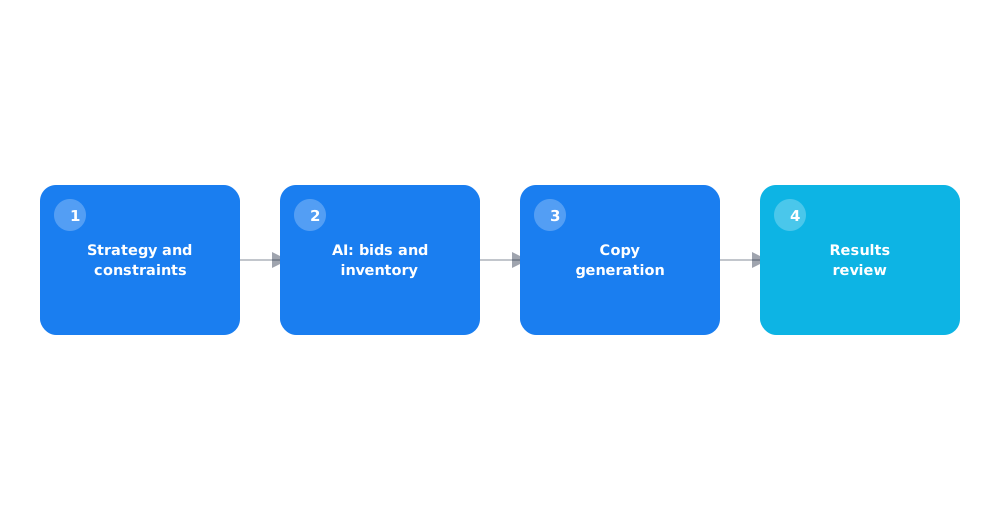
A working split of responsibilities looks like this: a person sets the strategy, the constraints, and feeds in accurate conversion-value data, while AI handles the operational optimization within those bounds.
- Set up conversion value tracking (revenue, margin) rather than just conversion counts.
- Set explicit constraints for Performance Max — inventory exclusions, a minimum ROAS.
- Use AI tools to draft ad copy, but review the output before anything goes live.
- Check automation's actual results against business metrics — not just ad account metrics — at least once a month.
- Keep a manual campaign audit as a safety net — a basic audit checklist is in the Google Ads account audit checklist.
Automation touches YouTube video campaigns too — which formats are available and how to set them up is covered in the YouTube ads guide.
Automating bids and placements is only part of what AI does in advertising; a dedicated breakdown of generating the copy and visual creatives themselves is in AI-generated ad copy and creatives.
Automation also touches newer campaign formats — how Demand Gen differs from Discovery and Display is covered in Google Demand Gen campaigns.
08 FAQ
Does AI replace a PPC specialist?
No — AI takes over operational tasks (bid calculation, budget allocation across inventory), but strategy, feeding in the right conversion-value data, and reviewing results still need a person.
How much conversion data does Smart Bidding need to work well?
Google recommends enough conversion history for the algorithm to learn from; for new accounts with few monthly conversions, the first weeks of automated bidding can be less stable — that's part of the learning process, not a bug.
Can I use ChatGPT for Google Ads copy?
Yes, as a supporting tool for drafting headline and description variations for A/B testing. Final relevance and ad policy compliance still need a manual check before launch.
Why does Performance Max sometimes spend budget inefficiently?
Usually from missing explicit constraints — like a minimum ROAS or excluding low-quality inventory — and from only feeding the system the fact of a conversion without its real value to the business.
How do I pass margin data to Google Ads instead of just lead counts?
Through conversion value tracking — passing revenue or another deal-value metric, often integrated with a CRM, instead of treating every conversion as worth a fixed, generic value.
Should I stop managing bids manually altogether?
Not necessarily — it depends on data volume and the niche. Accounts with enough conversion volume usually do better with automation than fixed manual rules, but regular auditing and oversight are still needed either way.