

01 Short answer: what Demand Gen is
Demand Gen is a Google Ads campaign type that replaced Discovery campaigns and combines images, carousels, and video into one campaign shown across YouTube, Discover, and Gmail. Per Google's official description of Demand Gen, the format gives more control over creative testing, audience targeting, and specific placements than Discovery offered.
Below: what happened to Discovery, how the format fundamentally differs from classic Display, which placements it runs on, which businesses it fits, and how to set it up.
02 What happened to Discovery campaigns
Discovery campaigns no longer exist as a separate type — Google upgraded them to Demand Gen, keeping settings, status, and historical data intact. For an advertiser already running a Discovery campaign, the move happened automatically, with no need to rebuild anything from scratch.
The main practical change for anyone who worked with Discovery before is added video support alongside images and carousels, plus built-in automatic testing of creative combinations through Google's algorithms — something Discovery had in a more limited form.
03 How Demand Gen differs from Display
Both formats run visual ads, but the targeting logic and placements differ fundamentally, and confusing the two is a common mistake when picking a campaign type.
- Placements. Display runs across millions of third-party sites and apps in the Display Network, while Demand Gen focuses on Google's own placements — YouTube, Discover, Gmail.
- Targeting logic. Display often runs on contextual page matching or remarketing, while Demand Gen relies on behavioral and interest signals inside the Google ecosystem.
- Creative format. Demand Gen is multi-format from the ground up — images, carousels, and video combine in one campaign, while Display often sets these up separately.
- Purpose. Display gets used more for broad, low-cost reach and remarketing; Demand Gen is aimed at higher-quality engagement on specific, logged-in Google placements.
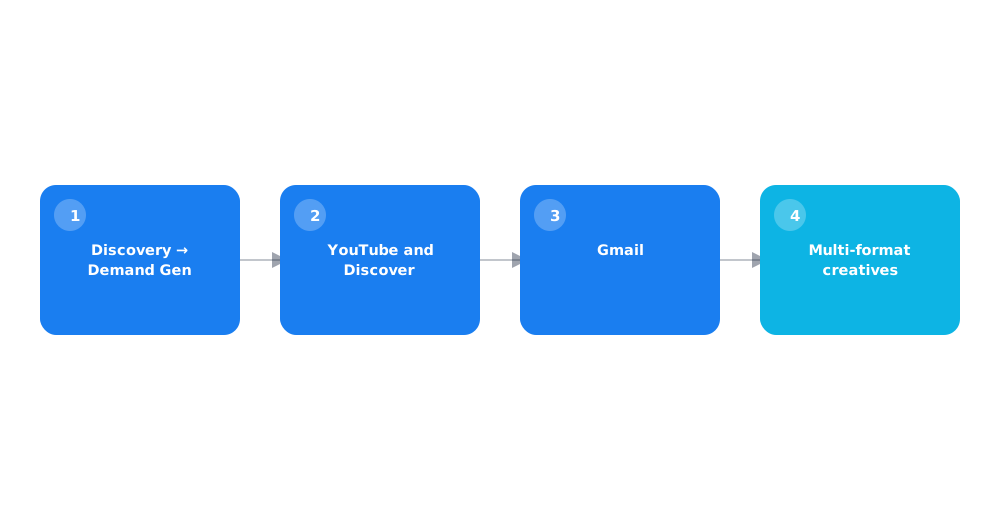
04 Demand Gen formats and placements
A Demand Gen ad can run across several Google placements at once within a single campaign, with no need to set each one up separately.
- in YouTube feeds and next to recommended videos — a similar placement principle is covered in the YouTube ads guide, though these are technically different campaign types;
- in the Discover feed on mobile devices, where someone browses a personalized content feed without actively searching;
- in the Gmail inbox, on the "Promotions" and "Social" tabs;
- on Google Display Network video partners, if that setting is enabled in the campaign.
05 Which businesses it fits
Demand Gen isn't a universal replacement for other campaign types — it earns its place in specific situations.
- a business that already has a variety of visual assets — images and video — and wants to test combinations without configuring each one by hand;
- projects aimed at users who spend meaningful time on YouTube, Discover, or Gmail, not just Search;
- upper-funnel campaigns where the goal is brand awareness and engagement rather than an immediate sale;
- a business with a ready list of interest or remarketing audiences to use as a targeting starting point.
For a business with no visual assets at all, or a narrow B2B niche with no meaningful behavior on these specific Google surfaces, the format is unlikely to deliver the expected result — a comparison with other automation approaches is covered in AI in PPC.
06 How to set up a campaign
Setting up a Demand Gen campaign is technically similar to other Google Ads campaign types, with a few specific steps.
- Create a new campaign and choose a goal — sales, leads, website traffic, or store visits.
- Upload images, carousels, and video — the more varied assets available, the more effectively the algorithm can test combinations.
- Set up audience targeting: interests, similar audiences, or your own remarketing lists.
- Set a budget and a bidding strategy aligned with the chosen campaign goal.
- Launch and give the algorithm time to learn — as with other automated Google Ads formats, results can be less stable in the first few weeks.
07 Metrics and evaluating results
Demand Gen needs to be evaluated with its funnel position in mind — metrics that matter for a Search campaign don't always apply directly here.
Beyond standard conversions, it helps to watch engagement metrics — video completion, carousel interaction — and the lift in branded search demand after launch, similar to how it's covered for video in the YouTube ads guide. Directly comparing cost-per-conversion against Search campaigns on the same metric is often misleading, because user intent on these placements starts out fundamentally different.
08 FAQ
What happened to Discovery campaigns in Google Ads?
Google upgraded all Discovery campaigns to Demand Gen, keeping settings, status, and historical data intact — the move happened automatically, with no need to rebuild the campaign.
What's the main difference between Demand Gen and Display?
Display runs across millions of third-party sites and apps, while Demand Gen focuses on Google's own placements — YouTube, Discover, and Gmail — with multi-format ads inside one campaign.
Do I need to set up video and images separately in Demand Gen?
No, the format is multi-format from the start: images, carousels, and video all go into one campaign, and Google's algorithm tests combinations automatically.
Does Demand Gen fit a B2B business?
Not always — the format works better where the audience shows meaningful behavior on YouTube, Discover, or Gmail and there are ready visual assets; for a narrow B2B niche without that behavior, results can lag behind Search campaigns.
How long does the algorithm take to learn in Demand Gen?
As with other automated Google Ads formats, results can be less stable in the first few weeks after launch while the algorithm gathers enough data to optimize.
Can I compare cost per conversion in Demand Gen and Search?
A direct comparison is often misleading — user intent in Search (an active query) and on Demand Gen placements (browsing content) starts out fundamentally different, so expected cost per conversion usually differs too.