

01 Short answer: where AI genuinely helps in SEO
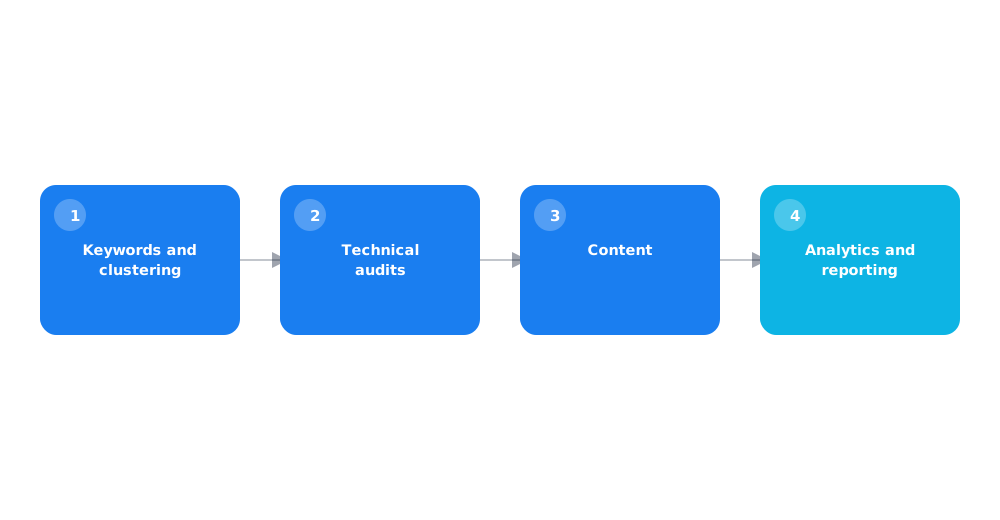
AI tools in SEO cover four major task categories in 2026: keyword research and clustering, technical site audits, content work, and analytics reporting. In every case, it's about speeding up routine work, not replacing the strategic call — which page to prioritize, for which query, and in what order is still a decision a person makes based on business context an algorithm doesn't have.
Below is a breakdown of each of the four task areas, plus a separate section on what AI still doesn't replace in SEO, and why.
02 AI for keyword research and clustering
Collecting and grouping keywords is one of the most time-consuming manual tasks in SEO, and it's exactly where automation saves the most time.
- expanding seed queries with synonyms, questions, and related phrasing based on a language model;
- automatically clustering a large keyword list by semantic similarity before a manual SERP check;
- drafting a rough "cluster → page" map for a specialist to refine.
How to build a keyword list from scratch, including free and paid data sources, is covered in how to do keyword research — AI speeds up expansion and rough grouping here, but the final clustering still needs a manual SERP check.
03 AI for technical audits
In a technical SEO audit, AI usually isn't finding the problems themselves — crawlers already catch broken links, duplicates, and indexing errors without any AI involved — it's interpreting the results: explaining why a specific issue matters and prioritizing findings by their likely impact on traffic.
The full process for running a technical audit, including without paid tools, is covered in a self-run SEO audit; a fuller list of free services for the job is in free SEO tools to get started.
04 AI for generating and checking content
This is the most visible and most contested use of AI in SEO. Language models genuinely speed up drafting — structure, a first pass at wording, adapting for different formats — but a final text published without human editing usually gives itself away through a few tell-tale signs.
- generic phrasing with no specific examples, numbers, or details from real practice;
- no personal experience or practical nuance that can't be found in a public source;
- a flat, "averaged" tone with none of the emphasis or caveats a real expert would naturally add.
Google's own position is that it evaluates content by quality and usefulness to the reader, not by how it was produced — using AI isn't a violation on its own if the result is genuinely helpful. This ties directly into E-E-A-T — how Google assesses an author's experience and expertise, covered in detail in E-E-A-T and personal brand. A working model is using AI for the draft and structure, and leaving the final edit — with real examples and numbers — to someone with actual experience in the topic.
05 AI for analytics and reporting
In analytics, AI is good at tasks that used to take hours of manual spreadsheet work: pulling data from multiple sources (Search Console, GA4, a rank tracker) into one report, flagging anomalies in traffic or rankings, and drafting a written summary of the numbers.
Setting up the data sources a report actually pulls from is its own task — how to do that for GA4 is covered in setting up Google Analytics 4 from scratch. Without properly configured analytics, any AI-generated report just summarizes the wrong underlying numbers.
06 What AI still doesn't replace in SEO
There's a category of SEO decisions AI consistently struggles with without heavy human oversight — not because the technology is weak, but because these decisions need context a model simply doesn't have.
- Prioritizing pages and queries. Which page to push first depends on business model, service margins, and company strategy, not just search volume.
- Judging an author's real experience and expertise. AI can generate text "in the style of" an expert, but it can't confirm the author actually practiced what's described.
- Connecting SEO metrics to business outcomes. Traffic and rankings aren't the same as revenue; that link is built by someone who understands the specific business's funnel.
- Decisions under SERP uncertainty. When data is thin or signals conflict, that calls for experience, not a model's statistical confidence.
07 How to pick a tool for the task
Instead of hunting for "the one best AI tool for SEO," it works better to pick a tool for a specific task — most strong tools are narrow specialists, not do-everything platforms.
- Identify which task eats the most manual time — that's the one worth automating first.
- Test a tool against your own site's real data, not a vendor's demo example.
- Compare the AI tool's output to a manual check on a small sample before scaling it up.
- Keep a human checkpoint anywhere the decision directly affects budget or strategy.
08 FAQ
Can AI fully replace an SEO specialist?
No — AI speeds up routine work (keyword expansion, a first-pass audit, a content draft), but prioritizing tasks, tying them to business goals, and judging real content expertise still fall to a person.
Can I trust AI keyword clustering without checking it?
Rough clustering by semantic similarity is a good starting point, but the final grouping should be checked against real Google results, since the model can't see which competitor pages actually rank in the top 10 for those queries.
How does Google feel about AI-assisted content?
Google evaluates the quality and usefulness of content to the reader, not how it was produced — that's stated directly in its guidance on creating helpful content; the problem isn't the tool, it's text with no real experience or specifics behind it.
Should I fully automate a technical SEO audit?
Automating crawling and initial diagnostics makes sense, but interpreting the findings and prioritizing them by impact on traffic and the business still needs a specialist who understands that specific site's context.
Which analytics tasks does AI handle faster than a person?
Pulling data from multiple sources into one report, flagging anomalies in large datasets, and drafting a written summary of the numbers — tasks that used to take hours of manual spreadsheet work.
How do I pick my first AI tool for SEO work?
Start with whichever task eats the most manual time, and test the tool against your own site's real data rather than a vendor's demo example.